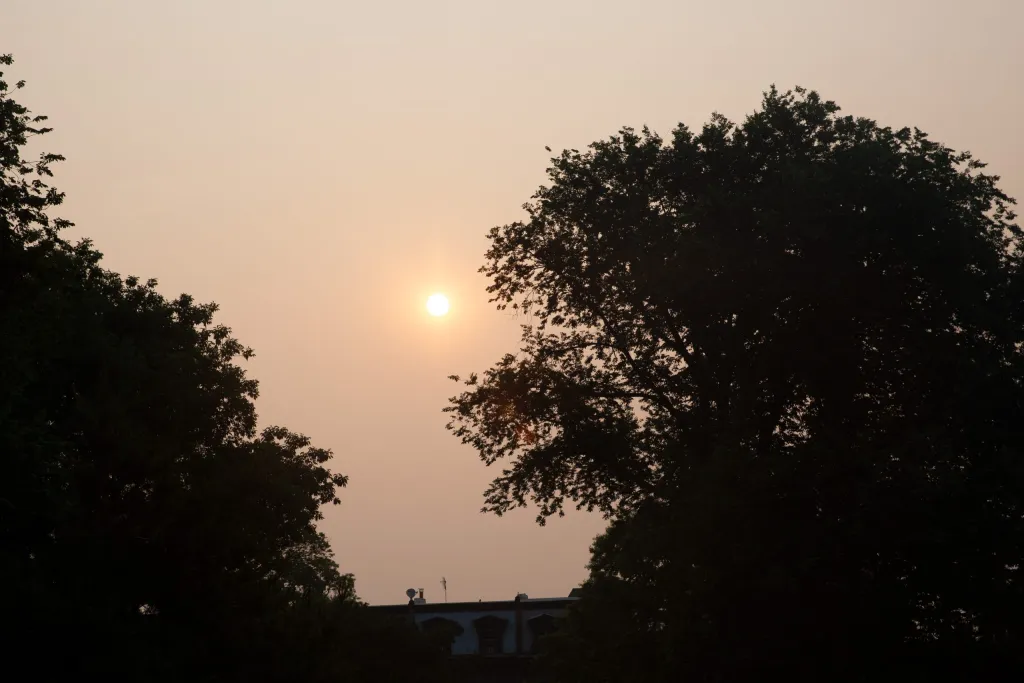
With smoke traveling in from wildfires burning in Minnesota and Ontario, New York is due for a week of hazy skies and possibly poorer air quality.
When smoke from Canadian wildfires engulfed the city in June 2023, the boroughs turned suddenly orange, with air quality indices reaching 484 — the highest ever recorded. It may not get quite that bad in the city this time around, but the forecast can change quickly.
Parts of upstate New York are slated for an air quality advisory on Wednesday, while the rest of the state, including New York City, will have moderate levels of particulate matter in the air, according to the state Dept. of Environmental Conservation.
Experts told The City Reporter the smoke event could last for several days, and the smoke could get thicker and closer to the ground on Wednesday and Thursday — just in time for another heat wave. Here’s what else to know:
Jump to …
- What is an air quality index, or AQI, and how is it measured?
- Is it safe to walk my dog during New York’s air quality alert? Is it harmful to exercise outdoors?
- Will this wildfire smoke hit New York as hard as it did in June 2023?
- Is my indoor air safe? Can I run my air conditioner?
- When to stay home and when to call a doctor
- Does an N95 mask protect against wildfire smoke?
- When will the wildfire smoke leave New York?
What is an air quality index, or AQI, and how is it measured?
The air quality index, or AQI, is a metric used by the federal Environmental Protection Agency to gauge how much pollution is in the air, and how concerning it may be to human health.
When the AQI is between zero and 50, the air quality poses little or no risk to human health, but the higher the index, the more risk. The DEC and Dept. of Health and Mental Hygiene issue air quality health advisories when the AQI exceeds 100, meaning members of sensitive groups may experience adverse health effects. The risk at this point remains low for healthy people, but sensitive people should avoid strenuous and prolonged outdoor activities.
Sensitive people may include people with heart or lung conditions, people with weakened immune systems, adults aged 65 or older, pregnant people, infants and children with health conditions, and people with social vulnerabilities, such as limited access to housing, transportation or health care.
Healthy individuals aren’t usually affected by air quality until the AQI exceeds 150.
You can check the AQI in your area by clicking here, a government-run air quality site. You can also find an air pollution map here maintained by IQAir, a Switzerland-based air quality technology company.
Due to ozone pollution unrelated to wildfire smoke, the New York City metro area was under an air quality health advisory on Tuesday.
Is it safe to walk my dog during New York’s air quality alert? Is it harmful to exercise outdoors?
Smoke conditions can negatively affect pets the same as humans, according to guidance from the American Veterinary Medical Association. That group suggested that dogs (and cats) only go outside in short bursts to relieve themselves when air quality alerts are active.
If animals are experiencing coughing or gagging, difficulty breathing, eye irritation, weakness or other symptoms, you should call your veterinarian, they said.
As for taking a walk or exercising at the current AQI — under 150 — for healthy people, it’s safe to walk your dog, exercise outside and more. For sensitive groups and people more sensitive to air pollution, continue to monitor your symptoms, as you may experience heightened symptoms.
If the AQI exceeds 150, all New Yorkers should limit strenuous and prolonged outdoor activities. A short walk should be fine for healthy people, but avoid being outside for longer than an hour. If the AQI exceeds 200, all unnecessary outdoor activities should be cancelled or rescheduled, and the same goes for your pets.
“If you’re sensitive to air quality, don’t remain in a space without air conditioning or filtration. And if you’re in a population vulnerable to heat — older adults, young children, people with chronic conditions — take the heat seriously, too,” Dept. of Emergency Management Commissioner Christina Farrell said in a press release Tuesday. “In both cases, you should get to a cool indoor space, and if you don’t have one at home, a cooling center is open near you.”
To find a city-run cooling center near you, click here.
Will this wildfire smoke hit New York as hard as it did in June 2023?
When Canadian wildfire smoke came to New York three summers ago, flights were grounded, public beaches closed and alternate side of the street parking was suspended. The AQI hit a record high, deeming the air unsafe for all New Yorkers, not just sensitive groups.
James Tomasini, a meteorologist from the National Weather Service, told The City Reporter that he’s not expecting it to be as bad — but he’s continuing to monitor the situation.
Amanda Lefton, commissioner of the DEC, said in a press conference on Tuesday that rain later in the week could help tamp down the smoke, but the situation is evolving and conditions depend on how well wildfire suppression efforts go in Minnesota and Ontario.
Is my indoor air safe? Can I run my air conditioner?
If the AQI becomes dangerous as wildfire smoke makes its way to the city, there’s a few ways you can protect your apartment from it.
The first step is to keep doors and windows firmly closed and sealed. You can stuff rags and towels against any cracks in doors or windows to block air and smoke from seeping in.
Most air conditioners are safe, because they cool down your apartment by circulating indoor air — not by bringing outdoor air inside. But make sure the filter is functioning properly, and clean.
The Environmental Protection Agency has more tips here on using an air conditioner during smoky conditions.
Run a high-quality air purifier, if you have one — and if you don’t, you can make a DIY version using air filters and a box fan. Some experts recommended purchasing air filters rated MERV-13 in bulk in advance of smoke events, so they’re ready to go when you need them.
When the AQI improves, ventilate your home and replace dirty HVAC and air purifier filters.
When to stay home and when to call a doctor
Every New Yorker has their own sensitivity to smoke and air pollution, but if you experience respiratory distress, seek medical help. If you have asthma, refill prescriptions for inhalers and other medications in advance. Click here for more tips on staying safe from the city’s health department.
Does an N95 mask protect against wildfire smoke?
Yes, experts say that a tight-fitting, high-quality KN95 or N95 mask is a good defense against the particles distributed by wildfire smoke. Free masks will be available at public library branches across the city, including Brooklyn and Queens Public Library locations, and a few New York Public Library locations: St. George Library Center in Staten Island, the Bronx Library Center in The Bronx and the Stavros Niarchos Foundation Library in Manhattan.
When will the wildfire smoke leave New York?
Hazy skies were already visible in the city on Tuesday, but smoke is expected to touch down closer to the ground on Wednesday and into Thursday, Tomasini said, which will make visibility worse.
It’s unclear exactly when the smoke will pass through the city as conditions are still evolving. Lefton said this is expected to be a “multi-day event.”
This article was adapted in part from The City Reporter’s previous coverage of wildfire smoke conditions from 2023.
Our nonprofit newsroom relies on donations from readers to sustain our local reporting and keep it free for all New Yorkers. Donate to THE CITY today.
The post Wildfire Smoke Is Back: A New Yorker’s Guide to Staying Safe appeared first on The City Reporter.
