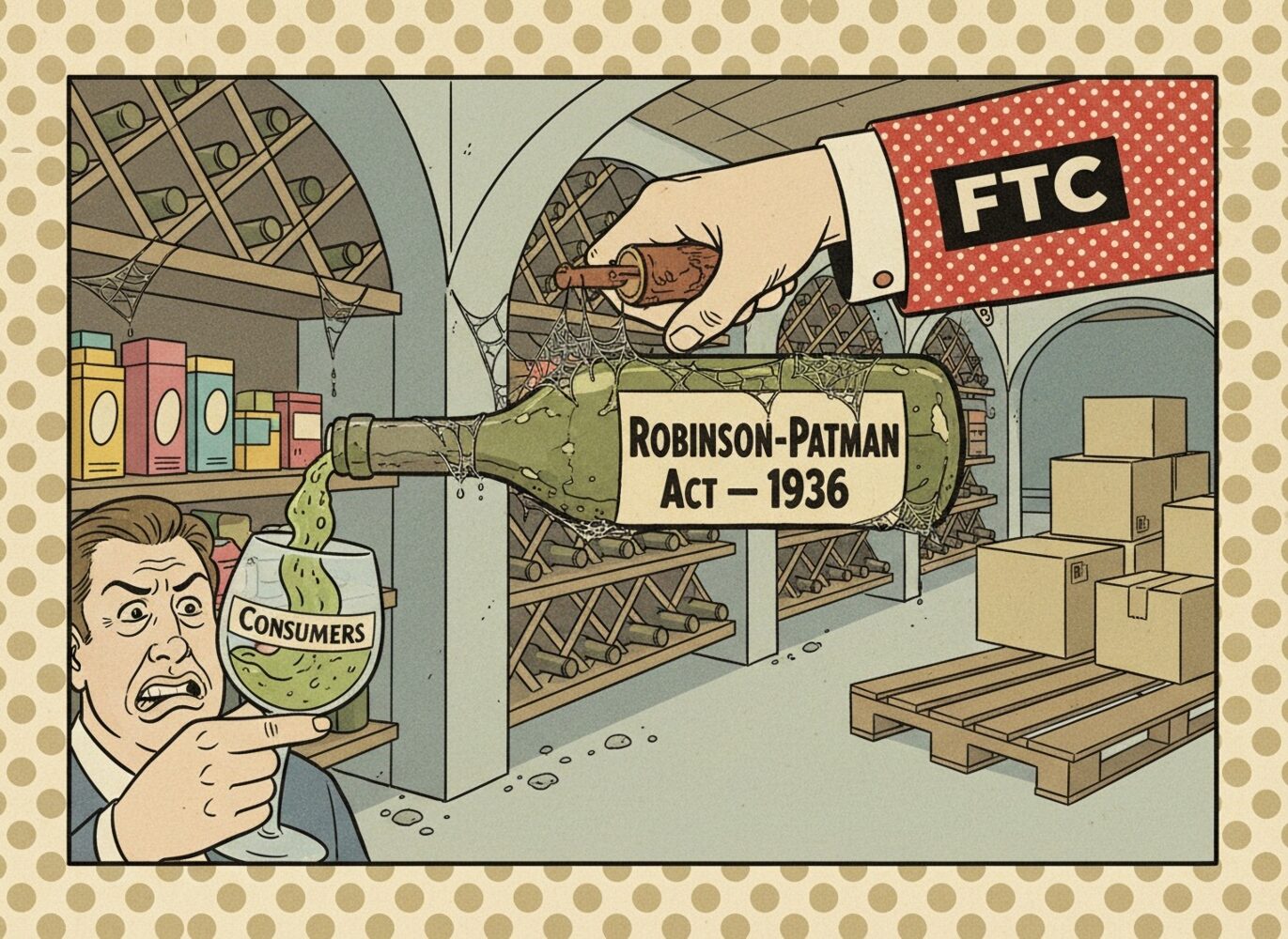
Toward the end of the Biden administration, the Federal Trade Commission (FTC) sought to revive the Robinson-Patman Act of 1936 (RPA), a statute federal enforcers had largely shelved for three decades. The law is also enforceable by private plaintiffs who claim antitrust injury from RPA violations.
Enacted during the Great Depression to shield small grocers from chain-store pricing power, the statute targets price differences between buyers in the sale of goods. Although often labeled “price discrimination,” RPA liability does not track economic price discrimination, which concerns different price-to-marginal-cost ratios across buyers.
For decades, courts, agencies, and scholars recognized the statute’s tensions with modern antitrust policy. The bipartisan Antitrust Modernization Commission concluded in 2007 that the RPA discourages discounting, raises consumer prices, and protects competitors rather than competition.
The U.S. Justice Department (DOJ) stopped bringing RPA cases in 1977. The FTC followed in the 1990s.
The reasons for this bipartisan enforcement hiatus were straightforward. As the Antitrust Modernization Commission explained, the RPA deters the price competition that benefits consumers. Firms facing aggressive RPA enforcement respond rationally: they refuse to offer discounts, adopt rigid uniform pricing, and sometimes stop dealing with small purchasers altogether—the very businesses the statute was meant to protect.
Scholars have been similarly direct. One detailed review of the literature concluded that the RPA’s prohibitions, on net, harm consumers and reduce economic welfare. An empirical study of all private-plaintiff RPA secondary-line decisions (where a seller charged different prices for the same product to different buyers) published between 1990 and 2000 likewise found harm to the competitive process. It reported that secondary-line procedures can weaken competition among suppliers, encourage collusion, and increase monopoly prices.
Government enforcement of the RPA did not fade from neglect. It receded because enforcers learned from experience.
Resurrecting Robinson-Patman — and Running into Reality
Ignoring that history, the outgoing Biden FTC in December 2024 filed an RPA complaint against Southern Glazer’s Wine & Spirits, the nation’s largest wine-and-spirits distributor, alleging unlawful price discrimination that favored large national retailers. Weeks later, the agency brought a similar suit against PepsiCo.
Both actions were authorized over forceful dissents from Commissioners Andrew Ferguson and Melissa Holyoak. Ferguson did not reject Robinson-Patman enforcement outright. He has argued the statute should apply where conduct reflects abuse of market power that threatens competition, not serve as a broad weapon against volume discounts and efficient distribution. In his view, these cases exemplify overreach.
Subsequent developments have borne that out. In May 2025, under now-Chairman Ferguson’s leadership, the commission unanimously dismissed the PepsiCo action. The Southern Glazer’s case remains alive only because a district court denied the company’s motion to dismiss last April—a low procedural bar that says little about the merits. Ongoing discovery is now surfacing problems with the FTC’s theory that extend well beyond ordinary litigation friction.
Schrödinger’s Market Definition
The most revealing development came Jan. 26, when Southern Glazer’s sought discovery of expert reports and internal materials from the FTC’s successful challenge to the Kroger-Albertsons merger—the agency’s marquee antitrust victory of the Biden years. This is not a routine discovery fight. It tests whether the FTC can maintain logically incompatible positions about competition in American retail.
To block the Kroger-Albertsons merger, the FTC told an Oregon federal court that large supermarket chains operate in a distinct, concentrated market, meaningfully insulated from smaller retailers, specialty grocers like Whole Foods and Sprouts, and warehouse clubs like Costco. The court agreed and enjoined the deal, and the parties abandoned the transaction.
The Robinson-Patman case requires the opposite. The RPA’s “competitive injury” element demands proof that favored and disfavored buyers compete directly—that Costco and a neighborhood liquor store vie for the same walk-in customer. The FTC’s own transaction spreadsheets assert as much, pairing a chain liquor store with Bed Bath & Beyond, a nightclub with a Publix supermarket, and Costco with multiple hotels. In a Rule 30(b)(6) deposition, the FTC’s corporate representative confirmed the agency alleges these retailers “likely compete.”
The FTC responds that merger analysis under Clayton Act Section 7 and secondary-line price discrimination under the RPA involve different legal standards. That is technically true, but beside the point. Southern Glazer’s presses a factual question, not a doctrinal one: do Costco and an independent wine shop serve the same customers in the same trade area, or not? The FTC said no when blocking a merger and says yes when proving price discrimination. An agency that defines competition one way on Tuesday and the opposite way on Thursday faces an evidentiary credibility problem no doctrinal distinction can cure. Courts have long guarded against such inconsistencies; result-driven market definition undermines the reliability of the agency’s analytical framework.
There is another wrinkle. The FTC resists producing the Kroger materials on burden grounds, arguing it needs third-party permission to disclose confidential information. Southern Glazer’s notes that both proceedings operate under protective orders that preserve confidentiality. The real concern is exposure. If the Kroger expert testimony endorses market definitions that contradict the FTC’s current theory, the RPA case could suffer serious damage. Discovery disputes rarely draw attention, but this one should. It goes to whether the FTC treats economic evidence as rigorous analysis or as a case-by-case instrument tailored to the desired result.
Punishing Efficiency
The deeper weakness in the FTC’s case is substantive. The Robinson-Patman Act contains an express cost-justification defense: price differentials are lawful when they reflect “differences in the cost of manufacture, sale, or delivery resulting from the differing methods or quantities” in which goods are sold or delivered. This is not a defense invented by creative counsel. Congress wrote it into the statute.
The economics are straightforward. A distributor that ships a consolidated truckload of wine to a Costco regional warehouse incurs materially lower per-unit costs than one making dozens of separate deliveries to small retail accounts scattered across a metropolitan area. The large buyer’s order is more predictable, requires less sales overhead, generates fewer invoices, and simplifies logistics. A lower price that reflects those savings is not favoritism. It is cost-based pricing, the result competitive markets ordinarily produce.
Then-Commissioner Ferguson made this point in dissent, observing that Southern Glazer’s “appears likely to succeed on a cost-justification defense.” The FTC’s complaint does not seriously engage the issue and instead treats price differences as the offense.
That analytical gap reflects a deeper confusion about the statute’s purpose. Commissioner Holyoak’s 88-page dissent traced the RPA’s judicial history and concluded courts have not treated differential pricing as presumptively unlawful. The complaint relies on FTC v. Morton Salt Co. (1948) for the proposition that competitive harm may be inferred from price differences alone. As Holyoak explained, later decisions substantially narrowed that reading.
In Volvo Trucks North America, Inc. v. Reeder-Simco GMC, Inc. (2006), the Supreme Court emphasized that RPA liability requires proof the alleged discrimination actually “threaten[ed] an injury to competition,” not merely that one buyer obtained a better deal. The Court declined to extend the statute to reach competitive dynamics “geared more to the protection of existing competitors than to the stimulation of competition.”
Taken seriously, the FTC’s theory would make ordinary commercial conduct unlawful. If every unmatched volume discount created liability, virtually every distribution company in the United States would live in chronic violation of federal law. That cannot be the correct interpretation.
Notably, the complaint does not allege consumer harm. It does not claim retail prices for wine and spirits rose, consumer choice narrowed, or output fell. The alleged injury runs to competitors—smaller retailers paying higher wholesale prices.
That distinction is not technical. It is the organizing principle of modern antitrust law. In Brooke Group Ltd. v. Brown & Williamson Tobacco Corp. (1993), the Supreme Court reaffirmed that “it is axiomatic that the antitrust laws were passed for the protection of competition, not competitors.” A price-discrimination theory untethered from consumer harm loses contact with the purpose of the antitrust laws.
Pleading by Spreadsheet
The case’s procedural posture raises separate concerns. Ordered to identify which transactions allegedly violated the RPA, the FTC produced a spreadsheet with roughly 17 million transaction pairings. It did not specify which pairings underlie the complaint, identify the allegedly injured retailers, or point to a single harmed consumer. Under oath, FTC witnesses reportedly could not confirm the factual basis of the claims and suggested the “real facts” would emerge closer to trial.
That is not how federal litigation works, particularly when the plaintiff is the federal government exercising coercive authority. A respondent must know the case against it with enough specificity to depose witnesses, develop cost-justification evidence for particular transactions, and test the factual predicates of the government’s theory. Both Ferguson and Holyoak observed in dissent that “isolated instances of unjustified price discrimination do not violate the RPA.” Providing 17 million undifferentiated data points is not the same as alleging—much less proving—a pattern of unlawful conduct.
Beyond the Bottle
The Southern Glazer’s case reaches beyond wine and spirits. If the FTC’s theory prevails, efficiency-based volume discounts across distribution industries become legally suspect. Firms offering lower per-unit prices to higher-volume buyers—which describes most firms in the U.S. economy—would face greater litigation exposure. Retail prices would likely rise, and the competitive process antitrust aims to protect would be penalized. That is substantial collateral damage from a statute the bipartisan Antitrust Modernization Commission recommended Congress repeal nearly two decades ago.
If the case fails, the lesson cuts the other way. The RPA revival will look like an effort to use a Depression-era statute to override market outcomes in efficient distribution. The Ferguson and Holyoak dissents would gain institutional weight as statements of commission policy. The broader principle—that antitrust enforcement requires evidence of harm to consumers and the competitive process, not solicitude for particular competitors—would be reaffirmed.
The FTC under Chairman Ferguson has already moved in that direction. The unanimous dismissal of PepsiCo and Ferguson’s commitment to cases that do not “unduly burden legitimate business activity” suggest a commission attentive to evidentiary rigor. The Kroger-Albertsons discovery dispute will test whether the agency applies that standard to a case it inherited but may not endorse. For practitioners, policymakers, and anyone concerned with coherent antitrust enforcement, FTC v. Southern Glazer’s bears close watching.
Time to Retire Robinson-Patman
The FTC’s recent revival of RPA enforcement has proven problematic. The statute remains on the books and continues to be enforced by private plaintiffs. Although the Supreme Court has narrowed its reach, the RPA still poses a meaningful obstacle to economically efficient sales practices and, ultimately, to consumer welfare.
Amending the statute could mitigate some deficiencies, but that is a second-best solution. Scholarly analysis points to a clearer answer: repeal remains the first-best response to a law long criticized as “corporate welfare at consumers’ expense.”
