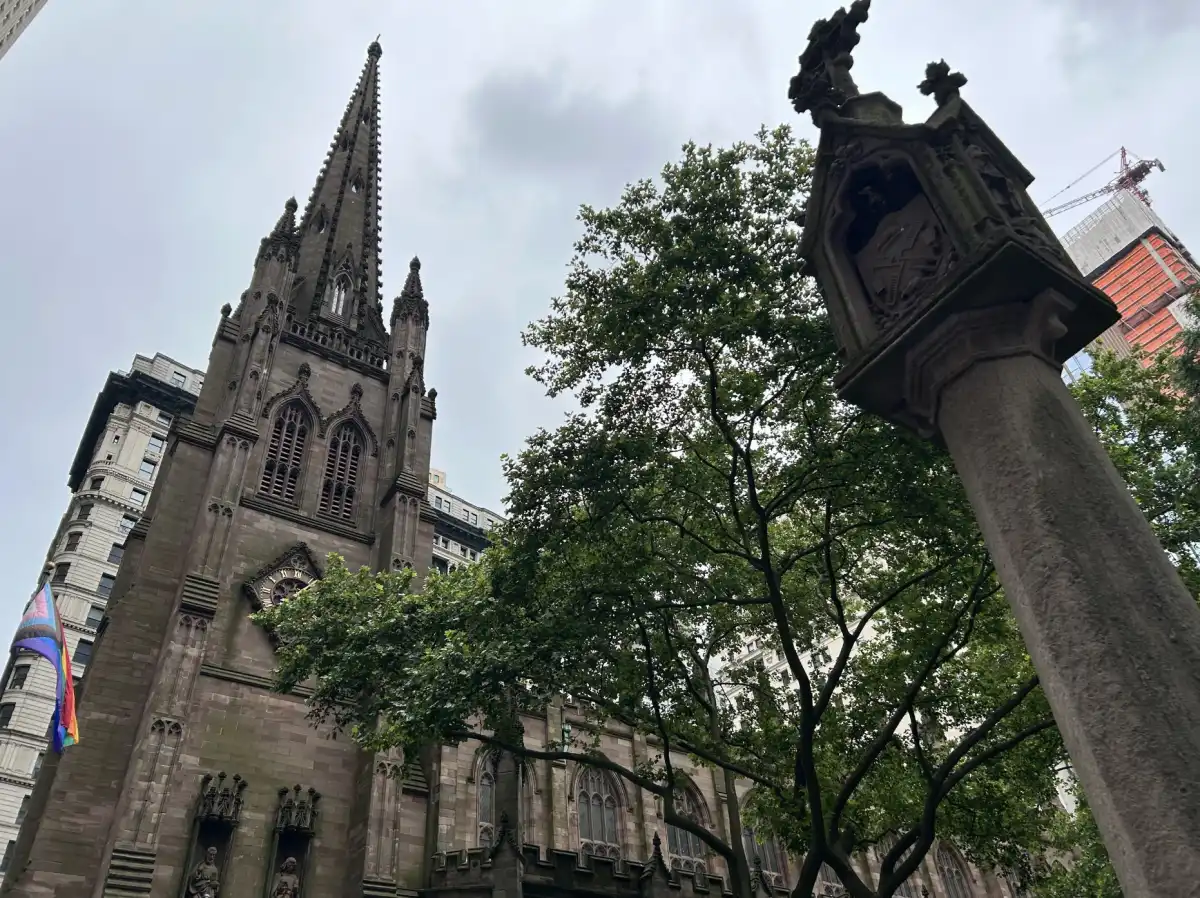
Trinity Church and St. Paul’s Chapel sit tucked between towering Wall Street skyscrapers and government offices, almost hidden behind the financial buildings and centers of global trade that define modern Lower Manhattan.
From the burial of Alexander Hamilton to providing relief to recovery workers after the Sept. 11, 2001, attacks on the nearby World Trade Center, the Trinity Church congregation has acted as a pillar of its community throughout American history.
Trinity Churchyard is the final resting place of several influential Americans, including Alexander Hamilton, Eliza Hamilton and Maj. Gen. William Alexander.
The churchyard is also the burial site of Revolutionary War spy Hercules Mulligan, former U.S. Rep. John Watts Jr. and Richard Churcher, a 5-year-old boy whose 1681 tombstone is considered the oldest legible gravestone in Trinity Churchyard.
The two Episcopal churches served as symbols of American culture long before the modern Financial District rose around them.
“The irony of the location doesn’t escape us,” Trinity Church Chief Communications Officer Lisa Benenson told amNewYork.
“When the first church was being built in the late 1600s, Broadway was a path at the edge of a long English settlement, and Wall Street was a 12-foot wooden wall built by the Dutch to protect against invaders,” Benenson said.
When the current Trinity Church was completed in 1846, its steeple rose 281 feet, making it the tallest building in New York City and the United States at the time.
The two houses of worship are part of the same congregation, with Trinity Church serving as the parish center since its founding in 1697, while St. Paul’s was built as a “chapel of ease” for parishioners who lived uptown.
Hamilton had his children baptized at St. Paul’s Chapel, which he attended alongside George Washington after the original church burned down in the Great Fire of New York in 1776.
According to a recent exhibition from The New York Historical, men and women were found sheltering near St. Paul’s Chapel during the Great Fire.
“As the British Army entered Manhattan in September 1776, a fire destroyed a large portion of the city. Several suspected arsonists were executed in its wake,” an excerpt from the exhibition reads.
The exhibition describes a private who encountered “a woman hiding in a cupboard near St. Paul’s Chapel alongside five men, gunpowder, and matches.”
A refuge on New York’s darkest day
More than two centuries later, the chapel would again serve as a center for shelter and relief after the terrorist attacks on the World Trade Center on Sept. 11, 2001.
Located only about a hundred yards from the World Trade Center site, St. Paul’s Chapel survived the collapse of the Twin Towers and became a refuge for recovery workers, first responders, and volunteers at ground zero.
“The chapel famously welcomed thousands of recovery workers, and these were just grueling shifts, and responders found respite in this beautiful 235-year-old chapel,” Benenson said.
“For rescue crews, police, firefighters, St. Paul’s became the place where they could rest up,” Benenson continued.
Benenson said Americans from across the country came to St. Paul’s Chapel and Trinity Church to drop off food, personal supplies and offer counseling to the workers at ground zero.
The Trinity Church parish was involved in the recovery effort for at least nine months after the attacks.
Continuing its centuries-old mission today
Today, Trinity continues to serve its community through philanthropic programs focused on education, housing and food insecurity.
“Trinity educational programs currently support 15,000 public school students across 13 New York City schools. Our grants for homelessness and housing helped prevent over 3,300 evictions in 2025. We help the hungry by providing 4.7 million meals at Trinity properties around the city,” Benenson said.
“We’ve never aspired to be a museum. Our work is in service to our community,” Benenson said when asked how the church balances its responsibilities as a parish while also maintaining its status as a historic landmark.
In an age when many churches are seeing dwindling attendance, Trinity is continuing to grow as a parish, in part because of its historic roots, but also through the ways the parish serves its modern community.
“Most churches are not growing, but ours is. We have more than 2,600 new members,” said Benenson, who said membership went up 35% in 2025.
“We protect our historic places and spaces by continuing to grow and to give back, caring for the people of our parish, our city and our global community,” Benenson said.
