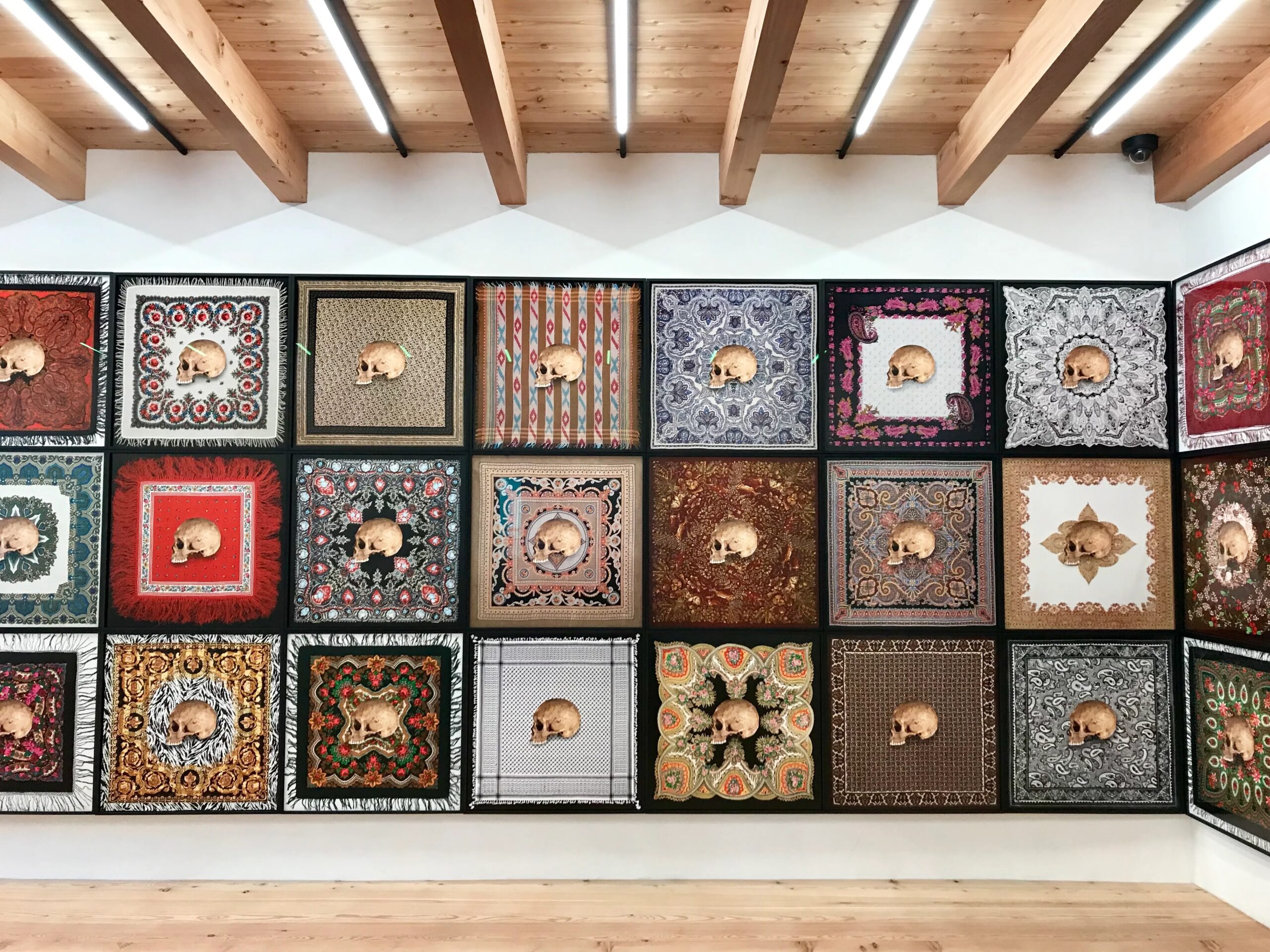
Muzeum Susch is situated hours from Zurich in the Engadin Valley of the Swiss Alps: a rural region in a sequestered mountain location. The site re-occupies a 12th-century monastery that later became a brewery, and the discreet white architecture reflects a singular sense of place rooted in local geology. Approximately 10,000 tonnes of rock were excavated from the mountainside behind the buildings. Some interior galleries sit deep inside that excavation with walls of visibly exposed rock, and museumgoers can hear water moving through the mountain. “Visitors descend, climb, pass through narrow corridors and suddenly enter tall, light-filled rooms. The architecture encourages close looking, and that rhythm fundamentally shapes the encounter with the artworks,” collector Grażyna Kulczyk, the museum’s founder, tells Observer.
(In the introduction to a publication about the venue, Muzeum Susch: Alpine Laboratory, art critic and editor Jennifer Higgie wrote: “That Muzeum Susch has gallery spaces hewn from stone is symbolic on many levels: it embodies the idea that art history is no longer fixed but mutable and that women are literally and metaphorically breaking down the walls that, for far too long, have confined them.”)
|
“Muzeum Susch“ |
The Muzeum Susch—”a name like a sigh,” writes Paweł Goźliński—opened in December of 2018, coinciding with the 100th anniversary of Poland gaining independence as a salute to Kulczyk’s place of birth. From the beginning, the museum was conceived not only as a site for exhibitions but also for international collaborations, publishing, residencies and research at the in-house Instituto Susch, which focuses exclusively on women artists in Central and Eastern Europe post-1945.
The venue’s 1,500 square meters are dedicated primarily to temporary exhibitions—currently on is feminist activist/artist Mariuccia Secol’s show “Unraveling”—although select parts of Kulczyk’s collection are also presented in a separate part of the complex. We connected with Kulczyk to discuss the ideal conditions for viewing art, the feminist figures she most appreciates and how artistic importance does not always dovetail with historical visibility.
What are the advantages and disadvantages of being located so remotely?
People often describe Susch as remote, but I experience it differently. It is removed from the constant demands of the art world, and that distance creates the conditions for concentration. Susch is inseparable from its architecture, its landscape and its pace—it could not be transferred anywhere else. Visitors do not arrive by chance. They come because they have made a conscious decision to be here, and that changes the way they experience art. The museum follows its own rhythm, largely independent of the metropolitan exhibition calendar. That allows us to devote time to research, to artists who require sustained attention and to projects that mature slowly.
Of course, there are practical challenges. Every exhibition requires more planning, transport is more complex and assembling international teams takes longer. Those logistical difficulties are a small price to pay for the intellectual freedom the place provides.

Can you tell me about your background as an entrepreneur?
Entrepreneurship was the way to build things that did not yet exist. I started early, in the 1980s, building a family business in Poland at a time when private enterprise operated within very narrow limits. After 1989, when the country opened, the scale changed—everything had to be built from the ground up. I trained as a lawyer in Poznań and went into business in the years when Poland was inventing a private economy from nothing. There was no model to copy. Everything was a first attempt, which suited me.
The project most people know is Stary Browar in Poznań, opened in 2003—a 19th-century brewery that I transformed into a place where commerce and art sustain each other: 50 percent business, 50 percent art. Building businesses taught me to think in decades, to accept responsibility for complex projects and to understand that lasting value comes from sustained work. When I turned to the cultural field, those were exactly the qualities required. Establishing a museum, supporting artists and developing research programs all demand patience and the willingness to invest in ideas whose significance may become visible only years later.
What is your approach to collecting?
I have been collecting art for more than 50 years. I work with galleries, occasionally with auctions, sometimes through private opportunities, but above all through long-term relationships with artists, curators and gallerists. I did not begin with a strategy or the ambition of building a major collection. What interested me first was direct contact with artists and with the intellectual questions their work raised. I have always been drawn to artists who were difficult to place, rather than those who already occupied an established position. [My] collection reflects conversations, encounters and decades of looking—a record of curiosity more than a catalogue of acquisitions.

How regularly do you add works? What is your most recent addition?
I continue to acquire, but far more selectively. One of my most recent acquisitions is an early painting by Marlene Dumas—a work from the late 1980s, from the years when she was still finding the language for which she later became known. That interest in formative moments—before an artist’s language is fully established or widely recognized—runs throughout my collection. Today, I am less interested in expanding the collection than in deepening it. What interests me are works that change the way I understand an artist I have been looking at for years.
Susch is described as presenting a “matrilineage of the sometimes omitted, overlooked or misread”… can you tell me about some experiences you had in the art world that made this state of affairs apparent to you?
When I started collecting, I repeatedly encountered remarkable women artists whose work was absent from the dominant historical narratives. What interested me was not simply that they had been overlooked, but why. Which institutional mechanisms determined visibility? Which works entered museums, publications and teaching, while others disappeared? This gradually became one of the central questions behind Muzeum Susch. What interests me is how art history is constructed, why certain artists disappear from it while others become central, and how we can better understand those mechanisms.
Who are some of the artists you love who fall into this category today?
There are many, and every exhibition changes the answer. Artists such as Anu Põder, Tapta, Běla Kolářová, Mariuccia Secol, Gabriele Stötzer, Edita Schubert, Laura Grisi, Emma Kunz and Evelyne Axell all demonstrate that artistic importance and historical visibility are two different things. What connects them is that their contribution deserves a far more central place within 20th-century art history.

Who are the thinkers, curators or writers doing the most to champion women in the arts?
Many people have contributed enormously to this field, and some of them have worked directly with us. Jennifer Higgie edited our monograph Muzeum Susch: Alpine Laboratory and spent time in Susch as a resident. Alice Rawsthorn, Siri Hustvedt and Chloë Aridjis all wrote for the book, and the title of our inaugural exhibition was inspired by one of Hustvedt’s texts. At Muzeum Susch, Cecilia Alemani curated the Anu Põder retrospective.
More broadly, the work of historians and curators such as Griselda Pollock, Catherine De Zegher, Lynne Cooke and the late Okwui Enwezor has profoundly influenced how museums and researchers approach overlooked artists and the writing of art history.
What matters most is that lasting change happens when research, exhibitions, publications and institutional commitment reinforce one another. Many of our exhibitions start with years of archival work, conversations with estates, scholars and artists and the reconstruction of histories that have never been properly studied. The museum presents the results publicly; the institute develops the knowledge that makes those exhibitions possible. Recognition is never automatic; it is built. Somebody is always writing art history—and it matters who.
More in Museums
