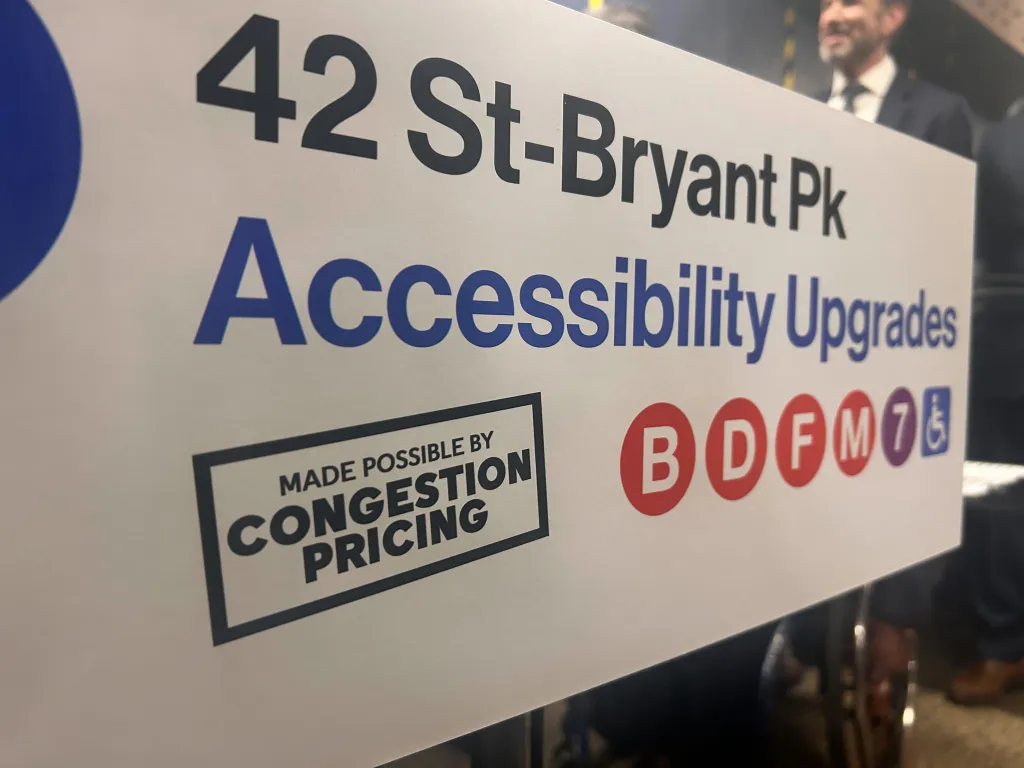
Here’s a sign of what congestion pricing is bankrolling.
The MTA has begun slapping “Made Possible by Congestion Pricing” seals on transit upgrades funded by the Manhattan vehicle-tolling program that launched last year.
Four elevators being installed at the 42nd Street–Bryant Park/Fifth Avenue subway complex on Thursday became the first to be billed as products of the tolling initiative, which is aimed at raising billions of dollars for capital improvements by charging motorists who drive into Manhattan’s congested core.
“It’s basic human nature, people want to know where their money is going,” said Janno Lieber, MTA chairperson and chief executive officer. “And what we’re able to communicate with this signage is: These are the projects that congestion pricing is funding and these are the benefits that New Yorkers who use the transit system, especially, are going to receive.”
Revenue from tolls on vehicles entering the so-called congestion relief zone that extends south of 60th Street is providing $15 billion for the more than $50 billion MTA capital plan that lays out major projects for 2020 to 2024.
The East Harlem extension of the Second Avenue Subway, signal upgrades along multiple lettered lines and accessibility upgrades at more than 20 stations are among the projects set to be bankrolled by congestion pricing, which has been credited with curbing gridlock and speeding bus service.
“New Yorkers have already been feeling the benefits of less traffic, safer streets and cleaner air thanks to congestion pricing,” Gov. Kathy Hochul said in a statement. “Now, we take the benefits to the next level as we unleash billions in investment to improve our transit system.”
No More ‘Underachieving’
The accessibility upgrades at the 42nd Street–Bryant Park hub, which daily serves more than 100,000 riders, will bring the 15th-busiest station in the subway system into compliance with the Americans with Disabilities Act, MTA officials said.
While the station already has three privately maintained elevators that connect the street with the mezzanine level, the lifts do not extend to the platforms on the B, D, F, M and No. 7 lines.

Those elevators have in recent years been plagued by low availability rates, as The City Reporter previously documented. MTA data shows the station’s elevator-availability rate plummeted to 4.9% in March 2022 and hovered just over 40% in February 2025. In August, the rate sat at 86.4%, below the 91.1% rate for other subway elevators maintained by a third party.
The MTA and city have legally gone after some landlords who operate elevators and escalators within the subway system.
“We’re not going to put up with anybody underachieving,” Lieber said. “That said, there has been a dramatic improvement since we started pushing in the performance of those privately owned elevators and we ain’t going to back down on that.”
‘I Can Go Anywhere’
When the next phase of work at the transit complex is completed by late 2028, three elevators will be added to carry riders between the mezzanine and platform levels on all the lines at the station, along with another linking the Times Square Shuttle’s pedestrian passage with the northbound platform on the B, D, F, M lines.
Additionally, station platforms will be rebuilt, new fare gates will be installed and station restrooms will be overhauled as part of the latest phase of work at the Bryant Park hub.
“It ain’t sexy, but it is the stuff that we need to do to make sure that this blessed system is here for another 120 years,” Lieber said.
ADA upgrades funded by the congestion tolls are underway at five other stations in The Bronx, Brooklyn and Queens, including 167 Street on the B and D lines, Gates Avenue on the J and Briarwood on the E and F lines.
In all, 23 stations will be made ADA-compliant with money from congestion pricing, as the MTA pushes to have 95% of its nearly 500 subway and Staten Island Railway stations have elevators or ramps by 2055. The terms are part of a landmark settlement approved by a federal judge in 2023.
Debra Greif, who uses a walker after previously relying on a wheelchair, said Thursday at the subway complex that putting a “Made Possible by Congestion Pricing” label on relevant projects is important for transit riders who don’t understand the MTA’s funding streams.
“Coming from a family with disabilities, having this system be so accessible will be wonderful,” she said. “That means I can go anywhere and that’s what I really want.”
Our nonprofit newsroom relies on donations from readers to sustain our local reporting and keep it free for all New Yorkers. Donate to THE CITY today.
The post This Subway Elevator Was Brought to You by Congestion Pricing, MTA Says appeared first on The City Reporter.