Senior managers in the agency that handles government purchasing and leases tried to hide their discussions about hot-button issues from the public by communicating via personal text messages, emails and hand-delivered written memos, an investigation by The City Reporter has found.
The conversations involve high-level executives of the Department of Citywide Administrative Services (DCAS), who sought to keep off the books chatter related to:
- Discussion of an executive deputy commissioner’s move to install her nephew in an agency job.
- Leasing a building in Queens for the Manhattan-based Probation Department because the then-commissioner wanted to work closer to home.
- Proposed protocols to test for the deadly Legionella bacteria in city-owned buildings.
Nearly all of these conversations took place during the first five months of Mayor Zohran Mamdani’s tenure and appear to violate rules requiring that city business take place over city-issued phones or via the city’s internal email system — a measure that ensures these discussions can be preserved as official records subject to public disclosure.
Are you a city employee? Do you know of city workers using private email and text messages to discuss city business? Contact reporter Greg B. Smith at gsmith@thecityreporter.nyc or on Signal at 646-391-2426.
The city reporter
This issue of hiding official records recently made headlines after it was revealed that Emilia Rowland Winter, who handles new media for Mamdani, used the Signal encrypted app to coordinate City Hall messaging with an army of Instagram and Tik-Tok influencers. The New York Times reported that Signal communications to at least one influencer were set to “auto-delete,” thus negating the ability to retain these communications as an official record.
In response, the mayor’s chief counsel said he took “immediate corrective action,” and all employees were then instructed not to use the “auto-delete” function and avoid using Signal altogether while discussing official city business.
Then, in a Sept. 21 universal text to city employees, Mamdani chief of staff Elle Bisgaard-Church broadened the advisory, instructing employees to “use your city email address for all work-related messages” and “use your city issued desk or cell phone” and “not use your personal phone for work-related calls.”

In a Jan. 15 memo first made public by The City Reporter in early September, Mamdani’s chief counsel, Ramzi Kassem, explicitly told municipal employees to only conduct city business on their work accounts: “You should not use WhatsApp, Signal, or any other communications app or platform for work,” he wrote.
Under the Radar
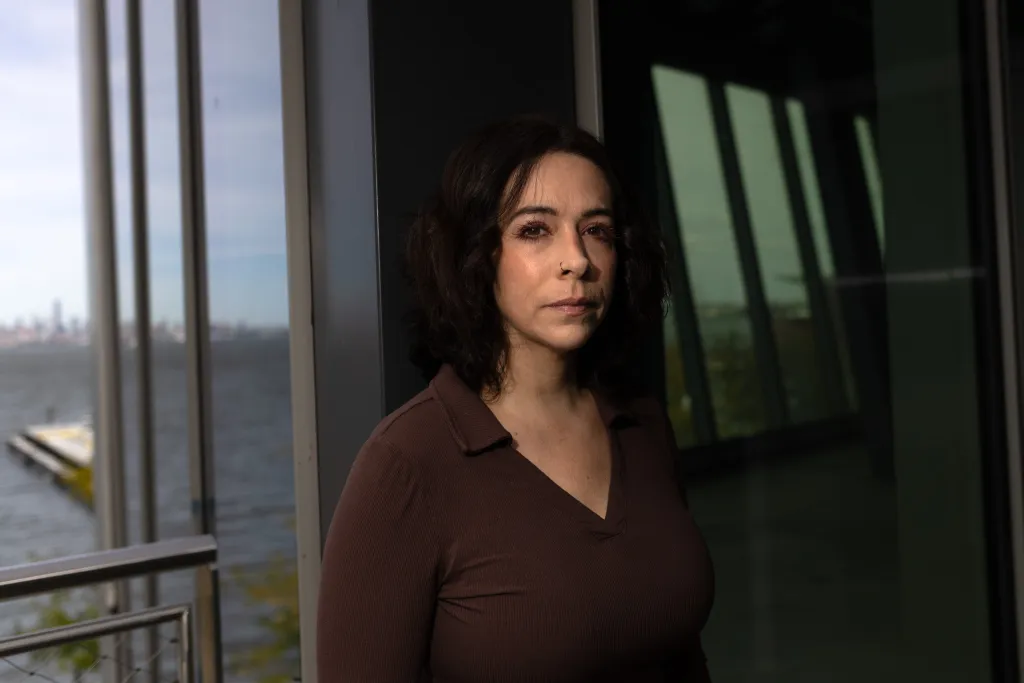
But Michelle Gundy, a former deputy assistant commissioner at DCAS, has come forward to allege in a whistleblower lawsuit and in conversations with The City Reporter that her supervisors regularly instructed her to use her personal phone — not one issued to her by the city — and personal email to discuss certain sensitive topics. Gundy says the tactic was fairly common at the top levels of the agency.
Her lawsuit, filed in August by attorney John Scola, alleges that she was fired in May because she had objected to some of these practices.
“Dr. Gundy had a spotless record running a 1,000-employee City division until she was fired for reporting nepotism at DCAS,” Scola said. “When the City punishes the person who reports corruption instead of the people who commit it, every civil servant learns to stay quiet.”
Retaliation Claim
In her suit, Gundy charges that she was terminated “in direct retaliation for disclosing and refusing to participate in governmental corruption, nepotism, abuse of hiring authority and the unlawful targeting of subordinate employees.”
Gundy says she was told she was not being let go for poor performance but due to a reorganization of the agency. Within 24 hours of her departure, Gundy’s supervisor circulated an agency-wide email recruiting to fill her position, demonstrating that “the ‘reorganization’ was a pretext for unlawful retaliation,” the suit alleges.
To corroborate the allegations in her lawsuit, Gundy provided The City Reporter with some of these private communications — all on the participants’ personal accounts — that she says were meant to dodge disclosure in public records requests.
The City Reporter sent DCAS a list of detailed questions about Gundy’s charges and the specific texts and emails. Citing the lawsuit, spokesperson Anessa Hodgson declined to answer, saying: “As part of this administration, we take all concerns about transparency seriously. We want New Yorkers to know just how their government is delivering for them.”
The Boss’ Nephew
A pattern of communication outside the city’s official system emerges in the narrative of the lawsuit and in a review of text threads and emails Gundy screen-grabbed and preserved.
In February, for example, an off-the-grid discussion centered on Executive Deputy Commissioner Shameka Boyer-Overton getting the agency “to hire her nephew Maurice Edouard Jr. in a senior position” after Gundy says the agency’s human resources unit “had formally rejected him as unqualified,” the lawsuit alleges.

Gundy says another top DCAS official, Laura Ringelheim, instructed her to “put in writing what she knew about Edouard’s hire and to hand-deliver it to (her) office rather than transmit it through official email channels.” She did as instructed, handing Ringelheim’s assistant the memo — an action that Gundy alleged “protected disclosure” of the possible nepotistism.
Gundy alleges that Boyer-Overton initially tried to get the state — which reimburses DCAS for employees assigned to maintain state courts — to pay for her nephew’s salary as an “oiler,” a trades job for which she says he had no qualification. That was rejected so, Gundy says, Boyer-Overton created a new DCAS position, “Strategic Initiative Specialist,” for him. Edouard lists his title as “Deputy Director of Facilities Operations DCAS” on his Linkedin profile.
Gundy says her supervisor, Deputy Commissioner Patrick Benn, instructed her verbally to submit a complaint about Edouard’s hiring to the Department of Investigation. She says she did this anonymously.
DCAS spokesperson Hodgson did not respond to questions about Edouard, including his job description and salary.
Beaver Street Blues
Boyer-Overton, who claimed on her city financial disclosure form that none of her relatives are on the city payroll, did not respond to a message from The City Reporter on Tuesday asking about Gundy’s allegations and her use of personal email to discuss official city business.
Gundy says she exchanged outside-the-system texts with another top DCAS manager, Senior Advisor Meghan Mulgrew, a daughter of teachers union head Michael Mulgrew. In her lawsuit, Gundy says they did this “because Mulgrew wished to keep the communications private.”
In texts on their personal phones, Mulgrew discussed moving to terminate an employee. Gundy told The City Reporter she had determined the justifications for the termination “were fabricated.” In a March 24 exchange, Gundy wrote, “I’m officially done fighting to remove (the employee) from anything.” Mulgrew responded, “Let me work on this.”
Early this year, Mulgrew and Gundy turned to personal texting to discuss DCAS’ plans to lease office space for the Department of Probation because the lease on its main office at 33 Beaver Street near Wall Street was about to expire.
Mulgrew started a Feb. 26 text message by writing, “Hey didn’t want this in teams,” a reference to Microsoft Teams, which automatically archives all content as official records.
Gundy texted Mulgrew that the then-Probation Commissioner Juanita Holmes was pushing DCAS to lease space for the agency’s main office in Long Island City, explaining, “Here’s what happened: the former commissioner chose that space in LIC because it’s close to her house.”

Gundy then explained to Mulgrew that the new commissioner, Sharun Goodwin, who had replaced Holmes a few weeks earlier, “did not want to be that far from City Hall and all of their community programs. Almost all of their functional sites are in Manhattan.”
Mulgrew did not respond to The City Reporter’s message asking her about her use of personal texting to discuss city business. The DCAS spokesperson declined to discuss the behind-the-scenes proposal to move the probation department to Queens. Probation wound up staying put at Beaver Street.
Legionella Protocol
Another area of private discussion involved DCAS crafting a protocol to ensure cooling towers on city-owned properties were properly tested for the potentially deadly Legionella bacteria. Gundy’s private text conversation with Deputy Commissioner Benn took place in April, just before a new law was set to take effect requiring building owners to do testing every 30 days, a big change from the prior 90-day requirement.
Gundy described to Benn how she’d vetted an internal DCAS memo memorializing the planned protocols: “The contract is really nuanced so we went through it to make sure it aligns with the memo. We should be good. Also the new law mandates testing every 30 days but the contract says every 90 days. We flagged it in the memo.”
Days after she was terminated, Gundy filed a 30-page complaint with the Department of Investigation detailing the off-the-grid conversations. On June 23, Ann Petterson, the inspector general overseeing several agencies including DCAS, responded via email to confirm that DOI was looking into her complaint.
Investigations Department spokesperson Diane Struzzi said, “DOI is aware of this matter and is looking into it.”
Our nonprofit newsroom relies on donations from readers to sustain our local reporting and keep it free for all New Yorkers. Donate to THE CITY today.
The post City Agency Sought to Hide Nepotism Hire Through Private Messages, Lawsuit Alleges appeared first on The City Reporter.