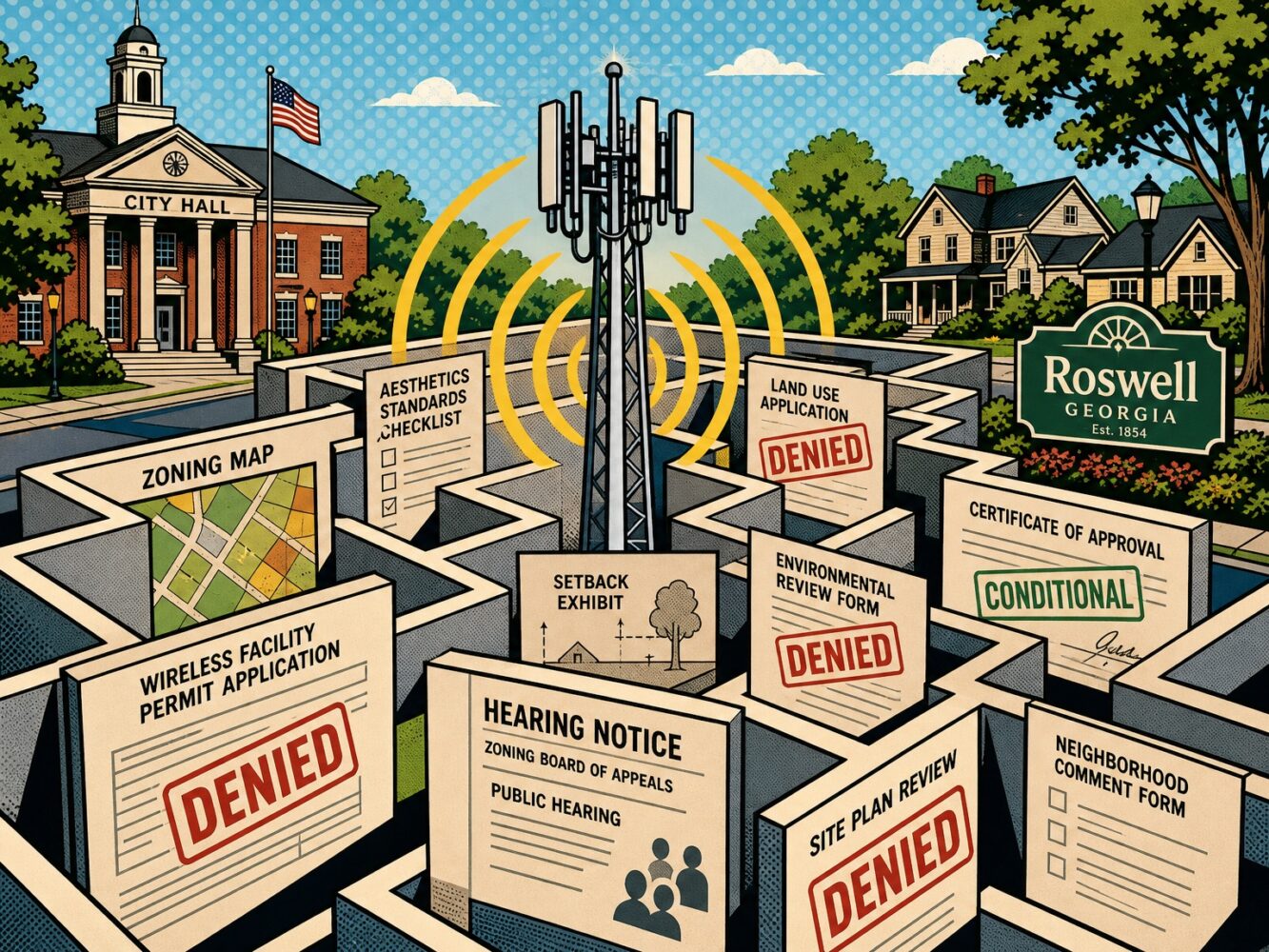
A city does not need to hang a “no cell towers allowed” sign to keep wireless service out. It can get there the quieter way: deny one permit, then another, each for reasons that sound local, particular, and perfectly ordinary. The question at the heart of the Telecommunications Act of 1996 is whether federal law cares about the difference.
The Act was designed to speed wireless deployment while preserving local control over routine land-use decisions. Section 332(c)(7) reflects that compromise. It preserves state and local authority over the “placement, construction, and modification” of wireless facilities, while imposing a handful of federal constraints to ensure Americans receive the benefits of timely wireless-service deployment.
The most important of those constraints is the effective-prohibition clause, which provides that local regulation “shall not prohibit or have the effect of prohibiting the provision of personal wireless services.” The key words are “or have the effect of prohibiting.” That language extends beyond outright bans to government actions that, whatever their form, leave an area without wireless service. For nearly 30 years, courts have wrestled with a recurring question: How far does that functional phrase reach?
Faced with a statute that condemned effects without defining them, the federal courts of appeals developed a framework to fill the gap. Beginning with the 2nd U.S. Circuit Court of Appeals in Sprint Spectrum, L.P. v. Willoth (1999), and eventually adopted by nearly every circuit to consider the issue, courts converged on the “significant gap” test. Under that approach, a denial has the effect of prohibiting service when it leaves a significant gap in a carrier’s coverage and the carrier’s proposal is the least intrusive means of closing it. The test gave concrete meaning to the statute’s “effect of” language, tied liability to real-world coverage rather than the label a locality attached to its decision, and used the no-alternatives requirement to supply the causal connection implied by the word “effect.”
Last month, the 11th U.S. Circuit Court of Appeals broke from that consensus. In T-Mobile South, LLC v. City of Roswell, the court held that the effective-prohibition clause governs only the regulation of siting—that is, control through generally applicable rules—and therefore cannot be invoked to challenge the denial of a single permit application.
That reading is difficult to square with the statutory text. The phrase “effect of prohibiting” is at least as naturally read to reach functional prohibitions as formal ones. The court’s narrower interpretation also carries consequences that cut against the deployment Congress sought to accelerate. Under the 11th Circuit’s approach, a locality can keep wireless facilities out indefinitely by denying applications one at a time, each on seemingly site-specific grounds, without ever adopting a rule that a court could invalidate. The result is a moratorium in all but name—effectively insulated from challenge because no one put it in writing.
The Consensus Nobody Argued About
For nearly 30 years, most federal courts of appeals operated on a shared—and largely unexamined—premise: a city’s denial of a single wireless-facility permit can “have the effect of prohibiting” service under 47 U.S.C. § 332(c)(7)(B)(i). The debate was rarely whether an individual denial could violate the statute. The real question was how courts should determine when it does.
The framework emerged almost immediately after enactment of the Telecommunications Act of 1996. In Sprint Spectrum, L.P. v. Willoth (1999), the 2nd U.S. Circuit Court of Appeals held that a denial effectively prohibits service when it prevents a carrier from remedying a significant gap in coverage and the proposed facility is the least intrusive means of closing that gap.
Just as important, the court rejected the argument that Section 332 reaches only general bans on wireless service:
Absent an explicit policy banning personal wireless services, the Board contends, courts can only consider whether in aggregate a town’s repeated denials of applications have the effect of a general ban. Since Ontario does not have a general ban in effect, as evidenced by its earlier approval of Frontier’s application and professed willingness to accept some level of PCS service, the Board insists its actions must necessarily be in conformance with subsection B(i)(II). We disagree with this reasoning.
Not every circuit followed the same path, but most arrived at the same destination. The 4th U.S. Circuit Court of Appeals initially suggested that the effective-prohibition clause targeted only general bans. See AT&T Wireless PCS, Inc. v. City Council of Virginia Beach (1998). Yet the court soon recognized that an individual permit denial could itself amount to an effective prohibition when it prevents a carrier from remedying a significant coverage gap and no reasonable alternatives exist. See 360 Communications Co. of Charlottesville v. Board of Supervisors of Albemarle County (2000). The court reaffirmed that understanding in T-Mobile Northeast LLC v. Fairfax County Board of Supervisors (2012), while emphasizing that the statute does not guarantee carriers flawless coverage. The burden may vary across jurisdictions, but the basic premise remained the same: individual siting decisions can be challenged under Section 332.
Stripped to its essentials, the resulting “significant gap” test asks two questions. First, does a significant gap in wireless coverage exist in the relevant area? Second, do reasonable alternatives to the carrier’s proposed facility mean that service can be provided without the denied application? That two-step inquiry became the dominant framework for effective-prohibition claims nationwide.
Over the next decade, most circuits adopted some version of the significant-gap approach. The 7th U.S. Circuit Court of Appeals did so in VoiceStream Minneapolis, Inc. v. St. Croix County (2003); the 9th U.S. Circuit Court of Appeals in MetroPCS, Inc. v. City & County of San Francisco (2005); and the 6th U.S. Circuit Court of Appeals in T-Mobile Central, LLC v. Charter Township of West Bloomfield (2012).
If anything, more recent developments expanded the reach of the effective-prohibition clause rather than narrowing it. In a 2018 declaratory ruling, the Federal Communications Commission (FCC) recast the inquiry around what it called “material inhibition.” Under that standard, a state or local requirement effectively prohibits service whenever it materially inhibits a provider’s ability to offer a covered service. The FCC explained that the standard extends beyond coverage gaps to include barriers to network densification, capacity upgrades, and deployment of new technologies such as 5G. A locality need not erect an insurmountable obstacle; a material one is enough.
The FCC derived the test from its 1997 California Payphone decision and applied it to the parallel effective-prohibition language found in both Sections 253 and 332. Although the ruling focused primarily on broad regulatory barriers, the 3rd U.S. Circuit Court of Appeals applied the standard to an individual permit denial in Cellco Partnership v. White Deer Township Zoning Hearing Board (2023). The court expressly abandoned its earlier significant-gap framework and instead asked whether, under the totality of the circumstances, the denial prevented the carrier from providing service without unreasonable cost. Where the significant-gap cases at least attempted to cabin liability, the material-inhibition standard lowered the bar further.
The 11th Circuit Changes the Question
Last month, the Eleventh Circuit decided that the widespread application of section 332 to individual siting decisions was incorrect. Instead, the court held that the statute’s bar on conduct that has “the effect of prohibiting” wireless service does not reach an individual permit denial at all. It limits only “[t]he regulation of” siting — and “regulation,” the court concluded, means control by rule, not the disposition of a single application.
Last month, the 11th U.S. Circuit concluded that nearly three decades of effective-prohibition jurisprudence had gone off track. In Roswell, the court held that Section 332’s prohibition on conduct that has “the effect of prohibiting” wireless service does not reach the denial of an individual permit application. Instead, it applies only to “[t]he regulation of” wireless-facility siting. And, in the court’s view, “regulation” means control by rule, not the disposition of a single application.
The court’s reasoning is relentlessly textual. Because “regulation” derives from the verb “regulate,” the court began with contemporaneous dictionary definitions, which generally described regulation as controlling or directing conduct “according to rule, principle, or law.” A locality that denies a permit, the court reasoned, is not regulating property through a rule. It is merely refusing to grant one applicant an exception to rules already in place. The actual constraints on where a wireless facility may be built come from the ordinance itself, not from any individual permitting decision.
The court found further support in Section 332’s structure. Subsection (c)(7)(A) preserves local “authority . . . over decisions” regarding wireless-facility siting. The limitations that follow in subsection (c)(7)(B), meanwhile, divide neatly into substantive and procedural categories.
The substantive limits—the prohibitions on unreasonable discrimination and effective prohibition in subsection (B)(i), as well as the radiofrequency-emissions provision in subsection (B)(iv)—speak in terms of “regulation.” The procedural limits—the requirement to act within a reasonable time in subsection (B)(ii) and the requirement that denials be supported by substantial written evidence in subsection (B)(iii)—speak instead of a “decision” to “deny a request.”
For the court, that distinction mattered. Congress had available a term broad enough to encompass both generally applicable rules and individual permit denials: “decisions.” Yet it chose “regulation” for the statute’s substantive constraints. When Congress uses materially different terms, courts generally presume it intends materially different meanings. On that logic, “regulation” is a subset of “decisions,” not a synonym for them.
The implications are sweeping. The court held that the significant-gap test “fails at the threshold” because it focuses on the wrong object. The relevant question is not whether a permit denial leaves a coverage gap, but whether a governing rule has the effect of prohibiting service. The panel was openly skeptical of the significant-gap framework’s pedigree, describing it as the product of judicial “common-law rulemaking” untethered from statutory text and suggesting that its widespread adoption was evidence that “something has gone badly wrong.”
Although the court framed its criticism in terms of the significant-gap test, its reasoning extends much further. The FCC’s material-inhibition standard likewise asks whether government action functionally impedes deployment. If the statute reaches only rules and not individual denials, that approach appears vulnerable for the same reason. As the court put it, its interpretation is “irreconcilable with any version of the significant gap test.”
Still, the court did not eliminate effective-prohibition claims altogether. Providers may continue to challenge local regulations that operate as barriers to wireless deployment. A carrier that can show ostensibly permissive siting rules function as a de facto ban, or that a consistent pattern of denials reflects an unwritten policy against wireless facilities, may still prevail. What the carrier may not do, under the 11th Circuit’s approach, is treat the denial of a single permit application as the prohibited act itself.
The Evasion Problem
The significance of Roswell lies not only in its sharp break from existing precedent, but also in how that break cuts against the purposes of the Telecommunications Act. If the decision stands, its effects may extend well beyond the 11th Circuit, creating new obstacles to wireless deployment and increasing uncertainty for providers nationwide.
As a textual matter, the court’s critique of the significant-gap test is less persuasive than it first appears. Congress did not merely prohibit regulations that “prohibit” wireless service. It prohibited regulations that “prohibit or have the effect of prohibiting” the provision of wireless service. An outright ban already “prohibits.” The additional phrase must therefore do some independent work.
The most natural reading is that Congress sought to reach government actions that, whatever their form, make service unavailable in practice. Viewed through that lens, the significant-gap test is not free-floating common law. It is an attempt to give operational meaning to the statute’s “effect of prohibiting” language. The test’s significant-gap requirement tracks the statutory concern with the provision of service, while its no-reasonable-alternatives requirement supplies the causal connection implied by the word “effect.” Without the alternatives inquiry, a court cannot determine whether a denial actually caused a service gap or merely foreclosed one of several viable paths to coverage.
Indeed, even the 4th U.S. Circuit’s decisions suggest that the significant-gap framework can be used to determine whether an ostensibly individual siting decision is functionally equivalent to a broader policy of exclusion. Under that approach, a permit denial can violate Section 332 when it effectively operates as a prohibition, regardless of whether the locality formally labels it as such. In that respect, the significant-gap test is not obviously inconsistent with the logic that Roswell claims to embrace.
The practical consequences of the decision are more troubling. Under Roswell, a single denial can never establish that a locality has effectively prohibited wireless deployment. Instead, a provider must identify a written or unwritten rule that forecloses service. That approach creates an obvious avenue for evasion.
A locality determined to keep wireless facilities out need not enact a moratorium or adopt an exclusionary ordinance. It can simply deny applications one by one, each supported by seemingly site-specific findings about aesthetics, neighborhood character, or the particular parcel at issue. So long as no formal rule emerges, the locality may achieve the same result while avoiding scrutiny under the effective-prohibition clause. The result is a moratorium in all but name.
That concern is hardly hypothetical. In its 2018 Small Cell Order, the FCC concluded that de facto moratoria—local actions that effectively halt deployment without formally banning it—can themselves constitute effective prohibitions. Roswell points in the opposite direction. Rather than looking at whether deployment has been blocked in practice, it rewards localities that accomplish the same objective through a series of individualized denials.
The panel acknowledged this concern but offered only a limited response. Providers, the court explained, remain free to challenge unwritten rules or to show that ostensibly permissive ordinances are merely a “fig leaf” for a prohibition. Yet the court also described that burden as “heavy.” The problem is that proving an unwritten policy is most difficult when intervention is most valuable: early in the process, before enough denials have accumulated to reveal a pattern. By the time a provider can demonstrate a systematic practice of exclusion, deployment may already have been delayed for years.
The court’s fallback answer is that Congress remains free to amend the statute. But that response assumes the statute does not already address the problem. A stronger reading is that Congress addressed it directly. The phrase “have the effect of prohibiting” instructs courts to look beyond form and examine function. The significant-gap test, whatever its imperfections, represented a serious effort to do exactly that. Roswell replaces that inquiry with one focused largely on whether the locality had the foresight to avoid putting its prohibition in writing.
The decision may also inject uncertainty into wireless deployment far beyond the 11th Circuit. The court did not reject the significant-gap framework on its own terms. Instead, it held that providers must first show a broader regulatory policy before the framework becomes relevant. Other courts could adopt that threshold requirement without formally repudiating their existing precedents.
That uncertainty matters. Wireless infrastructure projects require substantial upfront investment, and providers must assess regulatory risk before committing capital. If carriers can no longer assume that an unlawful denial can be challenged promptly under Section 332, some projects—particularly those with more modest expected returns—may never move forward. The result would be slower deployment, weaker coverage, and fewer options for consumers at a time when demand for wireless capacity continues to grow.
How to Ban Towers Without Banning Towers
Roswell marks a sharp break from nearly 30 years of Telecommunications Act jurisprudence. By insisting that only a “rule” can violate the effective-prohibition clause, the 11th U.S. Circuit removed the most common effective-prohibition claim from federal court and handed localities a roadmap for resisting wireless deployment without adopting a policy providers can challenge directly.
That result is hard to square with the Act’s text or purpose. Congress barred not only regulations that prohibit wireless service, but also those that “have the effect of prohibiting” it. The significant-gap test was imperfect, but it took that command seriously by asking whether local action actually prevented service from being provided.
Roswell trades that functional inquiry for formalism. Under its logic, the problem is not whether a locality blocks deployment, but whether it does so through a rule rather than one denial at a time.
Congress enacted Section 332 to keep local authority from becoming a bottleneck to wireless deployment. The 11th Circuit risks turning that bottleneck into a blueprint.