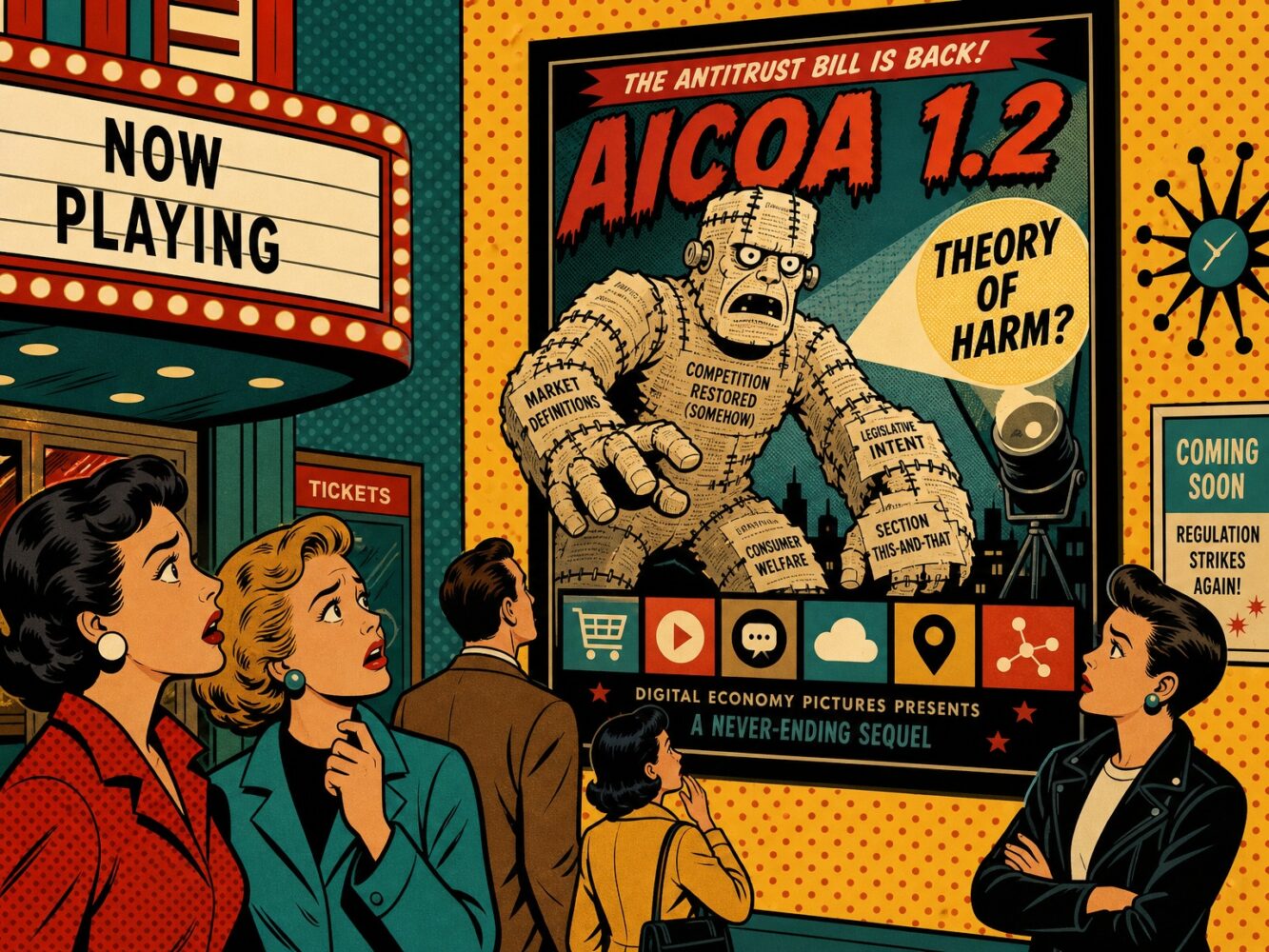
AICOA is back from the dead, and this time it has learned a few new tricks—mostly how to lower liability thresholds, raise defense burdens, and keep treating “Big Tech” as if capitalization were a theory of harm. The American Innovation and Choice Online Act has failed twice before. Its latest incarnation is not so much a fresh start as a sequel nobody ordered.
Sen. Chuck Grassley (R-Iowa) and Sen. Amy Klobuchar (D-Minn.) “introduced” AICOA last week. Co-sponsors include Sens. Dick Durbin (D-Ill.), Josh Hawley (R-Mo.), Sheldon Whitehouse (D-R.I.), and Cory Booker (D-N.J.). Here is the bill’s text, at least as introduced.
“Introduced” is technically correct as a matter of process. And, as far as I know, this precise text string has not been introduced before. But we have seen pretty darn similar bills, under the same title, from Klobuchar before. AICOA appeared as S. 2992 in the 117th Congress (we’ll call that AICOA 1.0) and S. 2033 in the 118th Congress (AICOA 1.1). There have been changes along the way, but the essentially bad idea remains, in essence, bad.
I don’t know whether AICOA 1.2’s bite at the apple will lead to anything more than the others did. There’s rather a lot going on, and I think I read something about an election to be held in November of this year. My best guess is that this version, too, will not pass.
Then again, I lack a crystal ball. And there is bipartisan interest—not least among populists on the right and the left—in doing something to the sector. So I’m less sanguine about all this than I’d like to be. Is the third time the curse?
Same Same But Different, And Not Better
My International Center for Law & Economics (ICLE) colleague Geoffrey Manne has a helpful initial summary under the equally helpful title, “Revised AICOA Doubles Down on Flawed Antitrust Shortcut.” Manne’s top-level observation is this:
The latest version of [AICOA] fails to fix the bill’s central legal and economic flaws—and in several ways makes them worse.
That seems right, as do Manne’s more specific objections:
AICOA’s economic assumptions remain flawed. The bill treats vertical integration, self-preferencing, and default settings as suspect, even though those practices often make products better, safer, and easier to use. …
It lowers the competition-harm threshold to anything above de minimis. …
[It] raises the burden for key safety, privacy, and security defenses. …
The bill also replaces the earlier enforcement-guidelines process with expedited litigation provisions that direct courts to prioritize these cases and seek final judgment within one year. …
While the bill lowers the maximum civil penalty from 15% to 10% of U.S. revenue during the violation period, it adds a 1% floor once penalties are imposed. That is not leniency . . . It is a new floor for enormous fines, even in close cases involving unsettled legal questions. …
To that I’d add, among other things, a basic “big is bad” assumption lifted straight from the neo-Brandeisian playbook. See, for example, Tim Wu’s “The Curse of Bigness” and, for one possible if counterproductive implementation, the European Union’s Digital Markets Act.
Analyses of AICOA 1.0 and AICOA 1.1 remain unfortunately relevant. Geoff’s list of prior ICLE scholarship is therefore useful as a current resource:
Many of our concerns were widely shared. Reviewing AICOA 1.0—the version from the 117th Congress—in the Michigan Technology Law Review, Herbert Hovenkamp summarized his view neatly: “AICOA was a bill that deserved to die.”
His concerns were many, and familiar. Noting AICOA’s general hostility to self-preferencing—when a firm favors its own products or services on its own platform—Hovenkamp observed that “[s]elf-preferencing is an essential tool of competition, which has never imposed a requirement that people must sell other people’s merchandise.” He also objected that AICOA’s prohibitions applied “to products and services over which the seller has little or no market power. As a result, its substantive requirements are egregiously mistargeted.”
Hovenkamp also anticipated that AICOA’s “gatekeeper” approach to competition policy would resurface—as indeed it has—despite the bill’s failure to gain traction in the 2021-2022 session:
The issue … will almost certainly be considered again by Congress. When it does so, the “gatekeeper” approach to competition policy should be abandoned. It is too narrow because it ignores the conduct of firms that are not designated as gatekeepers, including offline sellers who are not included no matter what their size. It is too broad because it overreaches, perhaps egregiously, to condemn competitively harmless conduct by firms defined as gatekeepers.
That was hardly a defense of the antitrust status quo. To the contrary, Hovenkamp suggested that “[u]nderenforcement is a serious problem.” Set aside debates about the degree or locus of such problems. Hovenkamp recognized AICOA’s fundamental flaws as a vehicle for competition-policy reform—one with consequences likely, in some cases, to be unpredictable and, in others, “just plain bad.”
Similarly, New York University’s Daniel Francis presented testimony on AICOA 1.1 before the Senate Judiciary Subcommittee on Competition Policy, Antitrust, and Consumer Protection in 2023. Francis, a former deputy director in the Federal Trade Commission’s (FTC) Bureau of Competition, also advocated antitrust reform and, not incidentally, increased funding for the federal antitrust-enforcement agencies. At the same time, like Hovenkamp, he was crystal clear that he did not “recommend enacting AICOA.”
His detailed critique—more than 80 pages of his testimony focused on AICOA—covered ground that should be familiar to readers of Truth on the Market. For example, sections of his testimony carried subheadings identifying several problems with AICOA’s approach to self-preferencing:
‘Self-Preferencing’ Includes Many Desirable Practices
Banning Self-Preferencing Would Inflict Consumer Harms
A Ban Would Deter Product Improvements
A Ban Would Deter Platforms from Protecting Consumers
A Ban Would Challenge Some Free-to-Use, Ad-Supported Services
A Ban Would Threaten Closed Ecosystems
Francis also argued that AICOA’s scope appears arbitrary. And he raised concerns about the bill’s limits on data use, its access and interoperability requirements, and its “no-conditioning rule.” On the latter, he noted that the “provision amounts to a per se rule against technological product tying of a kind that modern antitrust has long—and very wisely—left behind.”
AICOA’s Vertical Leap of Faith
Part of what’s striking about the new AICOA is how many deeply flawed assumptions it retains from versions that failed to gain traction in earlier Congresses. Part of what’s also striking is how arbitrary some of its departures from the alpha and beta test versions appear to be.
For example, the new AICOA’s general hostility to vertical integration, self-preferencing, and default settings is not new. Neither are its interoperability and data-portability requirements. Interoperability means designing a system so that it can interoperate–at the least, exchange data–with other systems; data portability means enabling users to move “their” data from one service or platform to another. Both can be useful. But the decades-long push to encourage, and now require, interoperability in electronic medical systems is an object lesson in potentially confounding factors, even in a context where there are clear policy benefits to interoperability and there is public funding behind its development. Mandatory interoperability and data portability restrictions can prove costly, risky, or counterproductive, as can other data restrictions contemplated by AICOA. They do not even guarantee the effective flow of information, much less competitive benefits.
Each of these issues could warrant a much longer critique. For more—much more—on self-preferencing, I’ll simply steer readers to ICLE’s Issue Spotlight on “The Case for Self-Preferencing,” with work from ICLE scholars, academic affiliates, and others.
As a related matter, we’ve had quite a bit to say about vertical integration, but the basic point starts with the Supreme Court’s stepwise recognition—from Continental T.V. Inc. v. GTE Sylvania Inc. in 1977, which rejected per se liability for vertical nonprice restraints, through Leegin Creative Leather Products Inc. v. PSKS Inc. in 2007, which rejected per se liability for vertical price restraints—that vertical integration is not generally anticompetitive, even if it can prove anticompetitive under particular facts and circumstances.
Directionally, at least, that trend in antitrust law has followed the economic literature. For example, James C. Cooper, Luke M. Froeb, Dan O’Brien, and Michael G. Vita reviewed the theoretical and empirical literature on vertical integration and vertical restraints and found “a paucity of support for the proposition that vertical restraints/vertical integration are likely to harm consumers.” They recognize that harm is possible—that is, the welfare effects of vertical integration are theoretically ambiguous—and argue that empirical evidence is therefore critical to sound competition policy. Their review of that empirical literature “suggests that vertical restraints are likely to be benign or welfare enhancing.”
Similarly, Francine Lafontaine and Margaret Slade reviewed the literature on exclusive contracts and vertical restraints and found that, when firms adopt vertical restraints, they typically improve product quality and service, benefiting consumers as well as producers.
The point is not that vertical restraints should be per se lawful. They remain subject to antitrust scrutiny under the rule of reason—the fact-specific legal test courts typically use to weigh competitive harms against benefits. Rather, as Cooper et al. observe, novel legal presumptions against vertical restraints are likely to produce too many false positives: condemning conduct that is actually benign or beneficial. Nothing in the literature, or in the “fact sheet” accompanying AICOA, suggests that the bill’s vertical restrictions will fare any better.
What’s New? The Target—and the Hammer
So what’s at least somewhat new? Start with the target: Which firms would be subject to the AICOA’s restrictions?
The bill’s reach has been somewhat redrawn, although AICOA 1.2 retains the big-tech-is-bad approach of versions 1.0 and 1.1. It keeps the DMA-style “gatekeeper” model Hovenkamp criticized in assessing AICOA 1.0, along with the scope restrictions Francis found arbitrary in his testimony on AICOA 1.1.
The new target is any “systemically important platform,” along with the firms that own or operate such platforms—or that hold, control, or benefit from at least a 25% share of them. It’s still Big Tech, but with a somewhat different metric for “big.”
Under the bill, “big” turns partly on the scale of the parent or “operator”—the firm that owns or controls the online platform. AICOA targets firms with “average annual gross revenues of not less than $175,000,000,000,” as adjusted. It also turns on the platform’s popularity: “monthly active users in the United States equal to not less than 34 percent of the population of the United States over the age of 12, as determined by the most recent decennial census of population conducted by the Bureau of the Census.” Alternatively, the bill reaches platforms with monthly subscriptions held by the same percentage of U.S. households.
To be sure, the revenue number is large. So is the monthly-active-user threshold. The most recent decennial census was conducted in 2020. It found roughly 280 million people over age 12. Multiply that by 0.34, and the threshold comes out to about 95.2 million monthly users.
That is not just the GAFAM firms—Google, Apple, Facebook, Amazon, and Microsoft—and their platforms. Walmart and others would seem to fit the bill. Still, AICOA would reach a relatively small number of firms that operate online platforms.
But why gross revenue? More broadly, why these large firms and these restrictions? Once again, there is no good answer—or even an intelligible one. Certainly, and consistent with earlier versions of AICOA, there is no market-power or monopoly-power requirement for any product or service market.
Another new wrinkle is the bill’s civil-penalty provision:
to be deposited in the Treasury of the United States, in an amount not greater than 10 percent, and not less than 1 percent, of the total United States revenue of the person for the period during which the violation occurred.
That is 10% of revenue, not any measure of profits. And it is the revenue of the parent firm, not the “systemically important platform” itself. The 1% floor is still revenue, and it is still the parent firm’s revenue. As Manne says, that is “a new floor for enormous fines, even in close cases involving unsettled legal questions.”
More than that, the bill contemplates civil penalties wholly untethered from any assessment of the harm supposedly caused by the prohibited conduct. Out the window goes the possibility of efficient remedies—that is, remedies that force firms to internalize the harms they cause and thereby give them incentives to avoid causing such harms in the future.
Instead, we get runaway penalties that might be appropriate for unequivocally harmful conduct, where courts and enforcers have little concern about overdeterrence or penalties that ultimately do more harm than good to competition and consumers. That is not the world we are in here. None of this is about unequivocally harmful conduct. Compare and contrast, for example, Steven Shavell with Louis Kaplow and Robert Cooter.
What of Manne’s twin complaints that AICOA “lowers the competition-harm threshold to anything above de minimis,” while increasing “the burden for key safety, privacy, and security defenses”? The first objection is lifted straight from the bill’s text. Key provisions—such as the self-preferencing provision—address conduct that “would materially harm competition.” And the definitions section sharpens the point: Under AICOA, “materially harms competition” means “any actual or reasonable risk of lessening competition or impairing the competitive process that is more than a de minimis amount.”
Couple that very low bar with AICOA’s burdens on defendants seeking to establish an affirmative defense after the government pleads any risk of anything more than de minimis harm. For the prohibitions on “preferencing, limiting, and discrimination,” a defendant must show, by “clear and convincing evidence,” that the conduct was necessary either to comply with federal or state law or to “protect safety, user privacy, the security of nonpublic data or of the platform, or any other significant cybersecurity risk, or to prevent fraud or spam.” The defendant must also show that the conduct was “narrowly tailored in scope” and “could not be achieved through less anticompetitive means.”
How are we to read “less anticompetitive means” against a standard triggered by any risk of anything more than a de minimis amount of harm?
What’s more, any such affirmative defense would rely on the defendant’s production of ordinary-course documents that:
i. describe the specific purpose for which the conduct was undertaken; and
ii. identify the material risks or harms the conduct was intended to address.
For other prohibitions in the bill, the defendant would have to establish, “by a preponderance of the evidence that the conduct has not materially harmed and would not materially harm competition.” But again, material harm to competition means “any actual or reasonable risk of lessening competition or impairing the competitive process that is more than a de minimis amount.”
These are not minor adjustments to the rule-of-reason scrutiny typically applied to allegedly anticompetitive restraints, and especially to vertical restraints alleged to violate Section 2 of the Sherman Act, at least since the Supreme Court’s 1977 decision in Continental T.V. Inc. v. GTE Sylvania Inc.
Rather, for conduct likely to be procompetitive or benign, AICOA presumes illegality—setting the plaintiff’s burden very close to ground level. It then shifts the burden to the defendant, where the bill’s sponsors seem to have in mind “ain’t no mountain high enough”—a ’60s classic, to be sure, but not a theory of harm to competition or consumers.
Third Time’s No Charm
The sponsors of AICOA 1.2 seem to have made at least a passing attempt to revise the details of versions 1.0 and 1.1. What drove those editorial choices is anyone’s guess. The key faults remain, and where the bill does change, it is hard to see a net improvement.
This version flunks the “no economic sense” test, just like the last one, and just like the one before that. Herbert Hovenkamp said that “AICOA [1.0] was a bill that deserved to die.” That assessment was strict but fair. Entirely fair.
So, with apologies to Sens. Klobuchar and Grassley: This one, too, deserves to die. Third time’s no charm.
