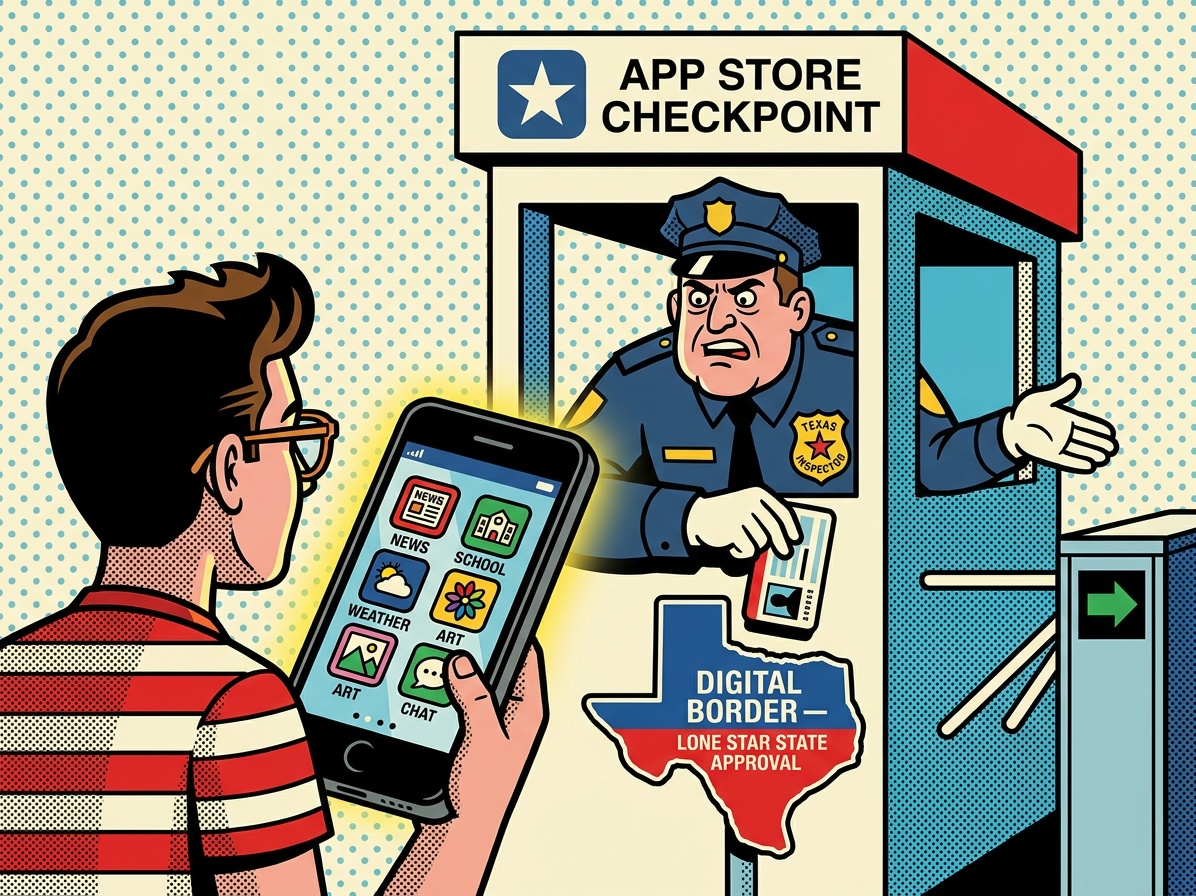
Smartphones are no longer just phones. For kids, they are libraries, newspapers, classrooms, cameras, maps, town squares, and, yes, bottomless distraction machines. Texas Senate Bill 2420 treats access to all of it as something that should first pass through a state-mandated checkpoint.
Also known as the App Store Accountability Act, SB 2420 is currently facing a major constitutional challenge before the 5th U.S. Circuit Court of Appeals. The consolidated cases—Students Engaged in Advancing Texas (SEAT) v. Paxton and Computer & Communications Industry Association (CCIA) v. Paxton—pit challengers against Texas Attorney General Ken Paxton and place the intersection of free speech and government regulation of technology platforms squarely before the court.
SB 2420 requires app stores to verify the age of every user and mandates that minors obtain individualized parental consent before downloading or purchasing any app.
Texas argues that the law merely strengthens parental authority. The U.S. District Court for the Western District of Texas was unconvinced. As the district court explained:
The Act is akin to a law that would require every bookstore to verify the age of every customer at the door, and for minors, require parental consent before the child or teen could enter and again when they try to purchase a book.
The case is now on appeal before the 5th Circuit. The International Center for Law & Economics (ICLE) filed an amicus brief supporting the plaintiffs and arguing that SB 2420 violates the First Amendment. The brief’s distinctive contribution is to connect First Amendment doctrine with an underlying law & economics framework, building on my prior ICLE issue brief, “A Coasean Analysis of Online Age-Verification and Parental-Consent Regimes,” as well as several earlier Truth on the Market posts examining app-store age-verification requirements.
The Wrong Gatekeeper
ICLE’s brief centers on the concept of the “least-cost avoider.” In law & economics, the principle holds that liability should generally fall on the party best positioned to prevent harm at the lowest overall social cost. As I have noted elsewhere:
From the perspective of law & economics, the most important question in disputes such as these is to identify the lowest-cost avoider of harms, while bearing in mind relevant transaction costs. It is not necessarily the case that the answer is always the user. It could be that online intermediaries are best-positioned to monitor and control harms to those users. But among the relevant social costs we must consider in this example is the risk of collateral censorship.
That risk is central to SB 2420. When the law makes app stores responsible for preventing potential harms to minors, it creates powerful incentives to overrestrict access to lawful content. To avoid liability, app stores must erect broad age-verification and parental-consent barriers around vast amounts of harmless, educational, and expressive material. The result is collateral censorship: protected speech becomes harder to access, not because it is harmful, but because platforms seek to avoid legal risk.
App stores are poorly positioned to make these judgments. Requiring them to police every download and purchase imposes substantial economic friction while restricting access to First Amendment-protected expression.
Under SB 2420, minors cannot access a large swath of the modern marketplace of ideas without first obtaining a government-mandated digital permission slip. A minor could be blocked from freely accessing:
- Current events through The New York Times app;
- Local weather information through The Weather Channel app;
- Vocabulary definitions through the Merriam-Webster Dictionary app;
- Scripture through the YouVersion Bible app; or
- Educational and creative content on platforms such as YouTube and Instagram.
Yet the Supreme Court has repeatedly recognized that minors enjoy substantial First Amendment protections. The government lacks a “free-floating power” to dictate which ideas children may encounter. SB 2420 nevertheless places state-mandated barriers between minors and a wide range of constitutionally protected speech.
Parents and minors, by contrast, are often the true least-cost avoiders. They already have access to voluntary tools—including content filters, parental controls, and built-in app-blocking features—that allow families to tailor restrictions to their own preferences and circumstances. That reality also aligns with a core principle of First Amendment doctrine: when less restrictive alternatives exist, the government cannot justify burdening protected speech with broad, one-size-fits-all regulations.
Calling Speech a Contract Doesn’t Make It One
On appeal, Texas has tried to minimize the First Amendment issues by recasting SB 2420 as a mere contract regulation. Because app stores require users to accept terms of service and often monetize user data, the state argues that it may freely regulate a minor’s ability to enter those arrangements.
The 5th Circuit accepted a version of that argument when it stayed the district court’s preliminary injunction, treating the law as a regulation of “commercial speech” and subjecting it to the less demanding standard of intermediate scrutiny.
Federal courts around the country, however, have repeatedly rejected similar arguments. As ICLE’s brief explains, there are at least two reasons why.
First, speech does not lose First Amendment protection simply because someone earns money from it. A bookstore does not forfeit its constitutional rights because it sells books for profit, and an app store is no different. The Supreme Court has long recognized that entities engaged in expressive activity retain First Amendment protection even when they operate as businesses.
Second, any commercial aspects of app-store transactions are “inextricably intertwined” with fully protected speech. App stores are multi-sided platforms that connect developers and users. Many apps are offered for free or at reduced cost because developers and platforms rely on advertising revenue generated through user data. The economic transaction and the dissemination of speech are therefore inseparable.
For that reason, SB 2420 cannot be treated as a simple commercial regulation. Because the law restricts access to fully protected speech based on content, the district court correctly concluded that it must satisfy strict scrutiny—the most demanding standard of constitutional review.
Parental Controls, Not State Controls
To survive strict scrutiny, a law must be the least restrictive means of advancing a compelling government interest. Even assuming the state has a compelling interest in protecting minors from potentially harmful content, SB 2420 fails that test because it is both overinclusive and underinclusive.
The law is overinclusive because it restricts access to vast amounts of harmless, First Amendment-protected speech. It also forces minors—and adults who value their privacy—to surrender sensitive age-verification information merely to use an app store. For many apps, parents would likely have no objection to a download. Yet in a world with real transaction costs, requiring parental approval for every app and purchase means some speech will inevitably be restricted regardless of parental preferences.
At the same time, the law is underinclusive. A minor can bypass the app store entirely by opening a pre-installed browser such as Safari or Chrome and accessing the same allegedly harmful content directly on the web.
SB 2420 fares no better under intermediate scrutiny. The law burdens substantially more speech than necessary to achieve its stated objectives. There is no sound basis for restricting access to speech across every app simply because a small subset of apps may contain objectionable content.
Helping parents protect their children online is a legitimate and worthwhile goal. The problem is that Texas chose one of the most speech-restrictive ways to pursue it. Parents already have access to voluntary tools, including content filters, parental controls, and app blockers. Market demand has given app stores strong incentives to provide those tools, and families remain free to use them as they see fit.
The 5th Circuit should affirm the preliminary injunction. The First Amendment problem with SB 2420 is not that it seeks to protect children. It is that they try to accomplish that goal using the wrong gatekeeper. The least-cost avoiders are parents and minors—not the app stores that stand between them and the modern marketplace of ideas.