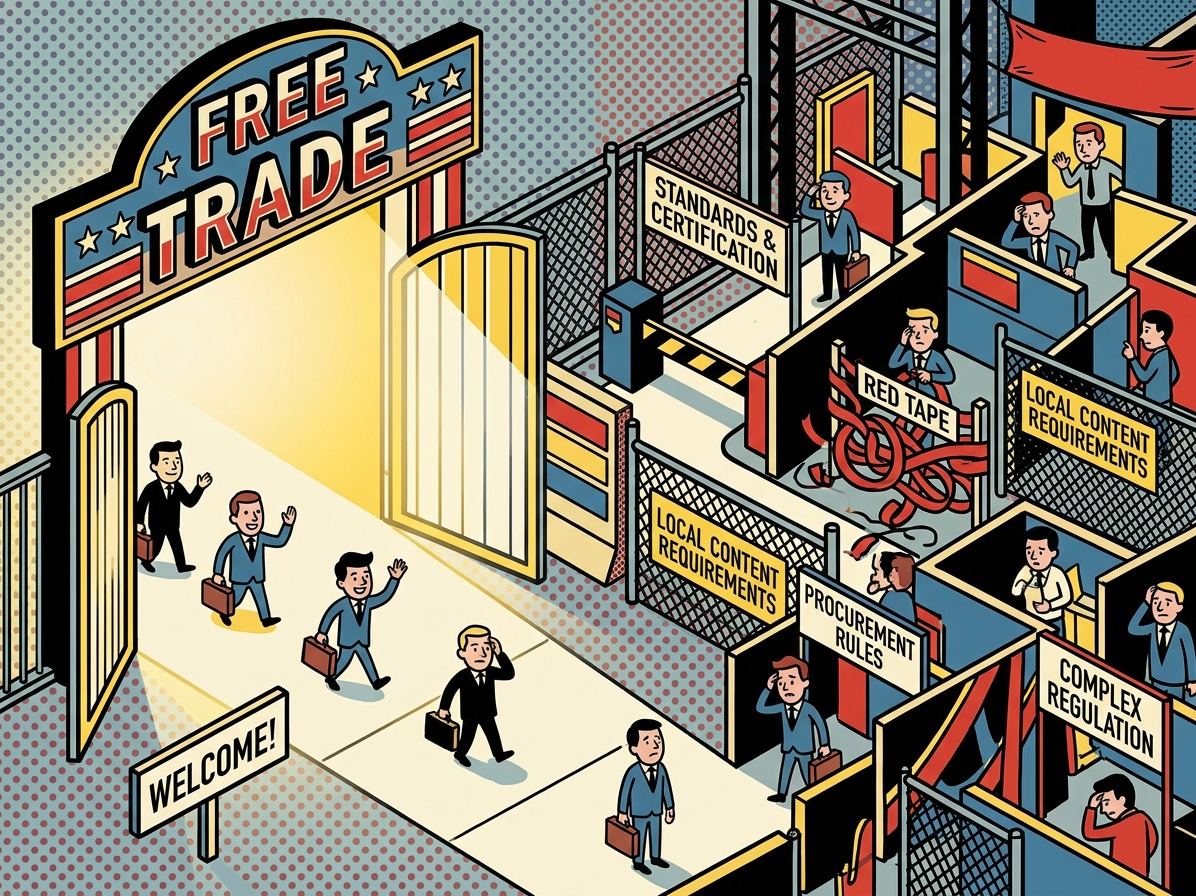
Not all trade barriers are created equal. The ones that matter most do not sit at the border. They sit inside markets, shaping who can compete—and who cannot—before competition even begins.
The recently released 2026 National Trade Estimate Report on Foreign Trade Barriers (NTE) catalogs foreign barriers to U.S. exports, foreign direct investment, and electronic commerce, country by country. It is a long document, and it invites a superficial reading as a grab bag of discrete complaints.
That reading misses the point. Some barriers frustrate but remain manageable. Others matter more. They reshape entire markets, steering outcomes away from competition on the merits. Those are the barriers the United States should prioritize. They impose the greatest economic costs and offer the greatest gains if negotiated away.
This is where Shanker Singham’s framework for anticompetitive market distortions (ACMDs) proves useful. The problem is not simply that governments block imports at the border. It is that they skew domestic markets through favoritism, discriminatory regulation, weak property-rights protections, or state-backed commercial privilege. In Singham’s Growth Commission white paper, ACMDs fall into three pillars: domestic competition, international competition, and property rights.
This post applies Singham’s framework to five major jurisdictions—China, the European Union, India, Indonesia, and Mexico—where ACMDs documented in the NTE impose significant economic harm.
Three Ways to Tilt a Market
The domestic-competition pillar asks a basic question: do firms compete on the merits, or do governments tilt the field through favoritism, incumbent protection, or directed allocation of capital and demand?
The international-competition pillar asks whether foreign firms can compete on reasonably equal terms. Localization rules, discriminatory standards, procurement preferences, and similar measures often push them to the sidelines.
The property-rights pillar asks whether firms can rely on secure legal protection for intellectual property, data, contracts, and investment-backed expectations.
This framework helps distinguish ordinary trade frictions from true market-rigging. A tariff can impose costs without reshaping the competitive order. By contrast, rules that channel procurement to politically favored firms, force technology transfer, or grant regulatory privileges to state-owned enterprises operate differently. They decide winners before competition even begins.
Viewed through this lens, the NTE reveals a clear hierarchy across the five jurisdictions at issue: China, the European Union, India, Indonesia, and Mexico.
China presents the most extensive and systematic ACMD problem. Mexico may pose the most urgent near-term negotiating challenge, because its distortions directly affect North American integration. India and Indonesia both exhibit significant issues with localization, standards, and state intervention.
The European Union differs in form. Many of its measures take the shape of facially neutral regulations. Still, certain digital and standards rules function like ACMDs. They burden foreign firms asymmetrically and, in some cases, weaken property-rights security.
China: When the Whole System Tilts the Field
China remains the easiest case analytically. The NTE’s China chapter describes an economy where industrial planning, state ownership, procurement favoritism, standards policy, and administrative discretion work in concert to advantage domestic firms and sideline foreign rivals. This is not marginal protectionism. It is a competitive system organized around state preference.
The report highlights extensive industrial plans aimed at securing dominance in targeted sectors, continued reinforcement of state-owned enterprises, procurement and tendering practices that favor Chinese-owned or Chinese-controlled firms, and standards processes that limit meaningful foreign participation.
Each of these maps directly onto the ACMD framework. They distort domestic competition by shielding favored firms from rivalry. They distort international competition by denying outsiders equal access. And in some cases, they threaten property rights by weakening the security of technology, know-how, and contract expectations.
China’s scale amplifies the problem. The NTE reports that China remained the third-largest U.S. goods export market in 2025, with $106.3 billion in exports and $414.7 billion in total bilateral goods trade. In a market that large, discriminatory procurement, subsidy-linked overcapacity, and standards favoritism do more than shave off export sales. They shape global supply chains and undercut U.S. firms in third-country markets.
If the United States aims to target the most consequential structural barriers to export growth, China remains the central long-run focus. The challenge is obvious. China’s ACMDs are not discrete policies. They sit at the core of a state-led competition model. That makes them difficult to negotiate away incrementally—and too consequential to ignore.
Mexico: Close to Home, Closer to the Problem
Mexico presents a different picture. It is not a state-capitalist system in the Chinese mold. But in one critical sector—energy—the NTE’s Mexico chapter identifies a serious ACMD problem. Recent constitutional and statutory reforms aim to restore the primacy of state-owned electricity and hydrocarbons firms, Comisión Federal de Electricidad (CFE) and Petróleos Mexicanos (PEMEX), while limiting private participation.
That shift matters. Under an ACMD analysis, Mexico’s energy policy plainly distorts domestic competition. The government is not just regulating the market; it is structuring it to favor its own firms. When the legal framework guarantees CFE a dominant position, prefers it in mixed-investment arrangements, and imposes regulatory burdens on private actors that do not apply in the same way to PEMEX, the state is tilting outcomes by design.
This helps explain why Mexico may warrant the highest short-run negotiating priority. The NTE reports that Mexico was the largest U.S. goods export market in 2025, with $338 billion in exports and $872.8 billion in total bilateral goods trade. Unlike China, these distortions operate within the North American production system and inside the institutional framework of the United States-Mexico-Canada Agreement (USMCA). That makes the economic costs more immediate and the legal tools for negotiation and enforcement more concrete.
The NTE also flags new procurement preferences in the medical-products sector. These rules award extra points to firms that invest in Mexico’s domestic production chain. The scale is smaller than in energy, but the logic is the same. Government demand is being used to privilege local investment and production over best-value competition.
India: Standards as Gatekeepers, Not Just Safeguards
India’s ACMD profile is more mixed, but still substantial. The NTE’s India chapter highlights an extensive set of Quality Control Orders (QCOs) that make Indian standards mandatory across a wide range of products and inputs.
Standards can serve legitimate public goals. But when regulators roll them out opaquely, without consistent notice, and without alignment to international norms, they can operate as market-screening tools. They favor firms already embedded in the domestic compliance system.
That is why India’s QCO regime is more than a technical-barriers issue. It can distort international competition by raising entry costs for foreign producers—especially where certification, testing, and licensing processes are slow, discretionary, or nontransparent.
India’s pharmaceutical and agricultural policies reinforce the ACMD diagnosis. The NTE reports that the Ayushman Bharat program, which covers more than 700 million people, does not reimburse patented medicines. That sharply limits the practical reach of innovative drug suppliers in one of the world’s largest health care markets.
Agriculture shows a similar pattern. Public stockholding and support-price policies distort domestic production and can spill into global markets.
For U.S. negotiators, India is not just a tariff story. It is a behind-the-border competitiveness problem. The goal should not be limited to trimming tariff lines. It should focus on more open standards governance, more neutral reimbursement and procurement policies, and less trade-distorting state support.
Indonesia: Local Content, Global Consequences
Indonesia may be the cleanest textbook case after China. The NTE’s Indonesia chapter details local-content requirements across sectors such as telecommunications, oil and gas, and electricity infrastructure. These are classic ACMDs. They do not merely raise import costs. They require firms to source, hire, or manufacture locally in ways that displace competition on the merits.
Indonesia also relies on export restrictions and domestic-market obligations to advantage preferred downstream users. The NTE notes export prohibitions or restrictions on certain raw materials, along with energy-sector rules that require a share of production to be sold domestically at discounted prices. This goes beyond a conventional trade barrier. It is a direct intervention in input markets that shifts rents toward favored domestic interests.
Indonesia’s market is smaller for the United States than China, the European Union, India, or Mexico. But the distortions are not trivial. When a government leans heavily on localization and domestic-market mandates, even a mid-sized market becomes a high-value target for structural reform.
Recent U.S.-Indonesia trade understandings, as described in the NTE, may deliver incremental improvements. They do not alter the underlying diagnosis.
The EU: Neutral Rules, Uneven Effects
The European Union stands apart from the rest. Many of its barriers do not look like classic cronyism or state capitalism. They emerge from large regulatory programs, often justified in terms of privacy, safety, fairness, or environmental protection. But an ACMD analysis does not end with stated intent. It asks how those rules operate in practice.
That lens brings the EU’s digital regulations into focus. The NTE’s EU discussion notes that the Digital Markets Act’s thresholds capture predominantly U.S. firms, while the Digital Services Act, Artificial Intelligence Act, and Data Act impose extensive obligations affecting trade secrets, training data, proprietary business information, and cross-border data use. The issue is not that the EU regulates digital markets. It is whether those rules systematically burden a concentrated group of foreign firms and weaken the security of legally protected assets.
The EU’s product and sustainability rules raise similar concerns. The NTE criticizes the timing and quality of EU notifications and argues that some measures rely too heavily on EU-specific standards or due-diligence requirements that do not track risk well. When access to a trillion-dollar market depends on navigating uniquely European compliance systems—systems foreign firms have limited ability to shape or challenge—those measures can function as ACMDs, even if they arrive dressed as neutral regulation.
Still, the EU calls for a targeted, not polemical, response. The Office of the United States Trade Representative’s (USTR) EU trade summary underscores the scale of the transatlantic relationship. That makes prioritization essential. The focus should remain on the rules that matter most—digital regulation, standards alignment, and protection of trade secrets—rather than treating the EU model as equivalent to China’s.
From Tariff Tallies to Market Reality
One virtue of the ACMD framework is that it moves the analysis beyond static lost-export estimates. The NTE acknowledges the limits of those estimates. They rest on contestable assumptions and do not aggregate cleanly across sectors. Singham’s three-pillar approach offers a broader lens: how much a given distortion suppresses domestic rivalry, blocks foreign contestability, or weakens property-rights security.
In practice, U.S. analysts could score major barriers along several dimensions—by pillar, by sectoral breadth, and by the degree of favoritism toward domestic or state-backed firms. They could then link those scores to the Growth Commission framework, which predicts that reducing ACMDs should boost productivity and GDP per capita by strengthening market contestability and the returns to investment and innovation.
This exercise would not produce a single, definitive number. But it would do something more useful. It would help negotiators separate the visible barriers from the ones that actually matter.
Picking the Right Fights in Trade Policy
If the United States wants to prioritize trade negotiations intelligently, the 2026 NTE points to a clear ordering. China remains the largest systemic ACMD challenge. Mexico may present the most urgent practical case, as energy favoritism cuts directly into North American integration. India warrants sustained attention for standards, reimbursement, and subsidy distortions. Indonesia remains a textbook localization problem. And the European Union calls for a narrower—but still consequential—strategy focused on digital regulation and standards. The approach to other jurisdictions should likewise turn on the nature of their ACMDs, as documented in the NTE.
That is the payoff of the ACMD lens. The most consequential barriers are rarely the most visible tariffs. They are the behind-the-border rules that determine, ex ante, who can compete and on what terms.
U.S. negotiators should also consider how to create leverage. One option is to use tariffs to press trading partners to reduce their ACMDs (see here, here, and here). Another is to lead by example. The United States can point to its own efforts to reduce ACMDs by dismantling anticompetitive regulations, as outlined in President Donald Trump’s April 2025 Executive Order on Reducing Anti-Competitive Regulatory Barriers.
A mutually agreed reduction in ACMDs—paired with tariff cuts—offers a genuine win-win. It would not just expand trade flows. It would generate dynamic gains in productivity, investment, and growth across the global economy.
