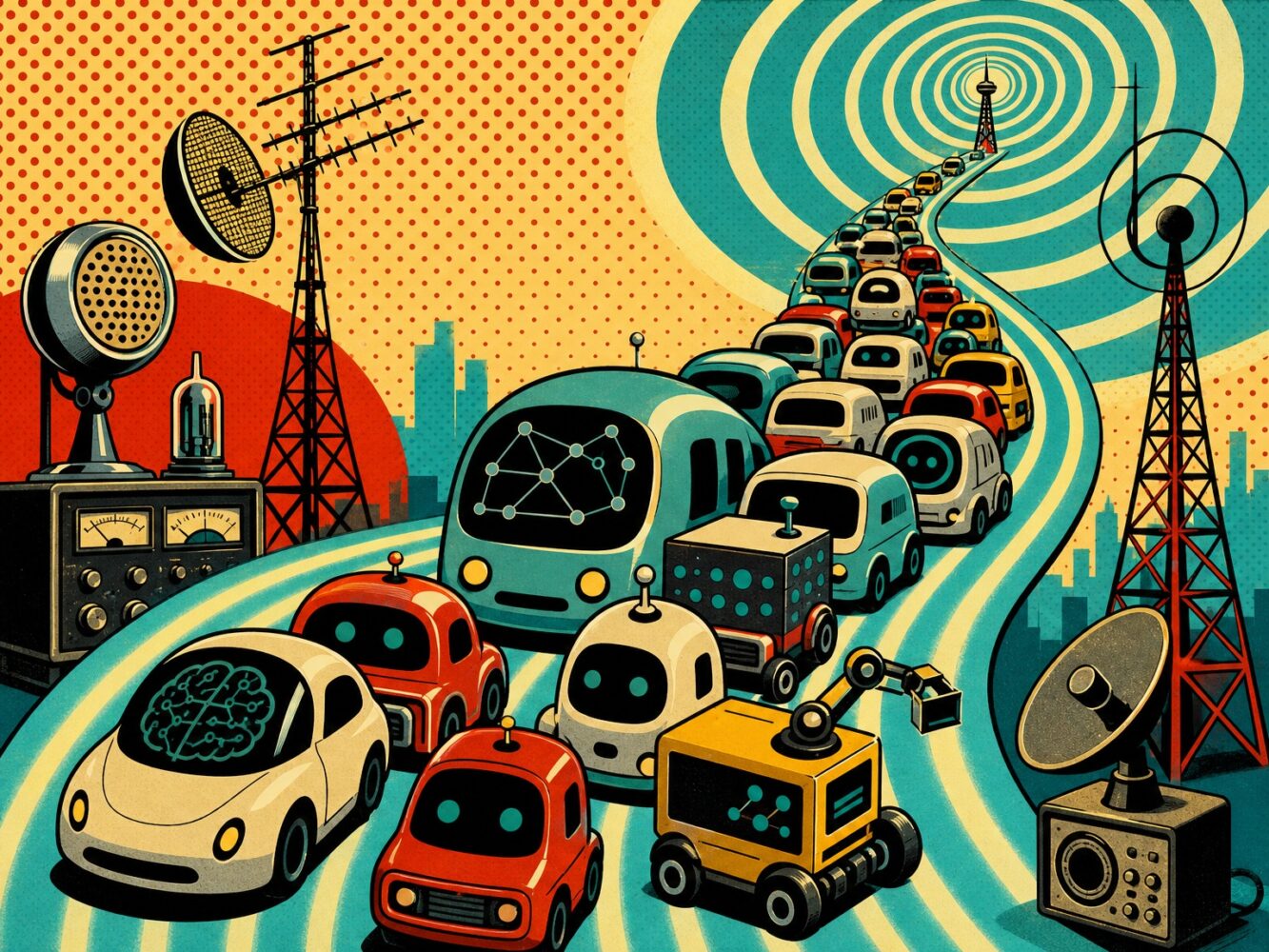
AI may live in the cloud, but the cloud still needs roads. Those roads are communications networks—and the airwaves they depend on may determine how far and fast the AI boom can travel.
That two-way relationship will take center stage tomorrow, when the U.S. Senate Commerce Subcommittee on Telecommunications and Media holds a hearing titled “Intelligent Networks: Powering Artificial Intelligence and Transforming Communications.” Networks carry the traffic AI generates, while AI is beginning to reshape how those networks are built, managed, and shared.
The hearing will likely cover the familiar ground of investment, deployment, and network architecture. Those questions matter. But each rests on a more basic input that rarely gets equal billing: radio spectrum.
A new International Center for Law & Economics (ICLE) issue brief examines that overlooked foundation in detail. It is the second installment in ICLE’s series on the infrastructure underpinning the next race for AI leadership.
The Airwaves Won’t Manage Themselves
Every wireless service depends on reliable access to radio frequencies where competing signals do not cause harmful interference. Spectrum is not scarce in the ordinary sense; nature does not issue a fixed number of frequencies and then close the shop. But physics limits how much data can travel over a given band, and the law limits who may use particular frequencies and under what conditions.
Those constraints shape the performance of every wireless service. That makes spectrum policy a critical part of infrastructure policy for AI and other next-generation applications.
Meeting growing data demand does not require tearing down the spectrum-management system and starting over. It does require targeted reforms. Policymakers should preserve a balanced mix of licensed, unlicensed, and shared access to meet the differing needs of AI, augmented reality (AR), and virtual reality (VR).
They should also move underused federal spectrum into commercial use more quickly by streamlining the cumbersome Spectrum Relocation Fund, improve coordination between the Federal Communications Commission (FCC) and National Telecommunications and Information Administration (NTIA) around a common technical record, and engage more coherently in the international bodies that shape global equipment markets.
Most promising for a hearing on intelligent networks, policymakers should replace reflexive worst-case interference analysis with risk-informed methods. AI can help here, too. Tools such as spectrum digital twins—virtual models that simulate how networks and signals interact—can estimate interference more realistically and allow more users to share the same frequencies safely.
New Technologies Need More Than One Lane
AI, AR, and VR will all increase the load on wireless networks, but they will not place the same demands on them. Immersive AR and VR require sustained capacity and extremely low latency—the delay between a user moving her head and seeing the image respond. AI traffic tends to arrive in bursts and, unlike most consumer applications today, can strain upload capacity as well as download capacity. No single frequency band or access model can meet all those needs.
That makes a layered approach essential. Low-band spectrum travels long distances and penetrates buildings well, but it carries relatively little data. Mid-band spectrum offers a useful balance of coverage and capacity, making it the workhorse for wide-area AR and cloud-rendered VR. The unlicensed 6 GHz band is a natural fit for immersive traffic that remains indoors and travels only short distances. Millimeter-wave spectrum can deliver enormous capacity in dense venues and campuses. Low-Earth-orbit (LEO) satellites add another layer by reaching places that terrestrial networks cannot.
The rules governing access matter as much as the frequencies themselves. Exclusive licenses give carriers the interference protection and certainty needed to justify billions of dollars in network investment. Unlicensed spectrum provides the permissionless, low-cost capacity that supports Wi-Fi and a connected-device market that generates trillions of dollars in annual value. Dynamic sharing, which coordinates users in real time to prevent harmful interference, opens frequencies that cannot be fully cleared of existing users.
Each model serves a distinct purpose. Tilt too far toward any one of them, and policymakers will either leave valuable capacity idle or deprive some applications of the access they need.
The larger problem is that the U.S. system for making spectrum available moves at bureaucratic speed. The FCC governs commercial use, while NTIA manages federal use, and no clear final arbiter exists when they disagree. Much of the prime mid-band spectrum needed for AI and immersive applications remains assigned to federal incumbents, especially the Department of Defense (DOD).
The One Big Beautiful Bill Act restored the FCC’s auction authority and created an 800 MHz spectrum pipeline. But while Congress can set a target, it cannot force an agency to relinquish frequencies. If the federal portion of that pipeline stalls, pressure will shift to productive commercial, shared, and unlicensed bands—including the 6 GHz band and the Citizens Broadband Radio Service (CBRS), which Congress declined to protect.
A hearing about powering AI should therefore ask a basic question: Can the reallocation process actually deliver the spectrum these applications will need?
AI Can Help Spectrum Think Smarter
AI is not just another source of network demand. It can also help networks manage competing radio operations more efficiently—and more intelligently.
Machine-learning systems can identify unused capacity, predict interference, and adjust channel access in real time. That allows secondary users to operate without disrupting incumbents, meaning users already authorized to occupy the band. Research on cognitive-radio techniques for 6G has found meaningful gains in spectral efficiency—the amount of data transmitted over a given slice of spectrum—and reductions in interference.
As these methods mature and regulators gain confidence in them, spectrum policy can move beyond the blunt question of whether one user should receive exclusive access to a band. The better question is how efficiently several users can share it.
The management gains may matter as much as the added capacity. For decades, agencies have relied on deterministic, worst-case interference analysis. These models often assume that every transmitter operates at maximum power, in the least favorable location, under the most adverse conditions, all at once. That caution imposed few costs when spectrum was lightly used. In today’s crowded bands, it can block productive entry based on scenarios that are technically possible but vanishingly unlikely—and give incumbents a potent weapon against competition.
A risk-informed approach asks better questions: What interference could occur? How likely is it? How serious would the consequences be?
AI makes that approach more practical. A spectrum digital twin—a continuously updated virtual model of a real radio environment—can run thousands of simulations using realistic combinations of device locations, power levels, and signal conditions. The result is a probabilistic assessment of interference risk, rather than a single alarming hypothetical.
The FCC already used probabilistic analysis when it opened the 6 GHz band, and the D.C. Circuit upheld that approach as a reasonable and legally defensible basis for spectrum policy. AI-driven modeling could make such analysis the rule rather than the exception. It would preserve robust protections for safety-of-life and national-security systems, where the stakes are genuinely high, while making room for new services elsewhere.
That is what an intelligent network should look like: not merely a pipe carrying AI traffic, but a system in which automated coordination, real-time sensing, and data-driven interference analysis allow more users to operate safely in the same frequencies.
Smart Networks Need Smarter Spectrum Rules
If the subcommittee wants networks capable of powering AI, it should focus on five reforms.
First, regulators should preserve a balanced mix of licensed, unlicensed, and dynamically shared spectrum, and judge allocations by their total economic value—not auction revenue alone. Second, Congress should streamline the Spectrum Relocation Fund so NTIA can study candidate bands earlier and move underused federal spectrum into commercial use faster.
Third, the FCC and NTIA should continue building a common technical record so disagreements emerge early, rather than erupting at the end of a proceeding. Fourth, regulators should make risk-informed interference analysis the default for spectrum reallocation and sharing.
Finally, the United States should present coherent positions at the International Telecommunication Union’s (ITU) World Radiocommunication Conference (WRC). That forum shapes the technical standards and global equipment markets on which future networks depend, and China increasingly treats it as an arena for strategic competition.
Clear direction from the White House will be necessary to align agencies whose missions and incentives often pull in different directions. But the central point is simple, and the July 30 hearing is well positioned to make it: Intelligent networks require intelligent spectrum policy.
Spectrum is the invisible infrastructure of the AI era. The United States cannot lead at digital speed while governing the airwaves at bureaucratic speed.