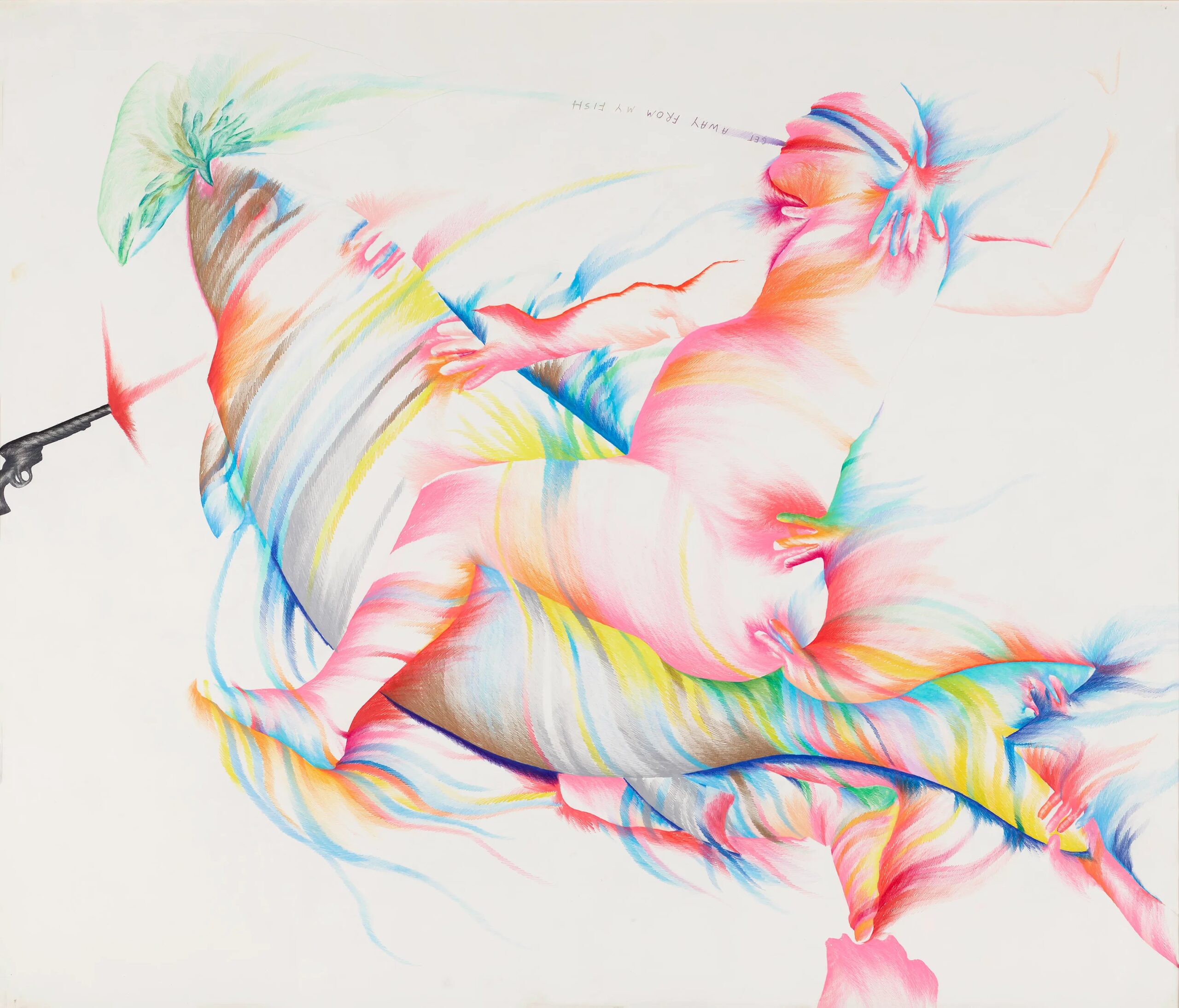
Centro Botín, an arts hub in Cantabria designed by Renzo Piano, with seaside views from the stilted structure’s corridors and platforms, has been spotlighting drawing practices since 2006. The current show, “Marisol: When Things Are Just Beginning” is the first dedicated retrospective of the Venezuelan-American artist’s drawings, featuring some 120 works spanning from 1949 to just before her death in 2016.
According to Bárbara Rodríguez Muñoz, Centro Botín’s director of exhibitions, the Spanish institution privileges “researching, presenting, and cataloguing the drawings of artists for whom drawing is fundamental to the practice—not a sketch, but a superior work—actually part of their positioning and thinking and expressing.” The Marisol show in particular foregrounds drawing as a medium by which the artist expressed both her colorful curiosity and looming anxieties. It is construed as a sampling from within her lifetime’s output; there are sketches for costumes she made for a Martha Graham performance in 1975 and outlines of her hand used to create silhouettes in the ’60s and offhanded doodles on envelopes from the 2000s. In the exhibition catalogue, curator Laura Vallés Vílchez writes of the drawings that “they are neither preparatory nor confessional, nor can they be considered marginal.”
MoMA lent two works on paper, and most of the works come from American collections. The drawing selection is custom-framed for the show and presented alongside a sprinkling of sculptures, which the catalogue qualifies as “carved and assembled wooden figures, often painted, incorporating found objects, plaster casts of [Marisol’s] own face and hands, and direct references to mass culture… hieratic figures that oscillate between caricature and idol.” There are also archival materials and several Warhol short films in which Marisol starred.

In fact, the exhibition opens with a 16mm Warhol-made film of Marisol, Women and Dog (1963-64), part of the Whitney’s collection, in which the artist stands stock-still adjacent to three shoulder-to-shoulder blocky female forms, as though an annex sculpture herself, doing nothing more than blinking for three minutes. Two other Warhol films later in the exhibition show her working in the studio on her sculptures in stop motion and, nearby, gallivanting with John Giorno and Robert Indiana as they scamper in dapper outfits, drinking, in Old Lyme, Connecticut, in 1964. Rodríguez Muñoz speculates that Warhol and Marisol “may have recognized in each other their [need for] privacy, in the fact that they were both shy people.” Marisol by reputation was characterized as being extremely taciturn. (“I feel uncomfortable with the established codes of conduct,” she once stated.)
The exhibition traces the artist’s drawing practice back to her strict Catholic school education. In a never-before-shown sketchbook of untitled drawings from 1958-60, “you can see here some of her aesthetic languages but also thematic preoccupations in terms of the body of the woman, the body of the woman being fragmented, lips and hands and nails, you will see that all across the exhibition.” Limbs are often autonomous and piecemeal: perhaps reaching for something or probing. The fixation on hands and fingers in cheery colors feels oddly resonant with the contemporary obsession with nail art. One drawing is scribbled on in green pencil: I don’t understand why she has found nothing. It’s a weirdly prescient statement that would seemingly foreshadow the emptiness Marisol felt about being a participant in the art world.
Marisol, née Escobar—though she excised her last name, explaining the choice thusly in an interview: “I wanted to get completely rid of my background”—grew up in an affluent Venezuelan family, zigzagging between three countries. Born in Paris in 1930, her family returned to Caracas in 1935, settling thereafter in Los Angeles in 1946. In Los Angeles, she began her artistic training, then returned to Paris to study at the École des Beaux-Arts and the Académie Julian before hightailing it to New York in 1950. There, she enrolled in drawing classes at the Art Students League and deployed colored pencils, charcoal and collage. In two separate interviews available within the exhibition, Marisol cited Rembrandt and da Vinci as influences. Prior curators of her work, Marina Pacini and Cathleen Chaffee, felt her pieces reflected an “openly Fauvist palette, evocative of both Picasso’s Guernica and Matisse’s Luxe, Calme et Volupté.”
Recognized for her sculptures more than any other artistic output, Marisol moved in the same circles as Pop Art figures, although she at no point embraced that movement. Rodríguez Muñoz notes of Marisol’s drawings that “they’re not doing what Pop Art did in terms of elevating consumer culture, she’s introducing more intimacy and vulnerability, and irony towards fame.” However apart she felt, she exhibited at Leo Castelli Gallery, an arbiter of taste of the era, renowned for spotting new talent, in 1957 on the Upper East Side, first in a group exhibition in May, then in a solo show in November. In one black-and-white photo, she appears as a demimondaine hanging with Castelli in December 1957, wearing all black and sporting what today might be called a cunty bob. Her work was cited alongside Jackson Pollock and Jean Dubuffet, in an article praising Alfred Barr, former director of the MoMA, as being a “forecaster of trends.”

As she gained art world notoriety and press attention, she retreated from the New York scene and eventually from public view altogether. The Centro Botín show is loosely structured around three “displacements” that truncated her life, increasingly stoking her skepticism of the Western art nexus. One disruption (possibly a mental health outburst) began in 1957, when she left for Europe after her first solo show, when media attention had ramped up. This recurred a second time a decade later, in 1968, when, as militant activist fury rose around the war in Vietnam, Marisol traveled for long stretches to Asia and South America. Thereafter, in the ’70s, the work she produced was “more violent, more explicitly sexual, more angry,” Rodríguez Muñoz notes. The final disruption of her life was not willful; in 2000, she began to struggle with dementia, though she continued drawing for another 15 years.
It was her first retreat that inspired the exhibition title, excerpted from a letter written by gallerist Castelli in the late 1950s. He wonders at her: “How can you leave when things are just beginning?”
Part of the reason was this: her work may have been well-known enough to cover Time magazine in 1970, but she, as an artist, was often reduced to her beauty or othered for her Venezuelan origins. Vallés Vílchez notes she was “repeatedly described in the press as ‘Latin Garbo.’” A short New York Times review of her sculpture work, a clipping here in a vitrine, describes these works as “found in some South American jungle, they would not surprise archeologists.” In July 1958, a magazine article was titled “Latin Beauty’s Host of Stern People, Staring Pets.” The persistent condescension is unsettling. Moreover, the catalogue cites that in 1974, Marisol indignantly rejected a “folk artist” designation assigned to her by a critic, countering that she did not come from some backwater with a hissing vehemence: “You still have delusions of colonialism.” She continued: “I’m sick and tired of your lousy art reviews—fucking asshole […] If you call my work folk art it is only because you are prejudiced about my South American background. Folk you.”

Even beyond reductionist criticism, art historian Cecilia Fajardo-Hill notes Marisol’s multiple identities muddled the context in which her work was featured. In 1966, she was included in one of the first surveys of Latin American art in the United States, “Art of Latin America Since Independence,” at the Yale University Art Gallery. That same year, she was part of “Art of the United States: 1670–1966” at the Whitney. Yet, earlier in the decade, she was excluded from the São Paulo Biennial in 1963 for lacking U.S. citizenship, and in 1968 she represented Venezuela at the Venice Biennale. “This condition of ‘no place/all places’ encapsulates both the constraints imposed on Marisol’s agency and the expansive, transnational scope of her artistic identity,” remarks Fajardo-Hill.
Ultimately, she donated her apartment and estate to the first museum to buy her works and back her economically. Buffalo AKG Art Museum received everything when she died in 2016; she had no heirs. The museum sold her New York apartment to fund managing the estate and digitizing the work.
A catalogue essay notes Marisol’s art world prevalence coincided with a surge in feminist thought: in 1963 Betty Friedan published The Feminine Mystique, and throughout the decade, the English translation of The Second Sex by Simone De Beauvoir increasingly circulated. Marisol never explicitly aligned herself with these discourses, but the idea of the female body as, per Vallés Vílchez, “a site of expectations” runs through her work without question, and her aesthetics of fragmented female bodies seem to address the deep malaise of living in a sexist society.
More in Exhibitions

