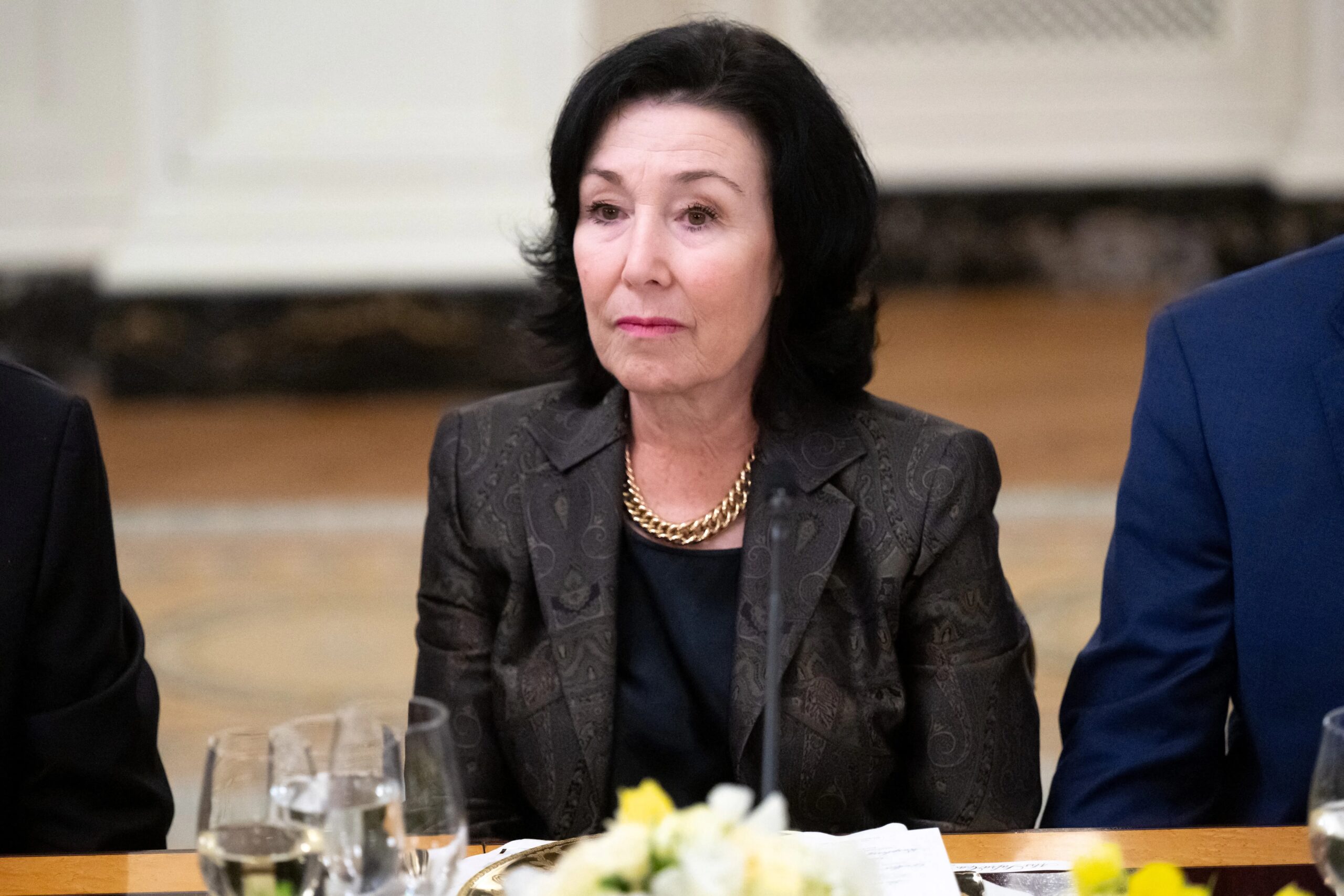
A year after stepping down as Oracle’s CEO, Safra Catz has kept a relatively low profile, with minimal media appearances. But she hasn’t gone far. Catz remains on Oracle’s board as executive vice chair, sits on the board of Paramount Skydance, and in March was named one of the first members of President Trump’s Council of Advisors on Science and Technology.
Meanwhile, the company she helped transform keeps growing, even as investors have soured on the cost of that growth. On Sept. 10, Oracle posted fiscal first-quarter 2027 revenue of $19.35 billion, beating analysts’ estimates of $19.14 billion, due in part to enterprise database migrations and A.I. cluster builds. Cloud infrastructure revenue more than doubled to $7.4 billion, and remaining performance obligations, a measure of contracted revenue not yet recognized, reached $664 billion. The performance can be attributed in large part to the vision of Catz, who led the company as co-CEO and CEO from September 2014 to September 2025 and helped turn Oracle from an enterprise software vendor into a hyperscaler.
Leaving on Top
Catz stepped down in September 2025, after which Oracle returned to a co-CEO model with Clay Magouyrk, a founding member of Oracle’s cloud engineering development center, and Mike Sicilia, who joined Oracle after the company acquired Primavera Systems in 2008. Before the leadership transition, Magouyrk oversaw the company’s cloud infrastructure business and Sicilia helped modernize Oracle’s industry applications businesses with A.I. technologies.
Catz framed her decision around timing. “You want to make a transition like this when things are great,” she told investors the day the change was announced. By most measures, things were. Earlier that month, Oracle reported first-quarter fiscal 2026 revenue of $14.9 billion, and after it signed four multibillion-dollar contracts, its remaining performance obligations jumped 359 percent year over year to $455 billion. Oracle’s shares had risen about 85 percent that year, and its market value was approaching $1 trillion. In the announcement of the transition, Oracle cofounder, executive chairman and CTO Larry Ellison credited her leadership, saying she led Oracle as the company became a “hyperscale cloud powerhouse.”
Catz said in a statement: “Today, Oracle is recognized as the cloud of choice for both A.I. training and inferencing. I’m very proud of that.” She added, “Oracle’s technology and business have never been stronger. And our breathtaking growth rate points to an even more prosperous future. At this time of strength is the right moment to pass the CEO role to the next generation of capable executives. Congratulations, Clay and Mike.”
Inside Oracle, Catz’s tenure was punctuated by massive multicloud partnerships with Amazon and Microsoft, a $300 billion cloud deal with OpenAI and high-profile deals with some of the biggest names in A.I., including xAI, Nvidia and Meta.
The Year Since
The year since Catz stepped aside has been rockier. Oracle’s shares have fallen roughly 58 percent since Magouyrk and Sicilia were named co-CEOs. The company cut roughly 21,000 jobs in fiscal 2026, about 13 percent of its workforce, and has begun another round of layoffs, while capital spending jumped to $28.5 billion in its latest quarter from $8.5 billion a year earlier. The company expects to spend $90 billion to $95 billion in fiscal 2027.
Oracle’s latest proxy statement, filed Sept. 25, shows what the company is paying the executives who replaced Catz. Magouyrk received a one-time equity award with a target value of $250 million, and Sicilia one worth $100 million. Under accounting rules, Oracle reported Magouyrk’s total fiscal 2026 compensation at $627.5 million, 6,623 times the pay of its median employee. Most of the options carry an exercise price of $308.46 and are currently underwater, and the performance-based portion begins vesting only if Oracle’s non-GAAP revenue reaches $100 billion by fiscal 2028, up from $67.4 billion in fiscal 2026. In the filing, Oracle said its “strong fiscal 2026 operating performance was not fully reflected in its stock price performance,” attributing the gap to broader investor concerns about the software, A.I. and cloud sector. The company also faces a shareholder lawsuit, filed in February and amended in July, accusing Oracle and several executives and directors of making misleading statements about its cloud infrastructure business; Oracle has said it intends to fight the case.
From Holon to Oracle
Catz was born in 1961, in Holon, Israel, to a Romanian Jewish father and a Lebanese Jewish mother, before emigrating to the United States and earning a law degree at the University of Pennsylvania. After spending part of her career in investment banking, she joined Oracle in 1999. She joined the board of directors in 2001, became co-president in 2004 and CFO in 2005, was named co-CEO with Mark Hurd in 2014 after Larry Ellison stepped down as CEO, and became sole CEO in 2019 after Hurd took a leave of absence.
Today, Catz has a reputation as one of the most successful CEOs in the world, a self-made billionaire who has helped close more than 130 acquisitions, with an estimated net worth of $2.9 billion. She has appeared at No. 40 on Forbes’ list of America’s richest self-made women and at No. 14 on Fortune’s list of Most Powerful Women.
Where Is Catz Now?
Beyond her role as Oracle’s executive vice chair, Catz joined the board of Paramount Skydance in August 2025, following the merger of Paramount Global and Skydance Media, alongside David Ellison, Larry Ellison’s son, who became the company’s chairman and CEO. The seat puts her in the boardroom of a company now pursuing a takeover of Warner Bros. Discovery valued at more than $110 billion. She had stepped down from Disney’s board in 2024 after six years, as the Ellisons’ Hollywood ambitions took shape.
In March 2026, President Trump appointed Catz to the President’s Council of Advisors on Science and Technology (PCAST), again alongside Larry Ellison, and other tech leaders including Jensen Huang, Mark Zuckerberg, Sergey Brin, Marc Andreessen, Lisa Su and Michael Dell. Catz and Su are the only two women among the council’s initial 13 members.
Operationally, Catz’s bet on cloud infrastructure has continued to pay off, even if investors have yet to reward it. And she stands as a standout example for women CEOs in an industry notoriously short on visible female leaders. According to the 2026 Fortune Global 500 list, there are just 34 women CEOs among the companies ranked.
Wired correspondent Lauren Goode recently wrote that if you ask who the most powerful man in tech is, you’ll get a response like Elon Musk or Jensen Huang, but if you ask who the most powerful woman is, “most people respond with a thoughtful pause.”
Even among high achievers like Thinking Machines Lab founder and former OpenAI CTO Mira Murati, AMD president and CEO Lisa Su, and the late former YouTube CEO Susan Wojcicki, Catz stands out as an exemplar for male and female CEOs alike, one who bet big on cloud infrastructure and largely got out on top.

