The Federal Commerce Fee (FTC) simply introduced a “landmark” settlement with one of many nation’s largest pharmacy profit managers (PBMs). The issue is that it doesn’t really finish the PBM case—and it raises as many questions because it solutions.
In its settlement with Categorical Scripts Inc. (ESI) and its affiliated entities, the company says the deal will drive basic modifications to ESI’s enterprise practices, improve transparency, and cut back sufferers’ out-of-pocket drug prices—together with insulin—by as a lot as $7 billion over 10 years. Maybe it should, though they don’t present their work on that one. It additionally guarantees new income for neighborhood pharmacies and aligns, in response to the FTC, with the Trump administration’s health-care priorities.
However right here’s wrinkle primary: the FTC settled solely half of a bigger case.
On Sept. 20, 2024, the FTC filed a complaint towards the three largest prescription-drug profit managers—Caremark Rx, Categorical Scripts (ESI), and OptumRx—together with their affiliated group buying organizations (GPOs). The company alleged anticompetitive and unfair rebating practices “which have artificially inflated the record worth of insulin medication, impaired sufferers’ entry to decrease record worth merchandise, and shifted the price of excessive insulin record costs to weak sufferers.”
Right here’s the redacted grievance.
The brand new settlement resolves the claims towards ESI and its associates alone. The instances towards the opposite PBMs stay pending, and the FTC has stated nothing but about how—or whether or not—these can be resolved.
The One-Commissioner Fee
The Federal Commerce Fee, on this occasion, successfully meant FTC Chairman Andrew Ferguson flying solo. Because the company defined, “[t]he Fee vote to simply accept the consent settlement for public remark was 1-0, with Commissioner Meador recused.”
A physique Congress designed to be bipartisan instantly grew to become merely bipedal. That’s uncommon. It could be lawful, and it could or could not have affected the settlement’s phrases.
Is there such a factor as a one-member “fee”? Perhaps. I’m not totally certain.
Part 1 of the Federal Commerce Fee Act gives that the fee:
…shall be composed of 5 Commissioners, who shall be appointed by the President, by and with the recommendation and consent of the Senate. No more than three of the Commissioners shall be members of the identical political occasion.
The statute clearly envisions a multi-member physique and, if not strictly bipartisan, not less than one spanning multiple political occasion (the fee has even had nominal independents at instances). However the textual content doesn’t set an express quorum requirement or invalidate actions taken with fewer than 5 commissioners.
The statute’s staggered phrases, mixed with the Senate’s advice-and-consent requirement, additionally recommend Congress anticipated vacancies now and again.
The FTC’s personal guidelines add a quorum requirement, although not with good readability. Beneath 2005 amendments to the principles of apply:
A majority of the members of the Fee in workplace and never recused from taking part in a matter (by advantage of 18 U.S.C. 208 or in any other case) constitutes a quorum for the transaction of enterprise in that matter.
Is one a majority when the variety of taking part members equals one? It’s actually greater than half of 1 (and by half). Whether or not that matches peculiar utilization is one other query.
For a considerate dialogue, see a 2018 Law360 article by Stephen Calkins and John Villafranco. They doubt the legality of the FTC’s rule and advocate revising it. They could be proper. I stay agnostic.
The FTC has operated with lowered membership earlier than. Now we have seen four-, three-, and two-commissioner businesses. From roughly February 2017 to April 2018, the Fee consisted of two members: Republican Performing Chairman Maureen Ohlhausen and Democratic Commissioner Terrell McSweeny. The company didn’t grind to a halt. It voted, introduced instances, and performed peculiar enterprise. I labored within the Workplace of Coverage Planning on the time, and operations continued—surprisingly easily.
Now we have additionally seen one-party commissions. After Commissioner Christine Wilson departed in 2023, solely three commissioners remained, all Democrats: Chair Lina M. Khan, Commissioner Rebecca Okay. Slaughter, and Commissioner Alvaro Bedoya.
Following Khan’s departure and President Donald Trump’s dismissal of Bedoya and Slaughter (not less than de facto, in Slaughter’s case—the Supreme Courtroom is predicted to handle whether or not it was de jure in Trump v. Slaughter by June 2026), the fee dropped to 2 members: Chairman Andrew Ferguson and Commissioner Melissa Holyoak, each Republicans. The company briefly returned to a few Republicans with Mark Meador’s appointment, then fell again to 2 after Holyoak departed to develop into a U.S. lawyer.
Single-vote motion can be not totally unprecedented. In 2018, one commissioner voted to change a previous order whereas Commissioner McSweeny was recused.
So this case is uncommon, however not wholly distinctive. It’s odd—and probably lawful, or probably not.
Part 5 And not using a Principle
Shifting from course of to substance, I’m in no way certain this was a very good case. I sympathize with among the instant beneficiaries—particularly sufferers with out satisfactory prescription-drug protection—however I’m inclined to doubt it.
It is a standalone Part 5 case: one rely alleging a violation of Part 5’s prohibition of “unfair strategies of competitors” (UMC), and two counts alleging “unfair” practices beneath Part 5’s ban on “unfair or misleading acts or practices.” No different counts. The FTC’s preliminary (redacted) grievance is right here.
Let’s begin with competitors. As one would possibly count on of a standalone Part 5 case, the grievance doesn’t allege any violations of the Sherman Act or the Clayton Act. And even permitting that Part 5 could attain considerably past these statutes, it’s laborious to see a clear competitors concept on the face of the pleading. As Herbert Hovenkamp put it when the FTC introduced the case:
The grievance doesn’t allege an anticompetitive cartel settlement. acutely aware parallelism? shared monopoly? no single agency apparently has sufficient share for monopolization. I’m scuffling with the idea of motion.
The FTC alleges that “[a]lthough the Respondents declare to prioritize affected person well-being, their actions reveal a sample of anticompetitive and unfair conduct.” The anticompetitive half is the place I get caught. What, precisely, is the residual prohibition in a Part 5 UMC case—not less than on this one—the half that doesn’t overlap with Sherman Act legal responsibility, however remains to be supposedly violated by the PBM conduct at situation?
This isn’t, for instance, an invite to collude—say, to interact in horizontal price-fixing—the place there isn’t any settlement (and thus no Part 1 violation), however the place the conduct is an try to type an settlement that that might be per se illegal as a result of it “at all times or nearly at all times” harms competitors and shoppers, and the place unsuccessful makes an attempt, like profitable ones, lack a procompetitive rationale.
Now flip to shopper safety. The alleged violations right here seem like strictly “unfairness” claims, which issues as a result of Congress positioned actual limits on Part 5 unfairness authority. Part 5 gives:
The Fee shall don’t have any authority … to declare illegal an act or apply on the grounds that such act or apply is unfair until the act or apply causes or is prone to trigger substantial damage to shoppers which isn’t moderately avoidable by shoppers themselves and never outweighed by countervailing advantages to shoppers or to competitors. In figuring out whether or not an act or apply is unfair, the Fee could contemplate established public insurance policies as proof to be thought of with all different proof. Such public coverage concerns could not function a major foundation for such dedication.
In different phrases, unfairness beneath the FTC’s UDAP authority requires substantial shopper damage (precise or probably), not moderately avoidable by shoppers, and never outweighed by countervailing advantages “to shoppers or to competitors.”
That brings us again to the identical sticking level: if the FTC’s consumer-protection concept activates an evaluation of aggressive results, it essentially remembers the query of the scope of the company’s UMC authority, and the extent to which the FTC’s twin missions beneath the FTC Act work as enhances, slightly than as a mash-up.
Because it occurs, the scope of UMC has been contentious for years—not less than for the reason that FTC, beneath then-Chair Khan, issued its “Coverage Assertion Concerning the Scope of Unfair Strategies of Competitors Beneath Part 5 of the Federal Commerce Fee Act” in November 2022. In my opinion, that assertion is garbage (right here’s a chunk I wrote with Gus Hurwitz and a quick explainer from Geoff Manne and me). And in any case, there’s valuable little jurisprudence to settle the matter.
Let’s take this in three steps. First, what do PBMs do? Second, how does the FTC allege that the PBMs’ conduct harms competitors and shoppers, in violation of the FTC Act? Third, how is the settlement prone to have an effect on competitors and shopper welfare?
PBMs Defined (With out the Pitchforks)
PBMs are sophisticated. They supply a fancy vary of administration companies—one which varies considerably throughout PBMs, but additionally throughout PBM purchasers. However we are able to not less than sketch the fundamentals.
The FTC is true that PBMs present companies to health-plan sponsors that present prescription-drug protection. To take action, PBMs contract with well being plans/insurers, pharmacies (and pharmacy networks), and drug producers.
The company can be proper that components of this technique look opaque to some contracting events—and definitely to downstream beneficiaries. And sure, there’s an excessive amount of cash concerned. Concern about excessive drug costs, and about whether or not competitors and antitrust enforcement can constrain them, is completely affordable.
For readers who desire a deeper dive, one of the best place to begin stays the FTC’s 2005 PBM “mail-order” report. It’s previous, however nonetheless precious. Congress requested it (by statute), and the employees performed a considerable empirical examine. The report offers a transparent description of PBM companies and presents analysis findings on their mixture results.
Newer work features a 2019 U.S. Authorities Accountability Workplace (GAO) report and a 2024 examine by Compass Lexecon economists Dennis W. Carlton, Mary Coleman, Nauman Ilias, Theresa Sullivan, and Nathan Wilson (now at Econic Companions). The FTC itself has additionally launched two “interim employees studies” based mostly on a newer examine: “Pharmacy Profit Managers: The Highly effective Middlemen Inflating Drug Prices and Squeezing Essential Avenue Pharmacies” (2024) and “Specialty Generic Medication: A Rising Revenue Heart for Vertically Built-in Pharmacy Profit Managers” (2025). In my opinion, the primary reads extra like a polemic than a examine, whereas the second provides a slender and selective view of the trade, significantly given the breadth of knowledge the FTC collected beneath 6(b) orders and the allegations in its grievance.
For individuals who favor the quick model, I provide this.
PBMs administer prescription-drug advantages for private-sector plan sponsors—employers, unions, and managed-care organizations, amongst others. Their companies embody claims processing and adjudication, rebate negotiation, retail-network formation and administration, benefit-design consulting, and drug-formulary design and administration.
The exact bundle varies throughout purchasers. The FTC’s 2005 report describes the core capabilities succinctly:
Plan sponsors usually rent PBMs to handle these pharmacy advantages on their behalf. As a part of the administration of those advantages, PBMs assemble networks of retail and mail pharmacies in order that the plan sponsor’s members can fill prescriptions simply and in a number of places. PBMs additionally negotiate with pharmaceutical producers for funds that may decrease the worth that plans and members pay for prescribed drugs.
Formulary design is particularly vital. In session with the plan sponsor, the PBM determines which medication are coated for every situation and on what phrases. Plans usually use tiers—decrease (generally zero) copayments for most popular medication and better copayments for less-preferred medication or channels. Because the FTC’s grievance notes, PBMs provide standardized formularies that sponsors can undertake “off the shelf,” however additionally they assist design personalized formularies tailor-made to specific purchasers. Massive plans could closely affect the method or deal with parts of plan design themselves.
Retail pharmacy networks work equally. They could be open, tiered (most popular pharmacies get decrease copayments), or restricted “slender networks.”
Plans additionally choose and select companies. PBMs usually are not the one corporations that present them. The GAO’s 2019 report discovered that “Half D plan sponsor contracts diverse by the variety of companies supplied by PBMs” and that “[p]lan sponsor contracts diverse within the variety of PBMs used to supply a number of of the drug administration companies.”
Issues about vertical integration predate the present case. Congress ordered the FTC’s 2005 examine by the Medicare Prescription Drug, Enchancment, and Modernization Act of 2003 as a result of PBMs owned mail-order pharmacies, elevating conflict-of-interest issues. The FTC’s 2024 report additionally notes broader integration: “[d]ownstream, PBMs are vertically built-in with massive well being insurers which, by their well being plans and plan sponsor companies, present protection for a whole lot of thousands and thousands of Individuals.”
Vertical integration can be anticompetitive, but it surely often will not be (see, e.g., Francine Lafontaine and Margaret Slade; James Cooper, Luke Froeb, Dan O’Brien, and Michael Vita; David Reiffen and Michael Vita). And the FTC’s personal 2005 analysis didn’t affirm the fears that had motivated the inquiry.
FTC employees examined a large set of enterprise data and contracts—each downstream (PBM–plan sponsor) and upstream (PBM–producer)—and performed two rounds of knowledge assortment: mixture worth and meting out knowledge, adopted by particular person claims knowledge. Amongst different findings, mail-order costs at massive PBMs had been, on common, decrease than retail costs for a similar medication and prescription sizes, together with at vertically built-in PBMs.
In brief, the issues that prompted Congress to fee the examine weren’t borne out. For the 2002-03 interval examined, PBM possession of mail-order pharmacies didn’t drawback plan sponsors and, on web, saved them cash.
The report did observe limitations:
As a result of… [the] knowledge had been aggregated, they don’t reply the query whether or not every plan sponsor has negotiated the absolute best deal or whether or not every PBM has fulfilled its contractual obligations on account of every of its plan sponsor purchasers.
Nor might the info decide whether or not any specific conduct by any specific PBM was anticompetitive.
The 2019 GAO report equally discovered that drug “utilization administration companies [provided by PBMs and other entities] had been related to financial savings for the Medicare program, Half D plans, or beneficiaries.” That discovering sits uneasily with the FTC’s 2024 allegations, though one can nonetheless think about hurt in particular markets from particular conduct, even when mixture financial savings exist.
Extra not too long ago, Carlton et al. concluded:
Claims that PBMs have contributed to rising prices for prescribed drugs usually are not supported by the proof. There’s substantial proof that PBMs have lowered the price of prescribed drugs for plan sponsors and their members, and, though PBMs are paid for his or her companies, PBM margins are a small part (lower than 5 %) of the price of prescribed drugs.
That examine will not be peer-reviewed, but it surely comes from skilled economists utilizing a lot of the identical knowledge the FTC gathered for its 2024 and 2025 studies. None of those research definitively resolves whether or not any agency violated the Federal Commerce Fee Act or the antitrust legal guidelines. They do, nevertheless, present a baseline—one in pressure with the FTC’s allegations. On common, PBMs (and vertical integration of PBMs and mail-order pharmacies) seem to generate financial savings for plan sponsors. That fundamental remark will not be meaningfully contradicted by the company’s 2024 and 2025 interim studies.
Now Serving: Part 5 Soup
Nobody disputes the FTC’s level that “[i]nsulin is a life-saving medicine for thousands and thousands of diabetics.” Studies that many sufferers have “rationed their use of insulin … by delaying refilling prescriptions, skipping doses, or taking smaller doses than wanted” increase critical coverage issues. So do distributional observations, together with that rationing seems extra frequent amongst lower- and middle-income sufferers and amongst Black sufferers. Nothing right here diminishes these issues.
The coverage query, although, is what to do—and tougher nonetheless, what to do this produces extra good than hurt.
For current functions, a number of narrower questions matter:
- Did ESI or the opposite respondents really trigger the issues?
- In that case, how did the conduct fall inside Part 5 of the FTC Act however exterior the antitrust legal guidelines?
- Is the FTC proper that “[t]he substantial damage to shoppers will not be outweighed by any countervailing advantages to shoppers or to competitors”?
- Will the negotiated treatment with ESI eradicate—or not less than materially cut back—the hurt with out creating important tradeoffs elsewhere?
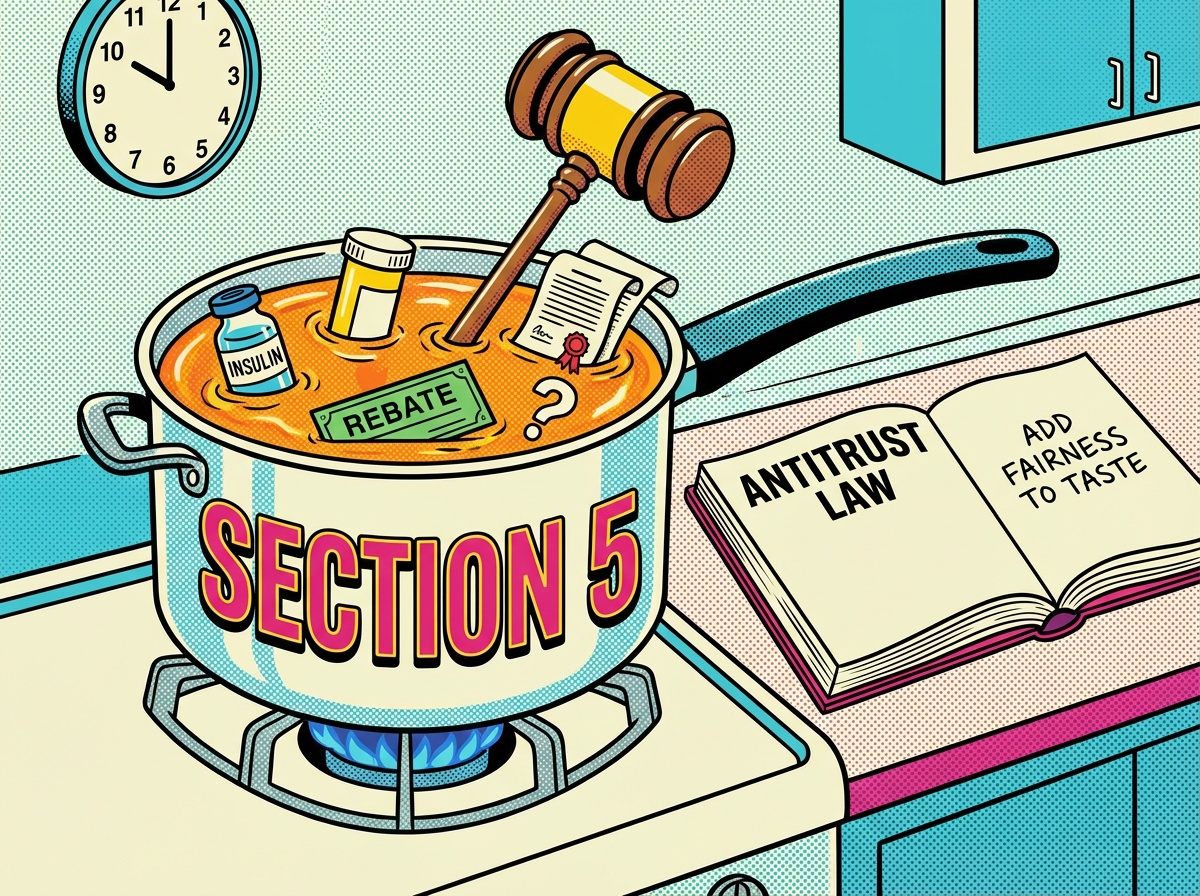
The grievance asserts that “[r]espondents’ practices, whether or not seen individually or collectively, inflict critical hurt on sufferers whose drug prices are calculated based mostly on the inflated, unrebated record worth and probably on sufferers extra broadly.” Maybe. A course of conduct can have many shifting components, and there’s no canonical method to decompose it into atomic actions or practices. Nonetheless, the reason has delicate spots. One wonders whether or not we’re being served a “Part 5 Soup” concept and, in that case, whether or not that’s any higher than Monopoly Broth.
Contemplate the FTC’s allegation about formulary design, together with tiering and selective contracting:
The PBM Respondents’ systematic apply of excluding a low WAC [wholesale acquisition cost] drug in favor of an similar excessive WAC various from the identical producer doesn’t decrease web costs for the excessive WAC drug. Whereas some rebates could serve to decrease premiums throughout sufferers in a well being plan, not all rebates are used to decrease affected person premiums. Some rebates are retained by the PBMs and GPOs, and the vast majority of the remaining rebates are retained by the industrial payer. For insulin sufferers compelled to pay coinsurance and deductible funds based mostly on the record worth, dramatically increased out-of-pocket prices for insulin are considerably extra dangerous than the opportunity of barely decrease premiums.
Begin with a fundamental level: PBMs didn’t create—and don’t set—WAC costs. Drug producers do. The FTC doesn’t dispute that, though it argues rebate buildings “incentivize” increased WAC costs.
However then we have to ask extra basic questions. The FTC acknowledges that “some rebates could serve to decrease premiums throughout sufferers in a well being plan,” but alleges that “not all rebates are used to decrease affected person premiums.” Is {that a} violation of Part 5?
Sufferers’ whole drug prices have two parts: premiums and out-of-pocket spending. A key empirical query is subsequently simple. Does the PBM conduct at situation increase or decrease whole prices (mixture costs) for many beneficiaries? For the median beneficiary? For just some insulin merchandise—or throughout most insulin merchandise?
For that matter, what vary of drug merchandise is at situation? The FTC says that “Insulin is the poster youngster of Respondents’ damaged drug pricing system.” It additionally alleges that “Respondents’ ways have results past insulin.” What’s the market at situation? And what’s the affect of the conduct at situation throughout all medication on a formulary?
Run the identical questions once more, substituting “well being plans” for “beneficiaries.” What are the web results, on common?
These questions matter, significantly given Carlton et al. and the GAO’s 2019 discovering that drug “utilization administration companies [provided by PBMs and other entities] had been related to financial savings for the Medicare program, Half D plans, or beneficiaries.” Sure, that examine examined Medicare Half D and dates to 2019. But when the story is “that was then and that is now,” the place is the accounting of the web results now? The grievance does probably not say.
Answering these questions may not resolve legal responsibility beneath Part 5. However they’re certainly related. If the company can not reply them, can it confidently assert the absence of countervailing advantages to shoppers or competitors?
The grievance notes that “[s]ome rebates are retained by the PBMs and GPOs, and the vast majority of the remaining rebates are retained by the industrial payer.” In apply, a really massive—and growing—share passes by to well being plans, with estimates starting from roughly 92% to greater than 98%.
Vertical integration complicates issues but additionally highlights one other situation: producers and well being plans play central roles in pricing and profit design. In antitrust phrases, who really holds market energy wherein set of transactions? And why does the grievance allege no unlawful settlement beneath Part 1 of the Sherman Act?
The FTC has examined PBMs aside from the research talked about above. The company performed an eight-month investigation of ESI’s proposed acquisition of Medco, closing it in April 2012. The fee additionally produced in depth competition-advocacy feedback and testimony addressing regulatory proposals involving tiered advantages and selective contracting within the years earlier than and after that transaction.
A lot of these supplies stay searchable on the FTC web site, though the fee beneath former Chair Khan “withdrew” them—successfully attaching digital warning labels—with out figuring out contradictory findings and earlier than conducting the research that knowledgeable the 2024 and 2025 interim employees studies.
A few of these advocacy feedback addressed coverage interventions trying to cabin or prohibit among the PBM practices at situation within the matter, reminiscent of “any prepared supplier” (AWP) and “freedom of alternative” (FOC) mandates. For instance, in feedback to the Facilities for Medicare & Medicaid Companies (CMS) on “Contract Yr 2015 Coverage and Technical Modifications to the Medicare Benefit and the Medicare Prescription Drug Profit Applications,” the FTC warned that “[t]he proposed any prepared pharmacy provisions threaten the effectiveness of selective contracting with pharmacies as a instrument for reducing prices.”
To tell these coverage feedback, FTC employees from the Bureau of Economics and Workplace of Coverage Planning had reviewed related empirical work on the results of AWP and FOC provisions, together with peer-reviewed research by skilled Bureau of Economics employees, reminiscent of this early examine by Michael Vita (from 2001) and this current one by Daniel Hosken, David Schmidt, and Matthew Weinberg (from 2020). Their findings had been “according to AWP laws’ decreasing competitors by inhibiting the flexibility of insurers to maneuver demand throughout competing pharmacies.”
Has newer analysis overturned these conclusions? To not my data. The fee didn’t say so when it withdrew the paperwork, and the interim employees studies don’t say so both. None of this proves that PBMs (together with ESI) by no means engaged in illegal conduct, but it surely does counsel warning earlier than intervention.
There’s additionally a consumer-protection angle. One rely within the grievance depends partly on the opacity of plan advantages. Anybody who has tried to decipher a health-benefit plan acknowledges the issue. Shoppers face actual data prices, first when selecting amongst plans, after which when utilizing them. Even acquiring a full plan doc can require effort, leaving many individuals to depend on summaries.
The trade might probably enhance transparency, and in ways in which don’t increase antitrust issues in flip. Whether or not rebate agreements and formulary design trigger the opacity—or are even materials to beneficiaries’ alternative of plans—stays unclear.
For added dialogue of the settlement, see Satya Marar’s current Reality on the Market publish, “The FTC, Categorical Scripts, and the Excessive Price of Decrease Copays.” Alden Abbott, a former FTC common counsel, additionally wrote two posts on the case. Marar, particularly, highlights the tradeoffs—each from PBM practices and from the settlement’s mandated interventions.
Studying the grievance and settlement with out worrying about tradeoffs is tough, if not unimaginable. That doesn’t imply that intervention couldn’t be justified. Nonetheless, all the things that’s recognized in regards to the area means that the FTC’s declare of no countervailing advantages requires substantiation.
There’s extra we might unpack. For now, I’m left questioning whether or not we’ve a “Part 5 Soup” downside to accompany the acquainted monopoly-broth theories.
Settlements Don’t Make Part 5 Legislation
Settlements have apparent benefits. Even a powerful case carries litigation danger—actually in federal court docket and on attraction, if much less so within the FTC’s Half 3 administrative course of (the place the fee usually finds its personal arguments persuasive). Trials are costly. Administrative trials are additionally costly. All of it takes time, with or with out an attraction. All of that imposes prices on the company, the respondents, and, not directly, shoppers.
Resolving issues with out these dangers and prices—particularly given restricted company assets—ought to at all times stay an possibility. At the least in merger issues, present management on the federal antitrust businesses seems extra open to settlement than their Biden-era predecessors. In broad phrases, that’s a very good factor.
However settlements additionally include a draw back: they don’t make regulation.
That issues right here. Everybody agrees that the attain of Part 5 is considerably higher than that of the antitrust legal guidelines—the Sherman Act and the Clayton Act. However there’s no such consensus about what lies past. The related jurisprudence is roughly nil.
There be dragons? The FTC, beneath Khan, issued a controversial Part 5 UMC coverage statement in 2022. “Controversial” is placing it mildly, however I received’t rehash all of that (see, once more, this piece I wrote with Gus Hurwitz and this quick explainer from Geoff Manne and me). The doc reads much less like a roadmap and extra like an invite to open-ended administrative discretion. Unsurprisingly, however unhelpfully, the grievance borrows from its vocabulary. Phrases like “exploitative cost-shifting” seem repeatedly, but they don’t have any settled authorized that means.
Greater than that, an company coverage assertion will not be regulation. And when the company brings and settles a standalone Part 5 case, the consequence will not be precedent. There aren’t any findings of reality, and there’s no judicial holding, no clarified doctrine, and no administrable rule. The settlement alerts solely this: the defendant and the federal government each determined that hanging a deal beat the choice.
