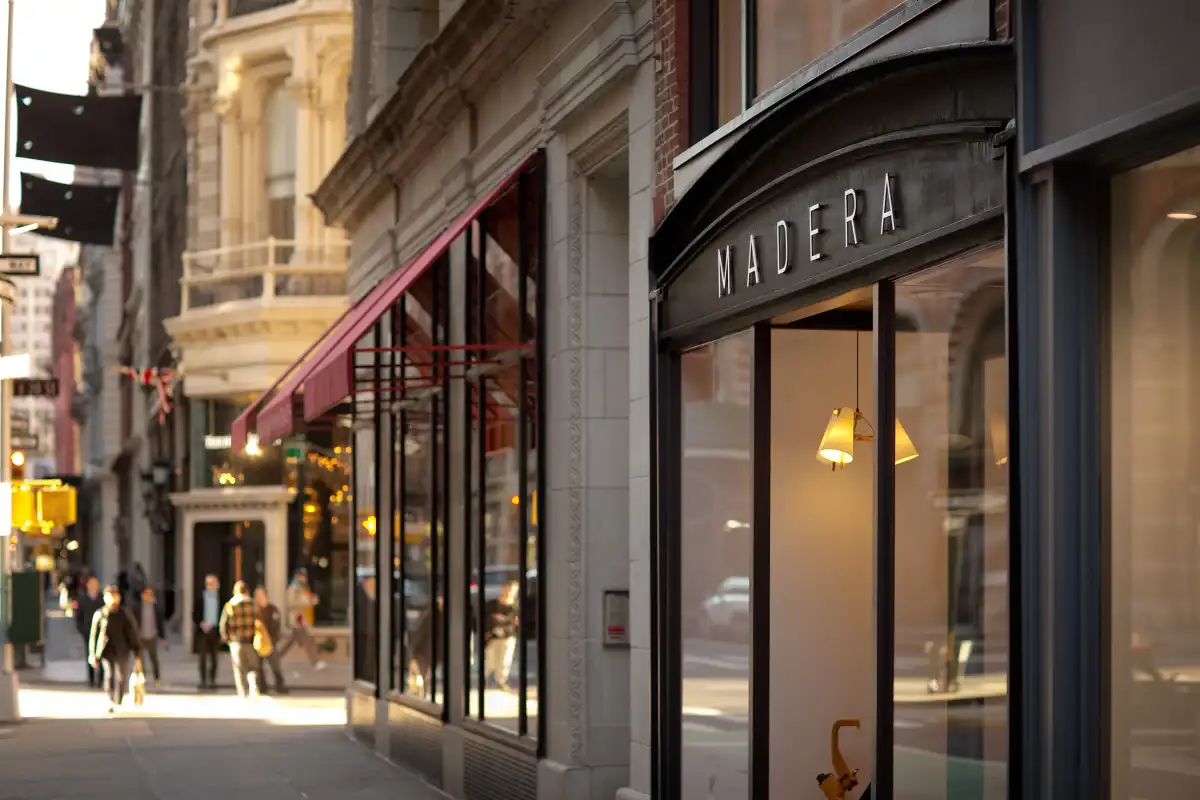
The first impression is tactile, almost disarmingly so. Light settles across a disciplined expanse of wood, each plank precisely cut, angled, and joined into a geometry that feels both ancient and exacting. Grain becomes rhythm. Surface becomes language. Marble rises beside it in quiet contrast—cool, veined, resolute—holding space with the kind of authority that does not need to announce itself. Arguably, this is where MADERA distinguishes itself most clearly: material is not a backdrop, but a philosophy, and the environment itself invites a slower, more considered way of seeing.
That shift in pace feels, perhaps, more important now than ever.
The way we encounter art is changing. It is faster, more immediate, more widely distributed than at any other moment in history. Images circulate endlessly. Works are reduced, flattened, consumed in passing. There is access, certainly, and with it a new kind of global dialogue. Yet something quieter, more essential, risks being lost in the process—the act of presence, of standing before a work and allowing it to unfold over time.
Within this setting, art begins to reclaim that space—subtly at first, then completely. It leaves behind the neutrality of the white cube and enters a world of context, proportion, and lived intention. It is no longer isolated. It is placed.
On Wednesday, April 29th, that philosophy finds its most refined expression in “Grain & Gesture,” a private salon presented by MADERA in collaboration with AA Luxury Atelier, featuring the work of Houben RT. The evening, perhaps unsurprisingly, signals a deliberate movement away from traditional exhibition formats toward something more exacting and ultimately more resonant. Art is encountered where it is meant to exist—in dialogue with architecture, material, and the sensibilities of those who shape space at the highest level.
MADERA’s ascent to global recognition has, in many ways, been defined by an unwavering commitment to precision and innovation in wood design. Founded in Brooklyn and now executing projects internationally, the firm has established itself as a leader in Seamless Wood Design®, collaborating with institutions, architects, and brands that demand both technical mastery and aesthetic intelligence. The company operates at a level where craft and concept are inseparable, and where environments are built not only to be seen, but to be experienced over time.
Within this evolution, individuals such as Niall Brandon have played a meaningful role in shaping strategic collaborations and expanding the firm’s cultural reach. His involvement in bringing together Houben RT, MADERA, and AA Luxury Atelier reflects a clear understanding that the future of collecting lies in context—where art, design, and audience are in direct alignment.

Houben RT enters this context with a language uniquely suited to it, and arguably sharpened by it.
His work navigates the tension between classical figuration and the visual codes of contemporary economies. References to currency—both symbolic and structural—thread through layered compositions that feel at once historic and immediate. Figures emerge from fields of texture and disruption, suspended between permanence and flux. There is a studied intelligence in his approach, one that draws from art historical frameworks while remaining acutely aware of the systems that quietly govern value, circulation, and desire. His work does not merely depict. It interrogates, reframes, and ultimately repositions what we assign worth to—and why.
Placed within MADERA’s architectural clarity, that interrogation becomes more focused. The discipline of the space meets the complexity of the canvas, creating a dialogue that extends beyond aesthetic appreciation into questions of placement, scale, and long-term integration. The work is no longer viewed in isolation. It is experienced as part of a larger composition—one that includes the room, the material, and the individuals who will carry it forward.
AA Luxury Atelier completes this triad with a sense of intention that feels both strategic and intuitive. As an international curatorial and editorial platform, the Atelier operates at the intersection of acquisition, narrative, and high-level client cultivation. Its work extends beyond the expected rhythms of the market, engaging with institutions, private capital, and cultural platforms to broker opportunities that elevate both artists and the environments in which their work resides. There is, perhaps, an unspoken clarity within this model—an understanding that we exist within a world shaped by exchange, where cultural significance and economic movement are not opposing forces, but deeply intertwined. The role of the Atelier is to navigate that intersection with precision, ensuring that value—both cultural and material—is realized with integrity.

At the same time, there remains a deeper imperative. As the art world evolves—becoming faster, more global, more fluid in how work is seen and acquired—there is an equally important need to preserve a sense of reverence. The act of looking, of living with a work, of understanding its lineage and its language, remains essential. Progress, in this context, is not a departure from tradition. It is a refinement of it.
“Grain & Gesture” becomes, in this light, an embodiment of that balance.
Perhaps most compellingly, this level of multi-dimensional collaboration gestures toward the future of how art will be experienced—and collected. It is a future less dependent on screens and saturation, and more attuned to presence, materiality, and human exchange. A return, in many ways, to the tactile. To the conversation. To the moment when a work is not merely seen, but felt, considered, and ultimately chosen.
For further information and to RSVP for April 29th, please contact artandlux@avalonashley.com
Visit maderasurfacces.com
