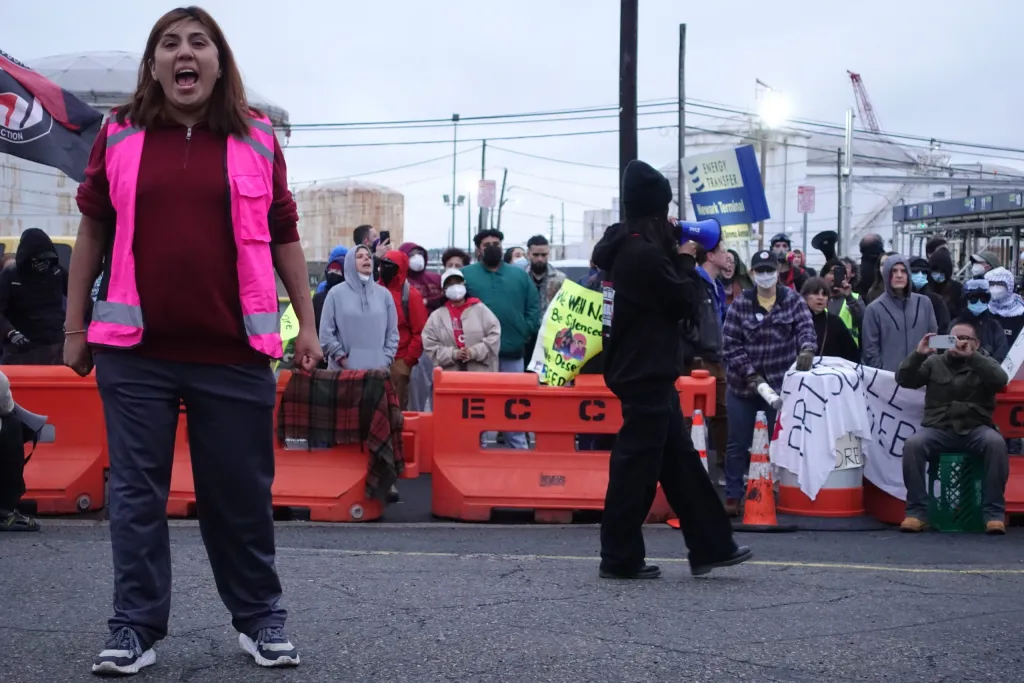
On the evening of May 24, a small blockade of protesters formed outside the entrance to Delaney Hall in Newark, Immigration and Customs Enforcement’s largest detention center in the New York metro area, as word spread that ICE agents were trying to move a Peruvian detainee named Martin Soto out of the facility.
Soto’s wife Gabriela, a U.S. citizen who was several months pregnant at the time, had been one of the lead rabblerousers outside the gates of Delaney Hall, rallying to support detainees who had announced a hunger and labor strike two days earlier.
The standoff went on for hours, with ICE agents eventually breaking through a diminished line of protesters in the pre-dawn hours the next morning. Guards moved Soto to an ICE detention center in Elizabeth, New Jersey, where he’s remained in solitary confinement ever since, according to his wife.
Soto was one of hundreds of immigrants shifted out of Delaney Hall as protests raged inside and outside the facility over the spring, according to new ICE data obtained by the Deportation Data Project through a Freedom of Information Act lawsuit, and analyzed by The City Reporter.

The new data mirrors what advocates were seeing in real time, and what they interpreted as an attempt by ICE to quash the civil disobedience roiling the facility.
“We know they were actively trying to break the strike from very early on,” said Kathy O’Leary, with the group Pax Christi USA, part of the activist Eyes on ICE coalition, which has been providing assistance to Delaney Hall detainees and their families since the facility opened in the spring of 2025. O’Leary saw the transfers as serving a dual purpose.
MORE: ICE Belatedly Confirms Death of Third Delaney Hall Detainee

“They want to break the bonds between the people inside the facility,” she said. “But they also want to break the bonds between inside the facility and outside the facility.”
Asked about the transfers, a Homeland Security spokesperson disputed the accuracy of the Deportation Data Project’s data, which it obtained from DHS through Freedom of Information Act lawsuits.
“Once an alien is transferred to ICE custody, the agency makes a custody determination based on bed space and ensures their presence for immigration proceedings or removal from the United States,” the spokesperson said.
Memorial Day Clashes
The protests came after months of organizing by detainees inside of the facility, starting with an open letter signed by hundreds of them decrying the poor food and inadequate medical care, and calling for their freedom starting with the releases of those with serious medical conditions, the elderly and the young.
The City Reporter documented dozens of lawsuits where detainees described difficulty getting access to medication and treatment for pre-existing conditions that worsened in detention.
That initial clash outside the gates that first night of Memorial Day weekend attracted more protesters on subsequent nights, who were met with clouds of pepper spray and batons from ICE agents at the gates for days on end, thrusting the facility into the national spotlight.
The number of people held at Delaney Hall dropped dramatically during the protests — falling from more than 700 people to 420 in a span of a few days between late May and early June, according to the newly released data, current to Aug. 7.
Transfers were up during the same time. ICE moved 489 detainees out of Delaney Hall during the monthlong protest — with the number of transfers spiking especially starting in June.
Transfers have remained high since, and are the main reason people leave Delaney Hall, as opposed to deportations, court ordered releases, or voluntary departures. In all, 2,305 people were transferred out of the facility in the 11 weeks between the protest kickoff and the dataset cutoff on Aug. 7 — up 63% from the 1,417 in the same time period prior to the protests.
The number of people released due to court orders also increased in those weeks, ICE data show. Meanwhile, just a handful of people were released on bond on a given day.

By June 22, advocates announced the protest inside the facility was over.
“Nobody’s left in there,” Gabriela Soto said. “There’s nobody left from the hunger strike.”
Detainees transferred out since the protest were moved to 32 different facilities across ten states, often to far-flung places in the South. One in three were sent to Louisiana.
Since May, the number of people held in Delaney Hall has steadily climbed back up. As of Aug. 5, 828 detainees were held at Delaney. The vast majority held there had no pending criminal charges or convictions. During July, 1,317 people without any criminal history were booked into the facility.

While the major protests have subsided, the transfers have not slowed down, the data show. O’Leary, of Pax Christi USA, said she and other advocates noticed detainees are being held at Delaney Hall for shorter intervals before being transferred out, making it even harder for them to connect with loved ones or legal assistance.
During her husband’s time behind bars, Gabriela Soto lost her baby in July after an emergency c-section when she was seven months pregnant.
“I had to tell my husband that in solitary,” she said.
Our nonprofit newsroom relies on donations from readers to sustain our local reporting and keep it free for all New Yorkers. Donate to THE CITY today.
The post ICE Moved Hundreds of Detainees from Delaney Hall as Protests Raged Outside appeared first on The City Reporter.
