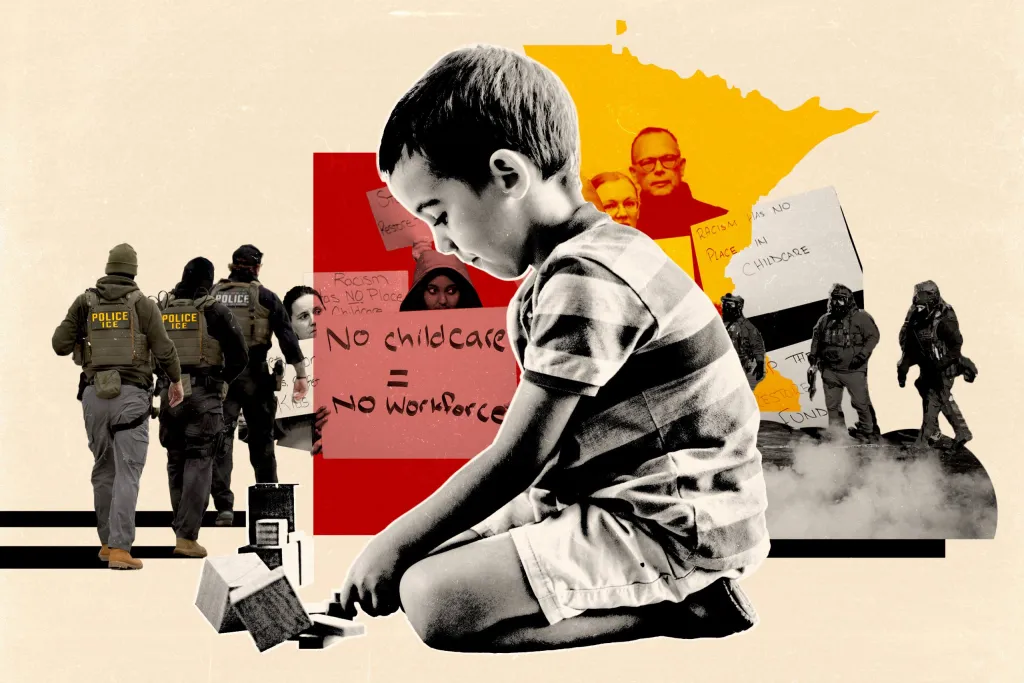
MINNEAPOLIS — On a frigid February afternoon at a Spanish-immersion little one care heart, toddlers grabbed puffy coats out of cubbies as dad and mom helped them pull on mittens and hats earlier than heading residence.
In an workplace down the corridor, Michael, the husband of the middle’s director, stared intently at a pc monitor streaming footage from the constructing’s safety cameras. Throughout dismissal, he watches for any automobiles that could be carrying brokers from the U.S. Immigration and Customs Enforcement. Since January, when federal brokers descended on the Twin Cities as a part of Operation Metro Surge, he began leaving his personal job early each afternoon to volunteer right here.
Because the final youngsters left, different volunteers arrived. Most of them are of their 70s, they usually’re now right here often, too. In truth they’ve develop into so acquainted the workers has affectionately nicknamed them the “abuelitas,” regardless that their very own grandchildren don’t attend the middle.
Their mission has been to drive 10 of the middle’s workers members residence and to function observers and translators ought to federal brokers pull them over. The staffers are immigrants, and regardless that the middle director says they’re all licensed to be within the nation and dealing, the aggressive enforcement left them too afraid to drive to the middle on their very own.
“I’m simply doing what I can do. And I clearly really feel much less susceptible than she can be,” stated Sarah, one volunteer driver. “I’m white, I’m 71. I believe I’d not be handled like she could be handled.” These interviewed for this story agreed to speak provided that the middle wasn’t named and their full names weren’t included, for worry of attracting the eye of federal authorities.
The trouble has been each a feat of group and a time-consuming every day grind: Some 60 volunteers, lots of whom stay in suburbs, have labored in shifts taking the middle’s workers members to and from their houses in neighborhoods throughout the town.
Associated: America’s little one care system depends on immigrants. With out them, it may collapse
The volunteer drivers are only one instance of the frilly techniques of mutual assist and help that little one care facilities have arrange within the Twin Cities. The immigration surge in Minnesota was linked to debunked claims that many daycare applications in Minneapolis and in St. Paul had been taking public cash however not caring for kids, placing all the sector beneath a microscope.
This one heart needed to cope not simply with fearful workers, however with threatening nameless telephone calls and households withdrawing their youngsters.
Nationwide, 1 in 5 employees within the little one care subject are immigrants, so enforcement actions across the nation have had an outsized impression on little one care suppliers.
The trouble that has saved this heart open presents classes for little one care amenities in different communities that will face comparable actions. Whereas Minneapolis and this heart’s workers slowly get again to one thing like regular, different areas could must develop volunteer networks of their very own.
“You actually must have a superb community to outlive, as a result of it’s not as if there’s a authorities group coming to assist,” stated Lily Crooks, the director of a kid care heart in St. Paul who’s energetic in native networks to assist suppliers. At her heart, for example, Crooks held a fundraiser that raised $5,000 for Lyft present playing cards in order that workers and fogeys may pay for a trip slightly than stand at a bus cease the place ICE brokers have been recognized to function.
“It’s each actually wonderful to see the best way that individuals are sticking up for his or her neighbors and supporting them, after which it additionally sort of feels bleak realizing that there isn’t going to be some saving entity coming,” Crooks stated.
However at the same time as Bruce Springsteen, U2 and others rush out anthems celebrating the mass resistance efforts by of us within the Twin Cities to assist their immigrant neighbors, some fear about what is going to come subsequent because the surge recedes from public view, and if such volunteer efforts can be sustainable in the long term.
“This isn’t over,” stated Diana, the director of the kid care heart. “And perhaps it’s going to take years.”
Associated: Younger youngsters have distinctive wants and offering the proper care is usually a problem. Our free early childhood schooling publication tracks the problems.
In November, workers on the Minneapolis daycare heart began listening to murmurs that immigration brokers had been detaining folks even when that they had authorized standing.
“They don’t seem to be respecting the due course of — like, what is occurring?” stated Diana, whose heart serves about 50 youngsters from 3 months to five years outdated. “Then some academics began to say, ‘I’m not gonna exit.’”
The workers began limiting how usually they left their houses, solely venturing out to work. All of her workers are licensed to work within the nation, Diana stated, however since English will not be their first language, they apprehensive about explaining their conditions if stopped by ICE.
“We needed to cancel our vacation get together as a result of they had been afraid to exit at evening,” she stated. Diana, who grew up in South America however is now a U.S. citizen, began carrying her passport in her purse, simply in case.

Then the day after Christmas, Nick Shirley, a 23-year-old right-wing influencer, posted a video on YouTube alleging fraud in Somali-run daycares in Minneapolis. The video — which included many claims that had been later proven to be false and deceptive — went viral, rapidly attracting tens of millions of views and amplification on social media by Vice President JD Vance and Legal professional Basic Pam Bondi.
Instantly the kid care system within the Twin Cities grew to become the main focus, with Shirley visiting facilities run by Somali immigrants that he claimed collected authorities handouts regardless of serving no children. Reporters visited among the similar facilities quickly afterward and located them working usually, however the Trump administration rapidly introduced that it could freeze federal little one care funds for low-income households in Minnesota due to what it stated was widespread fraud.
Just a few of the households in Diana’s privately owned heart are on public help, however she knew loads of different facilities within the space that may be plunged right into a monetary disaster with out federal funding; an estimated 23,000 youngsters within the state depend on it. (In February, a federal decide ordered the funds unfrozen whereas a authorized problem to Trump’s motion performs out.)
Shortly after the freeze announcement, on New 12 months’s Eve, Diana’s heart acquired a threatening telephone name.
“He was saying, ‘You guys should not protected. You guys have to go away,’” Diana stated. “And I used to be like, ‘Who is that this?’” The road went useless. “I used to be pondering, ‘Do I’ve to enter lockdown? Is that this somebody who will come and shoot, you understand, use weapons?’”
She known as the police to report what she felt was a threatening name however stated officers instructed her there wasn’t sufficient element to research. Nonetheless, Diana notified households, desirous to be clear about any dangers. She heard from different little one care heart administrators who’d acquired telephone calls from folks making extra direct threats in opposition to workers members and about social media influencers knocking on their doorways making an attempt to file movies of youngsters.
On Jan. 5, the Trump administration cited the Nick Shirley video as justification for including 2,000 ICE and Border Patrol brokers to its Operation Metro Surge in Minnesota. That introduced the entire quantity to some 3,000 officers, about 3 times the variety of cops in St. Paul and Minneapolis.
Then, two days later, ICE agent Jonathan Ross shot and killed Renee Macklin Good, one of many 1000’s of residents who’d taken on the position of volunteer observers throughout the enforcement surge. The shock of the occasion despatched most of Diana’s workers into hiding. So many workers stayed residence that she closed the middle for six days as she tried to determine transfer ahead.
Some households had been spooked, too. Households withdrew 12 children, forcing Diana to put off one workers member.
To steer her remaining workers to return, she reached out to folks and nonprofit teams she knew for assistance on hold her workers protected. A neighborhood immigrant rights group supplied to coordinate the system of volunteer drivers to escort workers to and from their houses.
The workers members all agreed to attempt it. Each morning, Diana checked to ensure nobody was detained.
“We are saying on the radio, ‘Everyone seems to be right here,’” stated Diana, tearing up. “The youngsters don’t know what we imply. However daily it’s: Who’s going to make it? Are all of us going to make it?”
The drivers stated volunteering was an apparent resolution, regardless that in addition they really feel unsafe doing it. Most don’t think about themselves activists.
“Oh, it’s dangerous,” stated Sarah, who has been driving one of many little one care workers residence two or 3 times every week, usually along with her 76-year-old husband as backup. “I nonetheless want to seek out the energy and braveness to do what I do know is correct.”
The volunteers have been coached about what to do if they’re stopped by ICE: Crack the window, don’t lie, see if the brokers have a warrant signed by a decide and dated.
If she had been stopped, stated Sarah, “I’d do the most effective I can. I’d comply with the protocol. I’d ask all these questions — and what would occur, would occur.”
Sarah takes precautions to keep away from being tracked. She at all times turns off her smartphone’s location companies when giving rides. She needs she had a second automotive so she may alternate automobiles.
She can be cautious when speaking about her volunteering, since she is aware of that not everybody sees issues the best way she does. At a current assembly of her neighborhood e-book membership, “one of many ladies stated, ‘The Somalis don’t belong right here.’ One other one stated, ‘They’re solely rounding up criminals,’” she stated. “It’s actually disheartening to me that folks can see issues and interpret it so otherwise.”
Sarah was a young person throughout the Civil Rights Motion, she stated, “and this seems like the same second for our technology to face up and in opposition to oppression in varied methods.”
And he or she has fashioned a bond with the kid care employee she drives residence, P. “We’ve sort of adopted her — we actually need to defend her,” she stated. Sarah and her husband have introduced her meals and are reaching out to their community to attempt to get her husband a job.
The language barrier makes the 30-minute automotive rides fairly quiet. P’s English is restricted, and Sarah doesn’t communicate Spanish.
“She’s so shy,” Sarah stated. “However she’s hard-working — an actual asset to this neighborhood.”
Associated: Immigration enforcement is driving away early childhood educators
P. stated that she is grateful for the assistance and wouldn’t be capable of work or eat with out it. However, in an interview carried out partly in English and partly with the assistance of a Spanish interpreter, she stated she’s pissed off that this sort of assist is important in any respect.
“It’s not OK that somebody feels unsafe in a protected nation,” she stated, placing the phrase “protected” in air quotes.
As an alternative instructor, she fills in when any of the opposite workers go on breaks, altering the diapers of the youngest children and serving to out with pre-Okay college students as nicely. She’s capable of neglect in regards to the scenario when participating with the youngsters. However she misses with the ability to transfer about with out concern.
“I’m free,” the staffer stated, once more with air quotes. “However I can’t do something. It’s very arduous.”
Although Trump administration officers have introduced that Operation Metro Surge is winding down, residents are regularly seeing a change: Crowdsourced websites like IceOut continued to file ICE actions. Native media stated that brokers had been getting stealthier and focusing on the suburbs slightly than city areas.
Even so, leaders of the volunteer driving effort have began on the lookout for indicators that the scenario is protected sufficient for them to wind down their efforts. In early March, all however two of the staff stated they had been comfy sufficient to start out driving to work on their very own once more.
P continues to be being pushed to work, however she expects that quickly she is going to return to driving herself. “I want a job. It’s not potential to cease for me,” she stated. “We’ve got to try to simply do it. We’ve got to outlive. We’ve got to ‘resistir.’”
Diana, the middle director, defined that “in Spanish we use that phrase loads — ‘resistencia.’” The that means carries a mix of resistance and endurance.
“It signifies that you don’t quit, you retain combating,” she stated. “We’re going to get by way of it. That is going to move.”
Contact editor Christina A. Samuels at 212-678-3635 or samuels@hechingerreport.org.
This story about ICE raids was produced by The Hechinger Report, a nonprofit, unbiased information group targeted on inequality and innovation in schooling. Join the Hechinger publication.
The submit How a Minneapolis little one care heart survived an ICE surge — and is shifting ahead appeared first on The Hechinger Report.