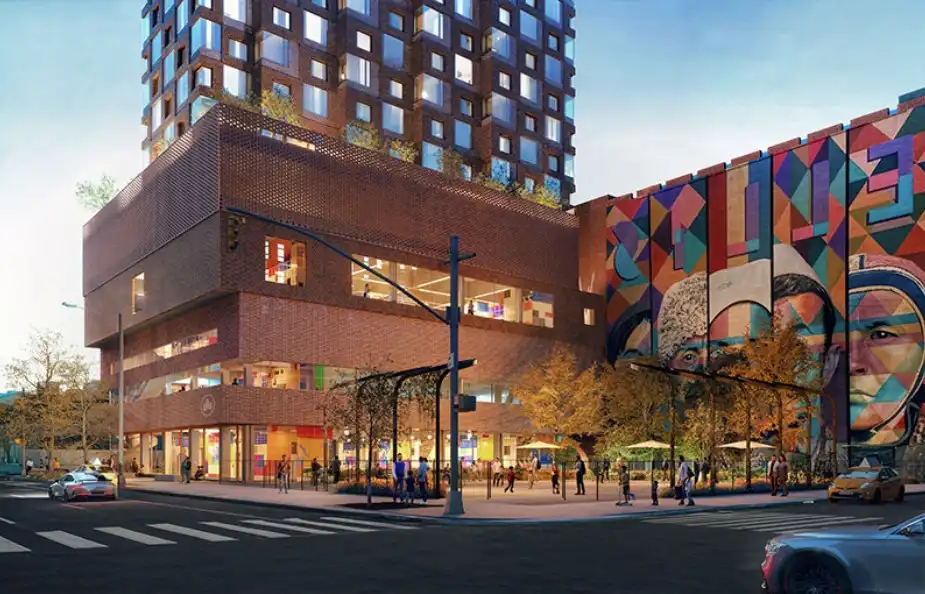
A number of community advocates in Greenwich Village have raised concerns about a proposed 31-story affordable housing development after the developer behind the project was named on Public Advocate Jumaane Williams’ list of the city’s worst landlords.
In the final weeks of the Adams administration last December, the city announced that it had selected Camber Property Group as one of the developers of a city-owned lot at 388 Hudson St., a “first-of-its-kind” project combining a housing development and a publicly accessible recreation center. Services for the UnderServed (S:US) and Essence Development were also selected to develop the Hudson Mosaic project.
The development, proposed to rise 31 stories and soar around 400 feet into the sky, would be the tallest building in the neighborhood and includes plans for roughly 280 homes.
The city has outlined that the project would be a 100% permanently affordable development. Presenting plans to Manhattan’s Community Board 2 last month, the city outlined that rent would be set at between 40 and 100% of the Area Median Income (AMI).
However, several community groups have raised concerns about Camber’s involvement in the project after Williams listed the company’s founding principal, Rick Gropper, as the 17th worst landlord in the city, pointing to over 1,000 open HPD violations and 28 evictions at other Camber properties. They also questioned what the inclusion of a recreation center means for the future of the nearby Tony Dapolito Recreation Center, which has been shuttered for several years.
Developer of Greenwich Village site a ‘questionable choice at best’
Andrew Berman, executive director of Village Preservation, a non-profit advocating for the preservation of architectural heritage in Greenwich Village, NoHo, and the East Village, described the city’s decision to select Camber as a “questionable choice at best.”
Berman added that he would like to see iron-clad commitments that the building will remain permanently affordable.
“They’re designing it to be as tall as possible. They talked about ensuring that every apartment had river views. It almost sounds as though it’s being designed to eventually become market rate,” Berman said.
Village Preservation also said the city pointed to a “regulatory agreement” with Camber that would ensure permanent affordability at the development during the recent community board meeting. However, Village Preservation accused the city of failing to provide details about that agreement.
“This is little changed from past statements from the City that claimed to offer guarantees without backing them up,” the group said in a post.
Sommer Omar, a local resident and community activist, said the city was asked several times about what instrument it would use to ensure the development remains permanently affordable at the CB2 meeting and accused the city’s representatives of failing to provide a clear answer.
“I have not heard to date what legally enforceable mechanism they’re actually going to have to make sure that this is not just a pinky promise,” Omar said.
Omar also raised concerns about Camber’s presence on Williams’ ranking of the worst landlords in the city, stating that any landlord present on the list has raised several red flags.
“Any developer or landlord that has made it onto that list has cleared several hurdles that you don’t want them to clear,” Omar said.
Berman further contended that many of the units in the building would not be “affordable” to many New Yorkers because they are set to be listed at 100% AMI, which requires a single household to make roughly $110,000 in order to qualify.
“It’s not what most people think of when they hear affordable housing,” Berman added.
Layla Law-Gisiko, a district leader with the Chelsea Reform Democratic Club, also raised concerns about the proposed development, pointing to Camber’s “problematic track record,” which she said should “give pause” to the local community.
Law-Gisiko also claimed that the 31-story development is out of step with the local area, adding that a large-scale housing development would set a “bad precedent” for the neighborhood.
“It is grossly out of scale, and it will overburden the district,” Law-Gisiko said. “It also sets a really, really bad precedent in an area that is under tremendous speculative pressure.”
Neither the city nor Camber Property Group has responded to a request for comment.
Support for project within the community
Several local individuals have stated that the project represents a crucial opportunity to address the housing crisis.
Jeanine Kelly, a Democratic district leader who is running for the 66th Assembly District, described 388 Hudson St. as a “unique opportunity” to build roughly 280 units of affordable housing in an area that has few vacant units.
“I’ve been in the fight since 2015 on 388 Hudson and won’t stop until this affordable housing is built,” Kelly said. “We don’t have time for delays. New Yorkers need affordable housing right now.”
Kelly said it was once a “moonshot” to build affordable housing at 388 Hudson St. and noted that the development is a city project and believes that concerns over Camber’s involvement in the project “can be addressed.”
“This site is so critical because New Yorkers need affordable housing right now,” Kelly said. “Greenwich Village has been around for a long time. There’s very little undeveloped land.”
Manhattan CB2 Chair Valerie De La Rosa added that the community board will work to ensure accountability and transparency at the affordable housing development.
“Delivering 100% permanent affordable housing at Hudson Mosaic (388 Hudson St.) is an opportunity with great responsibility,” De La Rosa said in a statement. “Our focus is ensuring that outcome is achieved with strong accountability, transparency, and long-term stewardship that serves the public interest.”
De La Rosa previously noted that CB2 has supported the development of affordable housing at the site since 2015, pointing to the site’s “unique capacity.” In a statement issued in December, De La Rosa noted that the selection of a developer moved the project “closer to reality.”
Adolfo Carrión Jr., then-deputy mayor for housing, economic development and workforce, said in December 2025 that the development will deliver much-needed housing and resources, including a six-lane indoor pool, a full-sized basketball court, indoor walking track, fitness areas, media lab and flexible community rooms in the proposed recreation center.
The city has also stated that 15% of units in the building will be reserved for formerly homeless individuals.
Leila Borzog, the current deputy mayor for housing, said in December that the project represented a “critical step” toward delivering high-quality, deeply affordable housing as well as delivering brand new recreation space in a high-cost neighborhood.
What does it mean for Dapolito Center?

But advocates have also raised concerns about what the development will mean for the nearby Tony Dapolito Recreation Center, a beloved local landmark and outdoor swimming pool that has been long shuttered due to structural issues.
The city has proposed demolishing the long-shuttered recreation center – designated a city landmark in 2010 – as part of a broader $164 million plan to revitalize the Clarkson Street corridor.
The city’s plan -introduced by former Mayor Eric Adams – calls for building a modern outdoor pool complex on the site as well as a separate indoor recreation facility located at the Hudson Mosaic at 388 Hudson St.
Omar, who founded the Coalition to Save the Public Recreation Center Downtown as part of efforts to save the Tony Dapolito Center from demolition, raised concerns that the recreation center at 388 Hudson will eventually represent a “complete replacement” for the Tony Dapolito Center.
“We are concerned that the new facilities will come at the expense of the complete erosion of Dapolito,” Omar said. “This is a city that is littered with broken promises from developers, particularly with respect to developing and constructing and maintaining facilities that are purely for the public.”
Omar added that public facilities like the Tony Dapolito Center are crucial due to the prevalence of luxury gyms and boutique studios in Greenwich Village.
“It’s really out of control.”
Berman similarly raised concerns that the planned recreation center at the base of Hudson Mosaic would replace Tony Dapolito as the only recreation center in the area. He alleged that elements of the building are “premised” on the demolition of the Tony Dapolito Center.
The city has proposed demolishing the Tony Dapolito Center – located at 1 Clarkson St. – after multiple rounds of investigative probes revealed multiple serious structural issues. Ultimately, the city determined that it bringing the current space would result in “significantly less usable space,” according to officials.
Restorative work would result in the reduction of the size of the pool from three lanes to two and leave the center with a non-regulation-sized basketball court with no spectator seating and a non-ADA accessible indoor track, according to Parks officials.
Berman said the city’s response was “100% a red herring,” adding that community groups have accepted that restorative work would result in changes to the interior layout of the building.
“This building was originally built as a public bathhouse, and it had to be changed and restructured to become a public recreation center,” Berman said. “There are all kinds of possibilities for how the building can be reimagined and reused, and the city is just really tossing out these red herrings as a way of avoiding their obligation, which is to preserve and restore the building.”
Omar, meanwhile, pointed to recently obtained FOIL documents which she says proves that the restoration of Tony Dapolito is feasible, adding that she will remain vigilant over the use of $100 million that the city allocated for the restoration of the center several years ago.
“We have a very clear and frankly copious public record that repair, modernization and reopening it is, in fact, feasible,” Omar said. “What I don’t take lightly is the possibility that those funds are going to be cannibalized for alternative purposes.”
Kelly pushed back against these fears and noted that the Parks Department has presented preliminary plans for the future of the Tony Dapolito Rec Center.
“It (388 Hudson St.) is not a replacement,” Kelly said.