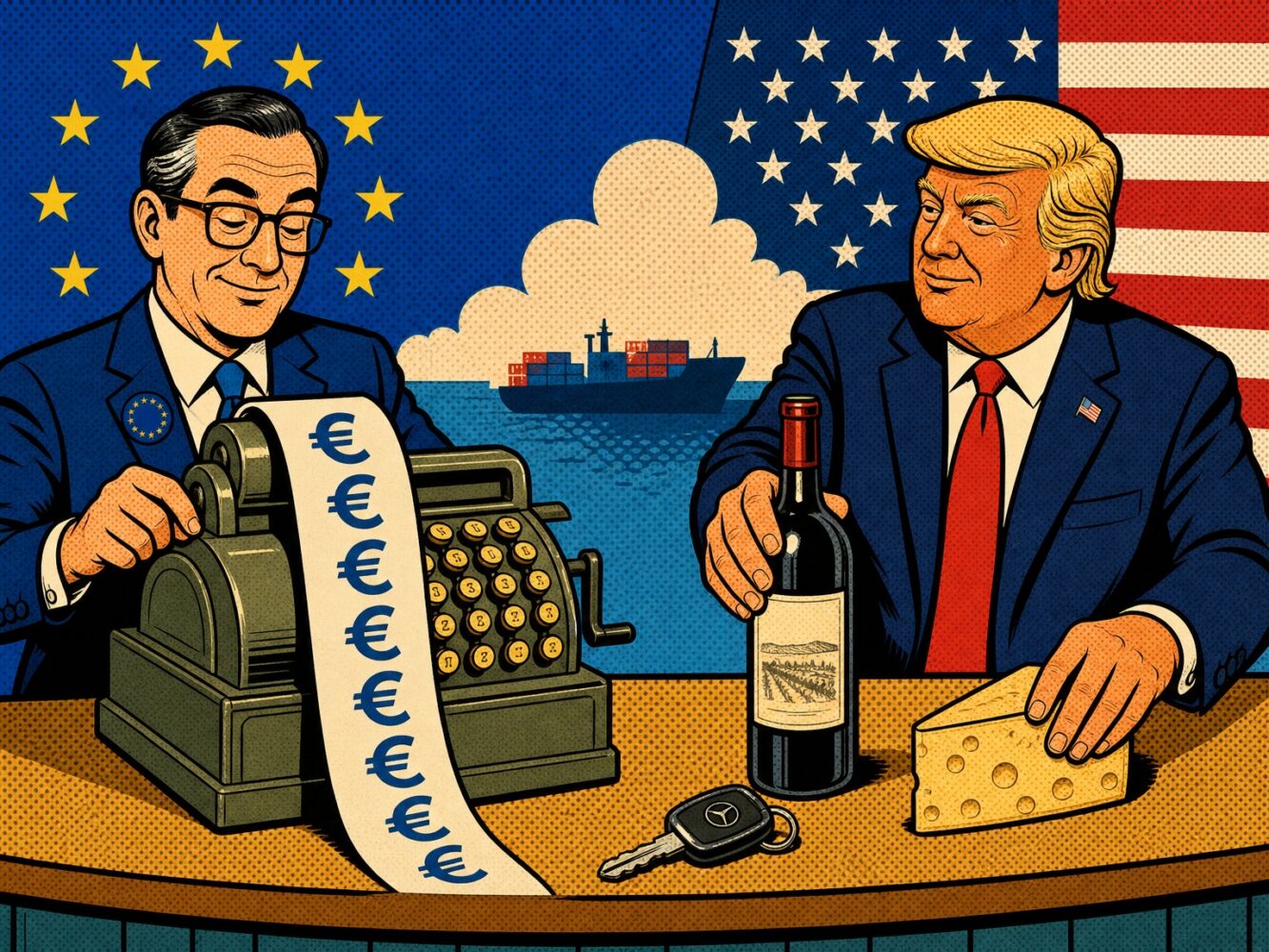
Brussels has spent two years testing how much regulatory pain Washington will tolerate before reaching for the tariff book. President Donald Trump may have supplied the answer. His threatened Section 301 investigation—a process that allows the United States to retaliate against foreign practices that unfairly burden U.S. commerce—could turn Europe’s digital rulebook into a transatlantic trade fight.
The immediate dispute revives a familiar argument. Brussels says it is policing anticompetitive conduct under the Digital Markets Act (DMA). Washington says Europe is taxing American companies. After two years of enforcement, the second account has become much harder to dismiss—which makes the Trump administration’s escalation worth taking seriously.
Last week, the European Commission fined Google €890 million under the Digital Markets Act. It imposed €460 million for favoring Google’s own shopping, hotel, transportation, and sports results in Google Search, and €430 million for restricting developers from directing Google Play users to cheaper purchasing options. The penalty was Google’s first under the law and the largest imposed under it to date.
The next day, Trump responded on Truth Social. He announced that the United States would “immediately” open a Section 301 investigation into what he called Europe’s “robbing” of American companies. The United States, he wrote, is not Europe’s “PIGGYBANK.” He predicted that the penalties would be “entirely reversed” and followed by a substantial tariff.
Some of Trump’s particulars do not survive contact with the record. The $15 billion attributed to Apple appears to include the Commission’s €13 billion Irish state-aid recovery order in a tally of “fines,” though it was not a fine. Nor can a Section 301 investigation “reverse” a legally binding Commission decision. Only the European Union courts can do that.
But the faulty arithmetic distracts from the two questions that matter: Is the underlying grievance well-founded? And, if so, is trade retaliation a defensible response?
On the first question, the evidence has become considerably harder to dismiss. On the second, the answer is probably yes—but for reasons rooted less in trade policy than in the political economy of European regulation.
Europe’s Industrial Policy in Antitrust Clothing
When Geoffrey Manne and I examined European Union competition enforcement in 2019, we found that U.S. firms paid vastly larger fines than European ones. Still, we concluded that the disparity largely reflected the sectors the European Commission targeted and its sales-based method for calculating penalties—not deliberate discrimination. After the DMA’s enactment and enforcement, that conclusion is harder to sustain.
The design problem is familiar. The DMA’s thresholds capture firms based on aggregate size, not demonstrated market power. Applying those arbitrary metrics, the Commission has designated seven gatekeepers. Five are American, while only one (Booking.com) is European. That imbalance is no accident. When lawmakers adopted the DMA, Andreas Schwad—member of the European Parliament for Germany—said it should focus on “the top five” companies while avoiding European rivals.
Enforcement has made the pattern starker. Every DMA noncompliance penalty so far—€500 million against Apple, €200 million against Meta, and now €890 million against Google—has fallen on an American company.
The Commission’s specification decisions are even more revealing than the fines. On July 16, it told Google precisely how to satisfy two DMA obligations. Google must open 11 Android system-level features to rival artificial intelligence (AI) assistants. Beginning in January 2027, it must also share anonymized Search-ranking, query, click, and view data with competing search engines and AI chatbots on fair, reasonable, and nondiscriminatory (FRAND) terms.
These requirements go far beyond ordinary prohibitions on anticompetitive conduct. They are product-design mandates that de facto transfer parts of Google’s property to its competitors.
Nor is the Commission coy about the destination. In its first DMA review, it candidly conceded:
The DMA contributes to the EU’s competitiveness, innovation and technological sovereignty objectives by addressing structural bottlenecks in CPSs that may hinder market entry and scaling. By promoting contestable and fair digital markets, it complements efforts to close Europe’s scale-up gap in line with the EU Startup and Scale-up Strategy. It facilitates competition through obligations on interoperability, data portability, access to business user data, etc. and through restrictions on self-preferencing… [I]t forms part of a coherent policy framework aimed at strengthening Europe’s innovation capacity and reducing strategic dependencies.
Put plainly, the objective is digital sovereignty. The Commission is trying to bolster European rivals by redesigning—and partly expropriating—American technology companies. It is therefore no surprise that the same review identified cloud computing and AI as the next frontiers of DMA enforcement. The European Union’s June Technological Sovereignty Package, with its cloud-eligibility tiers and procurement preferences, pursues the same goal.
The Commission’s own documents thus frame the DMA as an industrial-policy instrument. It aims to reshape the internet according to European policymakers’ preferences and for the benefit of the firms they want to succeed.
To be fair, the DMA also binds Booking, and several of its loudest beneficiaries—including Epic and, increasingly, OpenAI—are American. The point is not that the law amounts to naked protectionism. It is that a facially neutral regime, administered by an institution facing the incentives described below, has produced a systematically one-sided result.
The costs also extend beyond U.S. shareholders and European consumers. Compliance consumes one of the scarcest resources at frontier technology companies: senior engineers’ time. Meta reports devoting roughly 600,000 engineering hours to DMA compliance. Google says it assigned about 3,000 engineers full time for two years to comply with a single article. The Commission’s impact assessment, by contrast, projected annual compliance costs of about €1.41 million per platform—a figure that now looks almost quaint.
Every hour spent rebuilding a codebase for Brussels is an hour not spent building something else. Google’s response to last week’s decision made the engineering and consumer costs explicit. Compliance, the company says, will require removing live hotel, flight, and restaurant prices and availability from European search results, while rolling back Play Store safeguards. American users may not pay the fines directly, but they still pay for the engineering talent diverted from improving the products they use.
Making Brussels Feel the Cost
The deeper problem is that European policymakers pay almost no political price for enforcing the DMA more aggressively. The benefits of DMA enforcement flow to organized, well-represented constituencies: firms seeking access to rivals’ platforms, publishers, telecom incumbents, and would-be national champions. The costs are diffuse, delayed, and largely shifted onto foreign shareholders and 450 million consumers across 27 member states, who experience product degradation simply as products getting “worse.”
The fiscal incentives point in the same direction. Fines flow into the general EU budget and reduce member states’ gross-national-income contributions. That gives governments revenue without the political unpleasantness of raising taxes.
The contrast is telling. When the Commission blocked the Siemens-Alstom merger, Paris and Berlin issued a joint manifesto—and successfully demanded changes to the merger rules. When the Commission fines Apple, nobody blocks a motorway.
The result is a policy that is nearly free at the point of production. European officials intend to keep it that way. They describe the DMA as settled law and refuse to treat it as a bargaining chip in trade talks, despite the August 2025 joint framework in which the EU and United States agreed to address unjustified digital-trade barriers.
If the force driving enforcement is a public-choice problem—policymakers can impose the costs because almost nobody at home feels them directly—then the only response likely to work is one that creates a European constituency with something to lose.
That is what targeted tariffs can do, which is why the choice of target matters far more than the headline rate. French and Italian wine, agricultural products, German automobiles, and pharmaceuticals are obvious candidates. These sectors have the organizational muscle to pressure national capitals, which can then pressure Brussels. The EU is already lobbying Washington for tariff relief on wine, spirits, olive oil, and cheese. That tells us where the pressure points are.
Tariffs are not costless, of course, and escalation could trigger the EU’s Anti-Coercion Instrument, which allows Brussels to retaliate against foreign economic pressure with tariffs, procurement restrictions, and other limits on market access. But the relevant comparison is not tariffs against some frictionless alternative. It is tariffs against the status quo, in which the political cost to European policymakers of discriminatory regulation is roughly zero.
Now imagine the shoe on the other foot. Would the European Union sit quietly while its most successful companies were fined billions abroad under rules calibrated to capture almost exclusively them? It created the Anti-Coercion Instrument in response to considerably less.
Does the DMA Pass the Section 301 Test?
Section 301(b) of the Trade Act of 1974 permits action against a foreign act, policy, or practice that is “unreasonable or discriminatory” and “burdens or restricts” U.S. commerce. The 1984 amendments define an unreasonable practice as one that is unfair and inequitable, even if it violates no international legal obligation, and a discriminatory practice as one that denies national or most-favored-nation treatment. The statute also expressly contemplates foreign industrial targeting.
Because the DMA is facially neutral, de jure discrimination will be difficult to prove. The de facto case is much stronger. Designations, fines, and specification decisions have fallen disproportionately—and, in enforcement cases, exclusively—on American firms. Compliance costs exceed the Commission’s estimates by orders of magnitude, while total losses for U.S. companies may reach €114 billion.
The harder question is credibility. As of this writing, the Office of the U.S. Trade Representative’s (USTR) public docket lists no DMA-related investigation. It is already handling 18 investigations, from forced labor in China and elsewhere to German pharmaceutical pricing. Tariffs arising from the forced-labor investigation also face a challenge before the U.S. Court of International Trade. Whether USTR has the capacity to complete another major Section 301 investigation is therefore far from clear.
Europe, meanwhile, treats Section 301 as unilateral coercion, which raises the domestic political cost of yielding to it. Turning that confrontation into a tractable dispute will require a narrow, carefully documented case—not another press release with capital letters.
The DMA has become an instrument of industrial policy whose costs fall overwhelmingly on a small group of foreign firms and consumers around the world, many of whom have no political voice in Europe. That is precisely the kind of problem trade law’s nondiscrimination principle exists to address.
The goal should remain a negotiated settlement, and success should be measured by whether Europe changes how it applies the DMA—not by how much tariff revenue Washington collects. Trump’s rhetoric may be blunt, but Brussels may not reconsider the cost of DMA enforcement until French wine, German cars, or Italian cheese starts picking up the tab.
