A woman walks differently when a dress understands her.
She does not simply enter the room. She ripples into it. Beadwork catches the light, trembles against the body, and seems to come alive with each step, almost in the way a Jack Whitten surface can shift before the eye or a great painting can refuse to remain still. Light becomes motion. Embellishment becomes pulse. The body becomes a moving canvas. Dressing, when handled with real intelligence, is not vanity. It is choreography, architecture, seduction, and self-possession. It is art in motion, and Frederick Anderson understands that with unusual fluency.
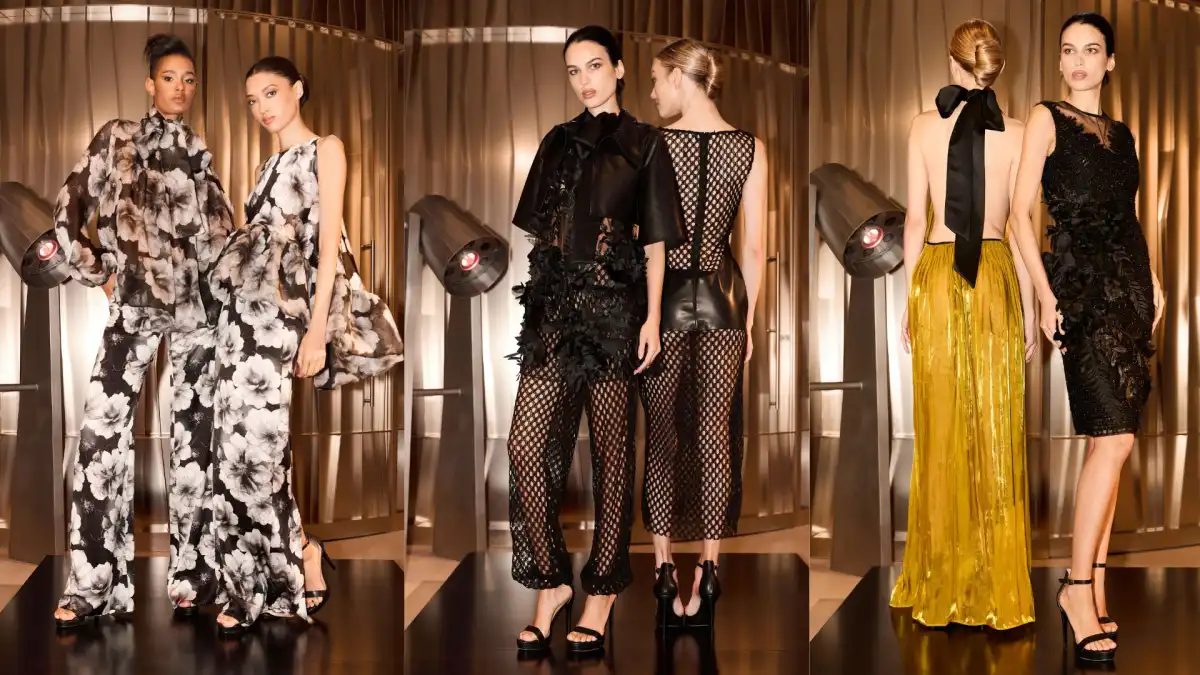
His Resort 2027 collection, presented last week at Printemps in New York, made that argument with elegant conviction. The 24-look offering was inspired by “a night in Careyes,” the ultra-luxury resort village in Mexico, yet it never fell into resort cliché. Rather, Anderson treated escape as atmosphere: heat on skin, silk grazing the frame, champagne lifting an afternoon into mischief, and a woman becoming slightly more magnetic by evening.
The setting mattered. Printemps, with its French department-store mythology newly translated into Manhattan rhythm, provided an apt stage for a collection built around touch, polish, and controlled sensuality. The afternoon had the soft electricity of the New York fashion crowd at ease: editors, stylists, clients, tastemakers, and women who understand that clothes are not simply worn. They are inhabited.
There was champagne, of course. There should always be champagne when clothes are this willing to flirt.
Anderson described the collection as uplifting, designed for a trip away or the holidays in New York. That duality is part of its charm. These are clothes with passports and dinner reservations. They belong equally to a sun-struck terrace in Mexico, a candlelit evening uptown, or a New York afternoon when a woman wants to look as though life has been especially generous to her.
Inspired in part by Slim Aarons’ vision of Acapulco and the Mayan Riviera, the collection carries that rare midcentury leisure impulse without becoming costume. Anderson is not simply chasing nostalgia. Instead, he extracts the attitude: languor, saturated color, and the quiet command of women who know precisely how they wish to be seen.
His strength, perhaps most importantly, is that he understands women’s bodies without reducing them to trend or ornament. The clothes have shape, but not punishment. They offer drama without swallowing the wearer. There is sensuality here, yet it is intelligently handled through proportion, texture, and movement. Anderson seems especially fluent in the difference between revealing a woman and exposing her. That distinction is everything.
Texture, as always, takes center stage. The season’s main print, a cactus flower rendered on silk fabric in the Italian hand-painted tradition, layers multiple motifs to create a woven, almost three-dimensional effect. It has depth, heat, and painterly lushness, as though the flower has been remembered through sunlight rather than merely depicted.

A Mexican terra cotta palette appears throughout Anderson’s signature tweeds, giving them the suggestion of raffia without losing structure. Resort often leans too heavily into ease, forgetting that luxury needs discipline. Anderson allows the materials to breathe, while maintaining the architectural poise that makes his work feel distinctly his own.
Then come the gowns. Chartreuse appears with tropical audacity, bright but not naïve. Red arrives charged with evening heat and unapologetic presence. These are dresses for women who do not require permission to be looked at, though they are far too refined to beg for attention.
The closing gown gave the collection its final flourish. A couture piece sewn with long vinyl sequins on the bias, it created a winging effect around the body, turning movement into shimmer and silhouette into flight. It was a reminder that Anderson, at his best, knows how to merge glamour with construction. The impact is not in excess alone, but in the intelligence of cut, placement, light, and the way a garment seems to understand the woman inside it.

Printemps also marks an important return to wholesale for Anderson, with the collection available in the retailer’s second-floor Boudoir. The placement feels fitting. There is something intimate and slightly theatrical about the Boudoir as a setting, a place where fashion becomes personal, tactile, and deliciously less anonymous.
Resort 2027 succeeds because it understands that escape does not always require departure. Sometimes it begins with a dress. Sometimes it arrives in silk, tweed, chartreuse, terra cotta, or sequins catching the light at precisely the right angle.
Frederick Anderson has given women a collection made for arrival. In Careyes, in New York, or wherever the next beautiful evening happens to find them.
For more information, visit frederickandersonDesigner.com.
