The long overdue disclosure of reams of air quality records by the administration of Mayor Zohran Mamdani this week offered advocates and survivors some answers for what they knew for the last quarter-century: that the environment in the Lower Manhattan offices, homes and schools they returned to immediately after the Sept. 11 attacks on the World Trade Center was unsafe.
The more than 170,000 pages — and counting — show city leaders knew the environment around Ground Zero was unsafe even as they publicly reassured New Yorkers otherwise. More than 2,900 people died in the attack on the Twin Towers; thousands more are believed to have died of related illnesses in the 25 years since.
The records have been the subject of furious debate in the decades following the terror attacks. Survivors asked: What did the government know about the air quality in Lower Manhattan and elsewhere, and when did they know it?

The City Reporter reached out to advocates, first responders and survivors, many of whom fought to enshrine the 9/11 Health Program and Victims’ Compensation Fund to all who were sickened or injured as a result of the attacks on the World Trade Center.
Their hope, on yet another somber milestone, is that the records compel further research into the hazards and illnesses that are excluded from federal funding. And they believe that the disclosures can — and should — empower a new generation of New Yorkers to seek the benefits they are entitled to.
These interviews have been condensed for length and clarity.
Dan Moynihan
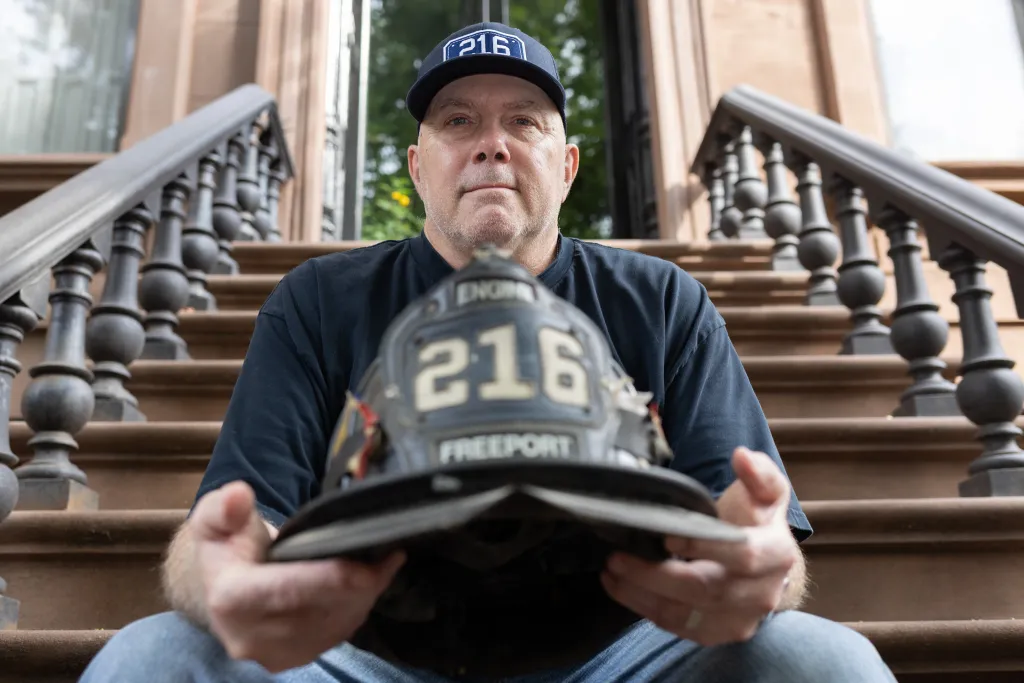
Moynihan, 61, was on site after the terrorist attack and worked on the Ground Zero clean-up operation for a month as a volunteer firefighter from Freeport, Long Island. The Marine Corps veteran is among those who successfully lobbied Congress to create a health fund for 9/11 first responders and survivors. He is now retired and lives in Bedford-Stuyvesant with his husband.
I first heard the records would be released when Mayor Mamdani announced earlier this year he was allocating $34 million to create the online portal. I was already a big fan of the mayor, and voted for him. But this, to me, was huge.
I worked for more than 12 hours on Sept. 11, until I was so severely dehydrated I was sent to the emergency room at Long Island College Hospital in Brooklyn for an IV and more treatment. I was discharged on the promise that I would rest and not immediately go back to the Pile. As I walked out of the hospital I saw a couple of cops and asked if they were going back to Manhattan. They told me to hop right in their van.

Back at Ground Zero we were woefully ill-equipped. We didn’t get respirators for weeks, and even then the replacement filters were hard to come by. I’m sorry to admit that I often preferred to just work without them, to take them off. They got so clogged up anyway — it was almost like, what’s the point?
We were totally monetized by the administration at the time. Giuliani and Bush wanted Wall Street and Manhattan reopened at our expense.
I’ve had 14 surgeries and procedures for illnesses, including the removal of a brain tumor. I deal with debilitating cluster headaches, chronic migraines and respiratory issues. I lost a lot of people that day, including some of my best friends. And it’s not over. We’re still dying.
I’m not interested in suing anybody. But I hope that the documents help shed new light on the associated conditions not currently covered by the 9/11 health program and inspire more people, especially young people, to get enrolled.
I speak at schools and I often hear young people who are hesitant to seek eligibility. They’ll say something like, ‘No, that’s for you guys — you’re the heroes.’ ‘No,’ I say. ‘We fought for everyone to get covered.’
Lila Nordstrom
Nordstrom, 42, was a sophomore at Stuyvesant High School when the World Trade Center was attacked. She is an author of Some Kids Left Behind and a founder of StuyHealth, which represents former schoolchildren who were in lower Manhattan on 9/11.
We went back to school on Oct. 9, 2001, less than a month after the attacks. We immediately knew the air was unsafe.
The city reassured the school community that the building had been vacuumed and sanitized, and that it had installed new HEPA filters. But Stuy is located just three blocks from the World Trade Center. The fires were burning until January.
And a dump site was erected on a barge next to the school — continuously recontaminating it every time debris and other materials were dumped there. We heard and smelled everything. Every time crews dumped something in there we would hear a loud crash — and everyone in the school would jump. Kids were constantly coughing. The lines to the nurses’ office seemed endless.

I think our leaders at the time failed in their duty to protect the residents of New York again and again. Stuyvesant is not a school that serves a neighborhood population — we were all commuting to the dust.
The youngest Stuyvesant alumni were diagnosed with cancer in their early 20’s. Now the number of people diagnosed is about 30 to 40. An untold number of people have been diagnosed with reproductive health and autoimmune issues, too. But there is very little available research on survivors.
In the survivor community, I don’t think that these documents will be met with a huge amount of shock. I think all of us understand that we were misled about the safety of the air downtown. But I have a lot of curiosity about what the city knew and when, in regards to sending civilians and schoolchildren like myself back to school. How much of the information they gave us was intentionally misleading versus them actually not knowing?
I hope that the release of these documents inspires more research to be done on this cohort, and that more survivors enroll in the health and victims’ compensation programs.
Fekkak Mamdouh
Mamdouh, 65, moved to New York City from Morocco in the late 1980s, and found work in restaurants. He started as a waiter at Windows on the World at the top of the North Tower in 1996, and was a shop steward in the restaurant’s union. Colleagues on every shift came to him for help. On Sept. 11, 73 of his colleagues were at work when American Airlines Flight 11 crashed into floors below, trapping them.
He immediately began helping any way he could, focusing on the families of his colleagues who died – many who didn’t have savings and were afraid to get help. That work led him to co-found the One Fair Wage campaign.
I lost 73 of my brothers and sisters at Windows on the World. I fought with the union to help people and do some relief — money to help people pay their rent, groceries, especially for the undocumented families. They had a really, really hard time asking for help.
After Sept. 11 the government set up a huge, huge tent on a pier with help for everybody. But there was an immigration and FBI table at the entrance. People that were undocumented or people who look like me, are Muslim, they were scared to go. We used to go with them to the center for help.

A lot of people got sick. I have a friend I was with just yesterday who has cancer. Back then we did not know, nobody told us that you have to be covered with masks. We served food to the firefighters, police department, people helping with the debris. We never worried about getting sick. We were working so hard to help people and we were not even taking care of ourselves, we did not have any experiences, we did not know that after this people were going to have all these diseases.
From the ashes of 9/11 we created this center that started in New York fighting for the workers, it was fighting for minimum wage.
[My colleagues] just came to work, they have families, they had hope, they were looking towards the future and their families. In their name we start organizing and letting people know that you have to fight for your rights.
I want the young people to stand up for their rights, to not let anybody tell them now. It’s your rights, stand up, fight for it.
Our nonprofit newsroom relies on donations from readers to sustain our local reporting and keep it free for all New Yorkers. Donate to THE CITY today.
The post For These 9/11 Survivors, Newly Published Air Quality Records Bring Some Answers appeared first on The City Reporter.
