Generative AI strains nearly every layer of copyright law. Policymakers have focused most on one pressure point: the use of copyrighted works to train AI models. Fitting that practice into a legal framework that supports both creative industries and the AI sector has proved difficult.
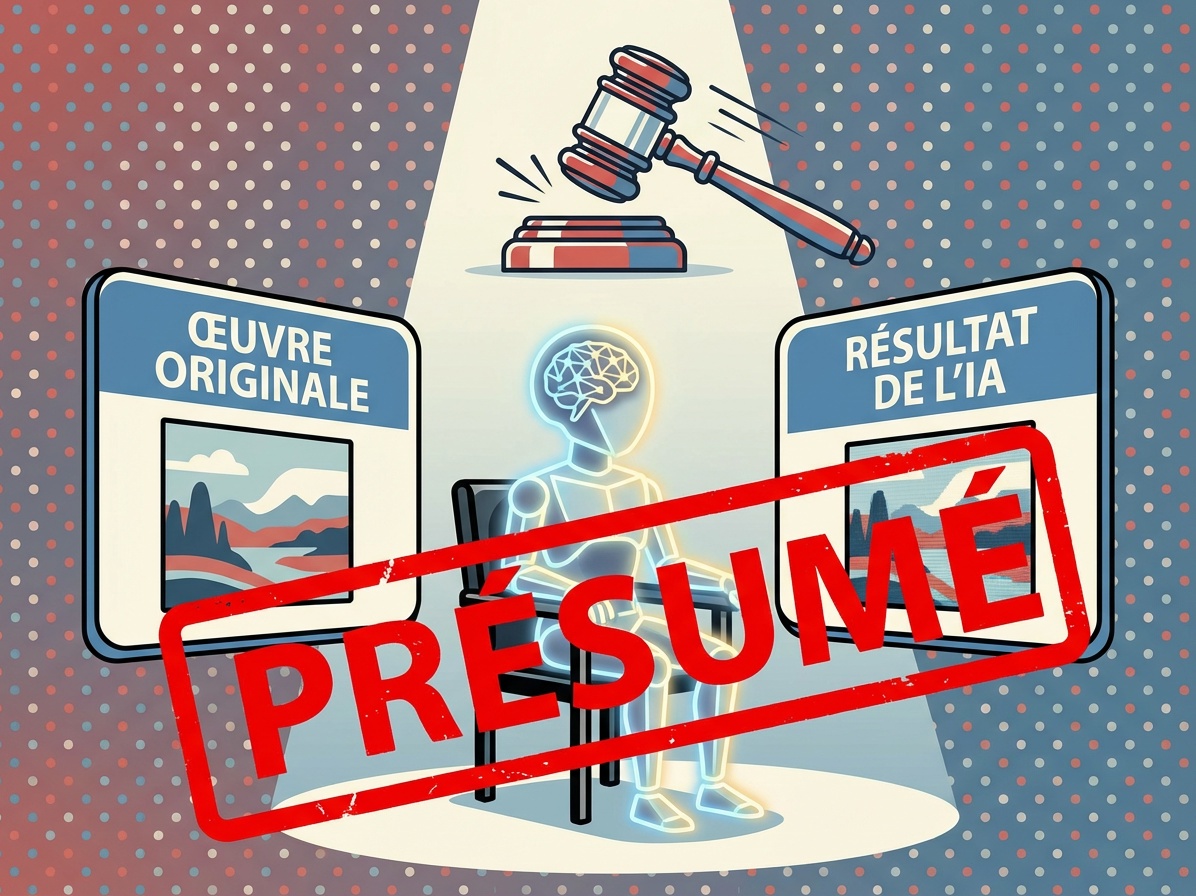
Against that backdrop, a recent French Senate proposal would add a striking procedural innovation. It creates a presumption that AI systems used protected works whenever there is a plausible indication of such use. In practice, that shifts the burden of proof in civil cases. Plaintiffs would no longer need to show their works were used in training or deployment. AI providers would have to prove they were not.
At first glance, the idea has intuitive appeal. It responds to a well-known problem in AI litigation: information asymmetry. Model developers control the key facts—training data, model architecture, and deployment. Rightsholders and other outsiders often lack visibility into whether and how their works were used. Seen this way, the proposal aims to rebalance evidentiary burdens in light of technological change. Done carefully, that approach could benefit both creators and AI developers.
The details matter. The French proposal collapses distinct categories of evidence into a single trigger for burden shifting. That choice carries significant consequences for how the rule would operate in practice.
Looks Like, Therefore It Is? Not So Fast
There is a meaningful distinction in this context between two types of evidence: inputs and processes, on one hand, and outputs, on the other.
The first category includes documentation about training datasets, internal communications about data ingestion, and technical records related to model development. When a plaintiff can point to this kind of evidence—and when it is reliable—the presumption functions as a fairly conventional procedural tool. It encourages disclosure from the party best positioned to provide it. Courts already move in this direction in other complex cases where one side controls the key information. Seen in that light, the presumption looks less like a departure from established practice and more like a formalization of it.
The second category presents greater difficulties. The proposed French statute allows the presumption to arise from indications tied to the “result generated” by the AI system. That language invites arguments based on output resemblance, stylistic similarity, or probabilistic inference. These forms of evidence differ in kind from evidence about known—or highly likely—training inputs. They are indirect, often ambiguous, and in most cases consistent with lawful behavior.
Modern machine learning systems are designed to capture statistical regularities across large corpora. As a result, they can generate outputs that resemble existing works without memorizing or relying on any specific protected work. That feature is not unique to artificial systems. Human creators operate in much the same way. Authors, musicians, and artists routinely internalize patterns, conventions, and stylistic elements from prior works. In some cases, they build entire careers around recognizable forms of influence.
Copyright law has long accommodated this reality. It distinguishes between protected expression and the unprotected ideas, styles, and building blocks that circulate through creative fields. Much of what appears “original” already reflects layers of prior influence embedded in derivative or transformative works. Models trained on large corpora may reproduce patterns that reflect this accumulated structure, rather than any particular protected work. Treating similarity as evidence of use risks collapsing that distinction and attributing to AI systems a form of copying that the law has historically declined to infer in analogous human contexts.
Similarity, in this sense, is not a reliable proxy for use. Treating it as such conflates two distinct questions: whether an output resembles a protected work, and whether that work was actually used in developing the system.
When ‘Close Enough’ Is Enough to Sue
From a procedural standpoint, the shift matters because the presumption does more than shape the ultimate finding of liability. It lowers the bar for bringing—and sustaining—litigation. If output similarity can trigger burden shifting, plaintiffs can proceed on relatively weak signals. Once triggered, the defendant must disprove use—a costly and sometimes elusive task. Proving a negative, especially in complex technical systems, is no simple matter.
This dynamic raises familiar law & economics concerns about error costs and litigation incentives. Lowering plaintiffs’ evidentiary threshold increases the risk of false positives. Some claims will move forward even when no actionable use occurred. At the same time, defendants bear the cost of rebuttal, including extensive discovery and technical analysis. Expected litigation costs rise, regardless of the merits.
Those asymmetries shape behavior. Even when an AI provider has strong arguments, the cost and uncertainty of litigation may push toward settlement. Over time, that pressure can produce a de facto licensing regime—not because liability is clear, but because it is expensive to fight. The presumption then operates less as a tool for resolving disputes and more as a mechanism for reallocating bargaining power and rents.
The rule also risks over-deterrence. If output similarity alone can trigger meaningful exposure, developers may avoid training data or capabilities that produce socially valuable outputs. The risk is most acute where expressive works naturally share structures or styles. The line between legitimate generalization and actionable use blurs. The safest path may be to scale back development in ways that reduce legal risk, but also constrain innovation.
Finally, the proposal’s domestic, one-off nature raises concerns about legal certainty. As more countries adopt their own approaches to AI training, regulatory fragmentation is becoming a serious risk—if it is not already here.
Fixing Asymmetry, or Just Moving the Goalposts?
Despite sustained efforts to reconcile competing interests, policymakers still lack a clear approach to the relationship between copyright and generative AI. Nor have they settled on a workable solution that both streamlines access to data for AI developers and secures fair remuneration for rightsholders. As one of us has previously noted, current proposals focus more on the “why” and “how” of compensation than on the “when.”
The French proposal follows that pattern. Its core aim—ensuring remuneration in all circumstances—carries intuitive appeal. But that same objective risks producing significant unintended effects.
None of this undercuts the underlying concern about information asymmetry. It is real, and it sits at the center of AI-related copyright disputes. The harder question is whether this mechanism addresses that problem with sufficient precision.
A more tailored approach would draw clearer lines. It would distinguish between indicia causally connected to training or deployment and those that merely suggest similarity. For instance, the presumption could apply only when plaintiffs identify specific evidence about datasets, ingestion processes, or internal decision-making. Courts could also require a more particularized showing before allowing output-based arguments to trigger burden shifting. Constraints like these would address asymmetry without inviting opportunistic claims.
As drafted, however, the proposal treats all plausible indications as equivalent. That choice creates a wide gateway to burden shifting—one likely to be used most in cases where the underlying inference is weakest. Resemblance, in effect, can stand in for evidence of use, with significant procedural consequences.
More broadly, the proposal reflects a familiar pattern in AI governance. Faced with hard doctrinal questions, policymakers are turning to tools that reshape incentives rather than resolve first principles. That strategy can work when it is carefully calibrated. When it relies on imprecise proxies, it does not clarify the law. It just moves the fight.
