I live on the Upper West Side, near Lincoln Center and half a block from Central Park, among gracious trees, handsome buildings and suspiciously well-behaved dogs. The neighborhood does not look haunted. Little in its elegance announces the Black and Puerto Rican families who once filled these blocks with music, mischief, political force and mutual care. That polished quiet is, perhaps, what makes the erasure so dangerous. New York has become rather accomplished at dressing disappearance as progress.
At the BlackStar Film Festival in Philadelphia—a vital celebration of cinema by Black, Brown and Indigenous artists—the film’s opening-night world premiere made that silence almost thunderous.
Taylor Hosking’s West Side Familia retrieves a chapter I had never learned about my own surroundings. More intimately, it is a love letter to her late mother, who insisted there was far more to know about their shared streets. A third-generation Upper West Sider, Hosking follows that maternal guidance into her Puerto Rican ancestry and a broader inheritance of Black and brown solidarity. Mothers are, perhaps, our earliest spiritual cartographers, preserving truths before we understand why they matter.
The documentary centers La West Side Familia, a Puerto Rican-led biker gang and community-care collective formed during the 1970s. The word “gang” is quietly complicated here. These young people protected neighbors, cleaned blocks, advocated for gathering places and drew inspiration from the Black Panthers, the Young Lords and the squatters’ movement. Fellowship was not an attractive slogan. It was the infrastructure of everyday survival.

Beneath the mythology of Lincoln Center and Central Park West emerges San Juan Hill, once home to Black, West Indian and Puerto Rican residents before urban renewal displaced more than 7,000 families and 800 businesses to create superblocks including Lincoln Center. Grandeur can be real, naturally, while carrying a terrible cost. The arts complex I treasure stands where other lives and cultural worlds were made to recede.
Hosking also restores the pleasure often stripped from accounts of low-income Black and Latino life. People relied on one another for protection, certainly, yet gathered just as readily for delight. They rode motorcycles, painted, teased, danced and treated the pavement as a communal living room. Graffiti writer George Morillo and early hip-hop dance pioneer Popmaster Fabel Familia reveal a district that helped invent culture later consumed as fashion. There is something especially cruel about enjoying the harvest while allowing its makers to vanish from the accepted story.
The squatters’ movement forms another essential strand. In 1970, Operation Move-In saw residents occupy vacant city-owned buildings around Columbus Avenue to resist displacement and create housing where municipal neglect had left only emptiness. “Squatter” can sound faintly disreputable from the comfort of a deeded apartment, yet this history reveals people converting abandonment into shelter, proximity into protection and collective will into sanctuary.
That organizing strength was later battered by the crack epidemic, AIDS, disinvestment and criminalization. West Side Familia refuses the lazy fiction that these bonds dissolved through personal failure. Catastrophe can exhaust a movement by forcing every available resource toward surviving addiction, illness, grief and the loss of those who once held entire blocks together.
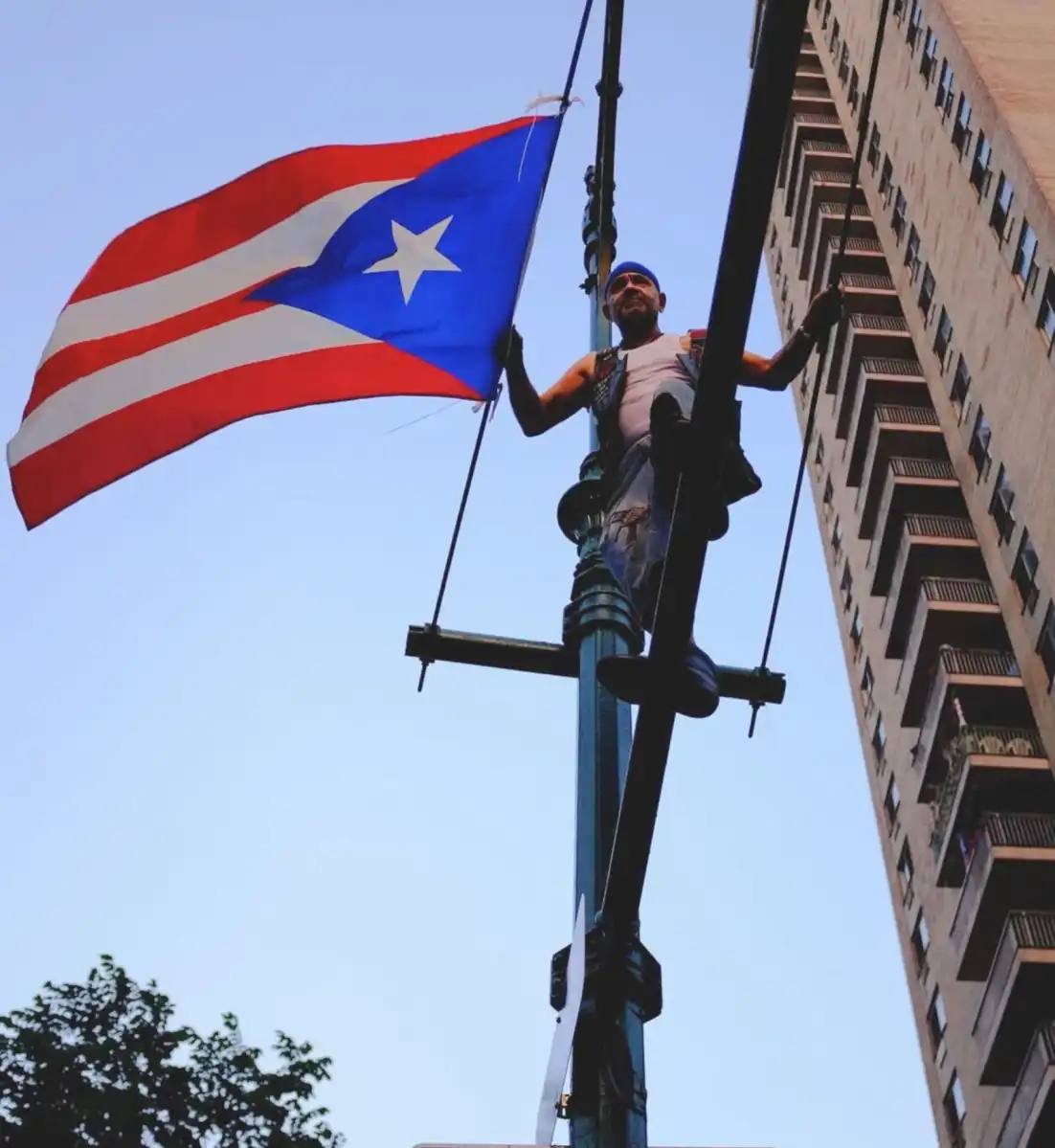
Gentrification, in Hosking’s telling, is not only the replacement of affordable apartments with expensive ones. It is also, rather insidiously, the conquest of meaning. One resident sees elders gathered on a corner and recognizes a lineage of protection; another perceives danger and calls the police. One hears continuity in music, while someone else hears noise. A Puerto Rican flag raised at 93rd Street and Columbus becomes either a cherished declaration of belonging or an inconvenience, depending upon whose interpretation carries institutional power.

This is not an indictment, nor does it ask the present to apologize for existing. It asks for something more meaningful: honesty. Beauty need not depend upon amnesia; safety cannot mean only the absence of unfamiliar people, and a quieter block is not necessarily more innocent. Such truth-telling becomes homage, honoring those who fought, loved and died for dignity and belonging as similar struggles continue.
I still adore the Upper West Side, naturally. Its trees, cultural institutions and almost theatrical self-regard remain part of its considerable charm. Affection without historical consciousness, however, is merely staging. Loving a neighborhood honestly requires knowing what its loveliness cost, who defended the right to remain and whose care made these streets livable long before they became enviable.
West Side Familia gives the Upper West Side back its pulse. The Puerto Rican flag above 93rd Street becomes more than ritual; it asserts an ancestral claim upon the corner and declares that those pushed from the dominant narrative have not relinquished their place in history.
https://blackstarprojects.org/
Catch upcoming viewings: https://www.westsidefamiliafilm.com/
