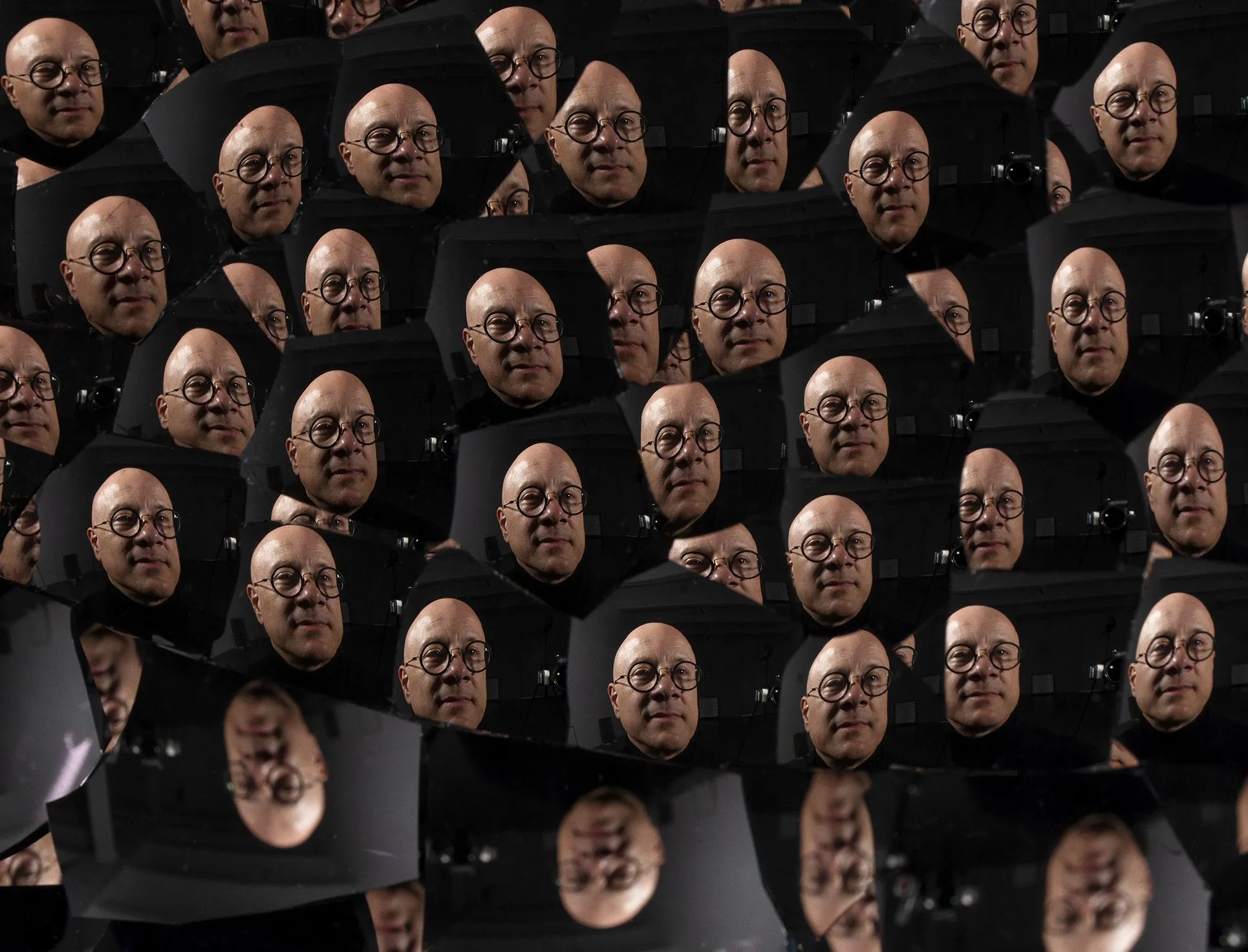
What number of photos could be contained inside a single picture? Or to place it one other manner, what number of completely different realities can exist on a seemingly plain monochrome floor composed of hundreds of micropatterns that work together with mild and area in several methods? For nearly a decade, Mexican artist Gabriel de la Mora has been trying to find a solution to paint with out paint, utilizing as a substitute each natural and inorganic fragments from the universe to check new symbioses and synergies of magnificence, the place the human-made world can nonetheless encounter some phantasm of concord and cosmic order inside the broader entropic course of nature.
Embracing and mixing the legacies of Minimalism and Arte Povera, De la Mora has formulated his personal distinctive type of natural and cosmic abstraction the place micro and macro cosmos collide. Obsessively accumulating remnants of each the constructed and pure world—eggshells, shoe soles, speaker screens, feathers, butterflies and stones—he engaged with a cloth archaeology that makes an attempt new types of taxonomy and classification. The ensuing compositions are visually and alchemically harmonious and deeply attuned to the innate properties of supplies and the encompassing atmosphere.
In these materials afterlives, the unique factor virtually disappears, exposing the continual cycles of accumulation and erosion that govern all issues, as entities flip into particles and fragments solely to take form once more in new kinds inside the countless circle of entropy and transformation. “Every part begins with the fragility of the fabric and the stress that comes from that fragility. The fabric could also be fragmented, however by way of type it finds new resistance and new power,” De la Mora tells Observer as we stroll by way of his newest present at Perrotin. The exhibition’s title, “Repeated Unique,” alludes to this, revealing an artist whose follow exists in relation to and collaboration with the broader cycles of matter.
“The thought is to go as minimal as potential in portray however by way of the utmost period of time, work and energy. It strikes from the minimal to the utmost, after which again to the minimal,” he explains. The sequence he’s presenting here’s a fruits of this relentless pursuit throughout completely different supplies. In his CaCO₃ sequence—named after the chemical method for calcium carbonate—white eggshell turns into the principle part, used by way of fragmentation and repetition to create a brand new monochrome entire.

“There may be all the time a dialogue right here with abstraction,” De la Mora says. “For me, the whole lot is each formal and conceptual. Every part turns into a monochrome, an abstraction, and a repetition of photographs with variations.” He typically makes use of the analogy of digital pixels. A picture composed of a single pixel, 20 pixels organized in a grid or 20,000 pixels forming a practical picture can nonetheless characterize the identical topic. Equally, his work shifts between micro and macro buildings, exploring correspondences inside the broader structure of actuality.
On this repetitive cycle of fragmenting, destroying and reassembling, the work begins to resemble a type of meditation—one which remembers the Japanese philosophy of wabi-sabi with its acceptance of impermanence and transformation. De la Mora describes his follow as an energetic type of meditation, an ongoing engagement with matter that requires attuning to its bodily properties in an effort to information these fragments towards their subsequent type. “I’m all the time taking part in with the micro and the macro—the correspondences, the construction of actuality and all these sorts of issues,” he says. “It requires numerous self-discipline. However it additionally turns into one thing meditative. I turned a bit obsessive with the sequence, however if you see how the sunshine interacts with them, it turns into unbelievable.”
This ingenious engagement with uncooked supplies echoes the artisanal resourcefulness shared throughout many Latin American cultures, the place robust ties to ancestral traditions have preserved a uncommon intelligence of supplies. In lots of Latin American contexts, he acknowledges, artists have labored with humble or leftover supplies, growing an ethos of artisanal transformation. For him, transformation is the central idea: objects initially created for sensible capabilities purchase new meanings as soon as their authentic perform ends. “My definition of artwork is easy: artwork isn’t created or destroyed—it’s remodeled,” he asserts. “If I needed to cut back my work to at least one phrase, it will be transformation. You can additionally name it a chemical or alchemical transformation, a change of state.”
From this reflection got here the exhibition’s title. “The unique is exclusive, however there are by no means two equivalent issues. True repetition doesn’t exist, as a result of there are all the time variations. There aren’t any two equivalent DNAs, no equivalent voices, eyes or fingerprints. You’ll by no means discover two people who find themselves precisely the identical,” he explains, noting how one can nonetheless rediscover magnificence in concord by way of the act of composing fragments. His installations are refined, occasion luminous, but they continue to be deeply materials, constructed from bodily substances and handbook labor.

The present physique of labor emerges from his beforehand steady try at “portray with out paint,” constant all through his follow: the concept of increasing portray past conventional pigment to have interaction with the very cloth of actuality as picture, and with the countless potential photographs already current inside the steady actions of particles coagulating into type. The works on view concurrently perform as drawings, work and sculptures, combining linear construction, floor and three-dimensional presence whereas sustaining a proper language of monochrome abstraction and refined variation.
“Once more, the whole lot right here is formal and conceptual. Every part turns into a monochrome, an abstraction and a repetition of photographs with variations,” De la Mora emphasizes. But what he desires viewers to expertise is the method, the fabric and the shape. “The primary affect of any paintings is all the time visible—it enters by way of the eyes, by way of the formal side and thru emotion,” he says. “Then contemplation begins to boost questions. One thing strikes you emotionally, after which it makes you suppose. For me, that’s the smartest thing that may occur in artwork.” Every part is formal and conceptual on the similar time. “These two issues can’t be separated. If one among them is lacking, the whole lot is lacking,” he says, smiling.
But De la Mora additionally says that even the conceptual dimension finally belongs to the viewer. He desires to go away the ultimate decoding and meaning-making to those that encounter the work. “Artwork is for everybody. You don’t have to learn about artwork to see artwork. When you’ve got eyes, you will notice it, and you’ll suppose. And for those who don’t have eyes, you possibly can expertise artwork by way of contact or by way of different senses,” he explains. “Artwork has to talk to the viewer in lots of instructions.”
He doubled down on this perception throughout his latest exhibition on the Jumex Museum in Mexico, which closed after Mexico Metropolis Artwork Week in February. Over six months, he performed 79 guided excursions and found that individuals touring the present typically recognized meanings in his work that he himself had by no means acknowledged.
His deliberate selection to go away the work’s coded materials composition open-ended additionally informs his determination to title works solely with numbers describing their materials components relatively than imposing interpretation—a way that may seem virtually scientific, bringing the work nearer to the concept of taxonomy. “You would possibly name {that a} scientific method, however for me it’s nearer to philosophy—asking questions in lots of instructions. Science and artwork are related in some ways, although not essentially within the technical sense in my work.”

His follow combines each a scientific engagement with supplies—when it comes to their chemistry and physics—and a extra inventive engagement with the philosophical and the religious. “I like how an thought can create a piece, the work can create a sequence and the sequence can create a brand new medium,” he notes, emphasizing the experimental dimension of his follow. At this second alone, in his studio, he’s exploring a number of completely different supplies he has by no means labored with earlier than, looking for the equation that may flip their obvious entropy right into a human-understandable order. On this course of, time turns into extraordinarily essential. “It’s a part of the concept of doing virtually nothing—with the utmost quantity of labor—to create a monochrome, which is essentially the most minimal picture potential. I actually love that contradiction.”
From this time-consuming but extraordinarily playful exploration of the properties of supplies got here his introduction of spherical aluminum-coated glass, marking a brand new optical flip. Every work’s alternating concave and convex surfaces produce recognizable but unstable and doubtlessly endlessly multiplying photographs relying on the angle. De la Mora engages with—and concurrently reveals—an alternate mathematical method that opens entry to other ways of perceiving actuality. “For those who have a look at this piece from right here, it creates a sort of visible phantasm—some components appear nearer, others appear farther away,” he observes, stating how particular optical results emerge from the interplay between concave and convex reflections. “The concave floor creates the phantasm that one thing is nearer, and your reflection seems the other way up. The convex floor creates the phantasm that it’s transferring farther away and seems smaller,” he acknowledges. “Then, the introduction and mixture of eggshell fragments in different separates the whole lot, so you have got the feeling of three planes regardless that there’s really just one.”
The eggshell fragments act as separators between these reflections, producing the feeling of a number of visible planes regardless that the floor is bodily flat. As viewers transfer by way of the area, the reflections shift and appear to animate the floor, giving the impression that the work itself is transferring. In actuality, the composition stays fully static—the motion belongs to the viewer. By means of this interplay, the attention begins to register what seems like three distinct spatial ranges rising from a single airplane.
Simply as dyslexia could cause written characters to seem reversed, the works invert the viewer’s expectations: what appears to maneuver upward may very well transfer downward, and vice versa. “If you have a look at my hand, what seems to be going up is definitely happening, and what appears to go down goes up,” De la Mora factors out. “I’m dyslexic. I write backwards, like a mirror picture. So that is virtually like a visible type of dyslexia. As an alternative of numbers and letters, it occurs with photographs. My reference to this work comes partly from my very own dyslexia, as a result of when you’re dyslexic, you might be consistently seeing issues in reverse.”
On the similar time, the set up engages intently with the structure of the area. The round motifs serendipitously echoed the gallery’s columns, whereas the nice and cozy gallery lighting he had simply arrange contrasted completely with the chilly surfaces of metal and concrete. Even the exhibition’s timing—opening March 5 and shutting April 11—locations it between winter and spring, a second he unexpectedly noticed mirrored within the interplay between the works and the encompassing atmosphere of snow, rain and shifting mild.
As viewers transfer by way of the area, small reflective fragments catch the spotlights, producing flickering factors of illumination that resemble constellations or open the floor into full of life diamonds. “Yesterday, we had been discussing methods to illuminate the exhibition. This morning, I got here again and seemed intently on the works, and we determined to strive turning off the ceiling lights,” he says. “Look how the sunshine interacts with them. They grow to be luminous our bodies.”

Generally it appears as if Gabriel De la Mora is just serving to issues discover their place. But inside this acutely aware relationship between the work and its broader spatial interactions, his structure coaching additionally emerges, which, like that of many Mexican artists of his era, gave him a specific understanding of supplies and area. “In a manner, these works are like structure with out perform or service. They’re sculptures, however additionally they resemble mechanical fashions,” he acknowledges. One can nonetheless see the extra geometrical—and architectural—dimension of those works within the drawings they comply with, tracing the underlying geometry that buildings the complete challenge: compositions constructed from straight strains and circles. “I all the time start with drawings. I don’t use computer systems or digital instruments,” De la Mora explains, acknowledging how his course of would possibly even really feel old school, virtually like one thing from the Nineteen Eighties. Reasonably than counting on digital instruments, he works intentionally at a drafting desk in an analog manner, utilizing millimetric paper, parallel rulers, pencils and sheets of mylar. “I place one sheet subsequent to a different, developing the geometry step-by-step. The construction all the time begins with strains and circles, after which the pictures seem by way of reflections and repetitions inside that geometry,” he explains.
These drawings type an in depth archive for every work, and he considers them artworks in their very own proper. The method itself has grow to be so central to the follow that he imagines it might type the idea of an exhibition devoted totally to the making of the work. The studio drawings, he notes, reveal one other dimension of the follow—one that nearly resembles a efficiency involving direct engagement with the construction of actuality, but from a really completely different perspective: one which now not follows the strictly anthropocentric, dominant and extractive method, however relatively applies a extra historic intelligence of supplies, extra attuned to the complicated relationship between human making and broader cosmic orders.
It’s a system of exchanges and interrelations that De la Mora not solely encourages viewers to acknowledge but additionally actively engages with himself, subtly repositioning them inside a dynamic shift in perspective. He connects the method to curiosity and play, recalling his father—a professor of philosophy—who advised him that youngsters are, actually, one of the best philosophers as a result of they uncover the world by consistently asking why. That sense of steady questioning and surprise, he says, stays central to his work. Playfully triggering our curiosity by way of his exploration and manipulation of fabric presences, his paintings encourages us to have a look at it—and on the world round us—with the identical childlike angle: free from inflexible scientific, ideological or political infrastructures, and with recent eyes.
Extra in Artists

