Pop has been declared dead often enough to qualify for its own resurrection retrospective. Too commercial. Too obvious. Too enamored of celebrity, branding and the shiny surface. Yet, despite it all, Pop persists. Of course it does. We still live inside the very machinery it learned to expose, only now that machinery fits rather neatly inside a handbag.
The movement’s central subject was never merely the soup can, comic strip or famous face repeated until personhood dissolved into packaging. Pop was always concerned with desire: how an image becomes an appetite, how commerce infiltrates identity and how repetition makes almost anything feel inevitable. In our feverish era of algorithms, memes and personal brands, that inquiry has not become obsolete. It has simply acquired Wi-Fi.
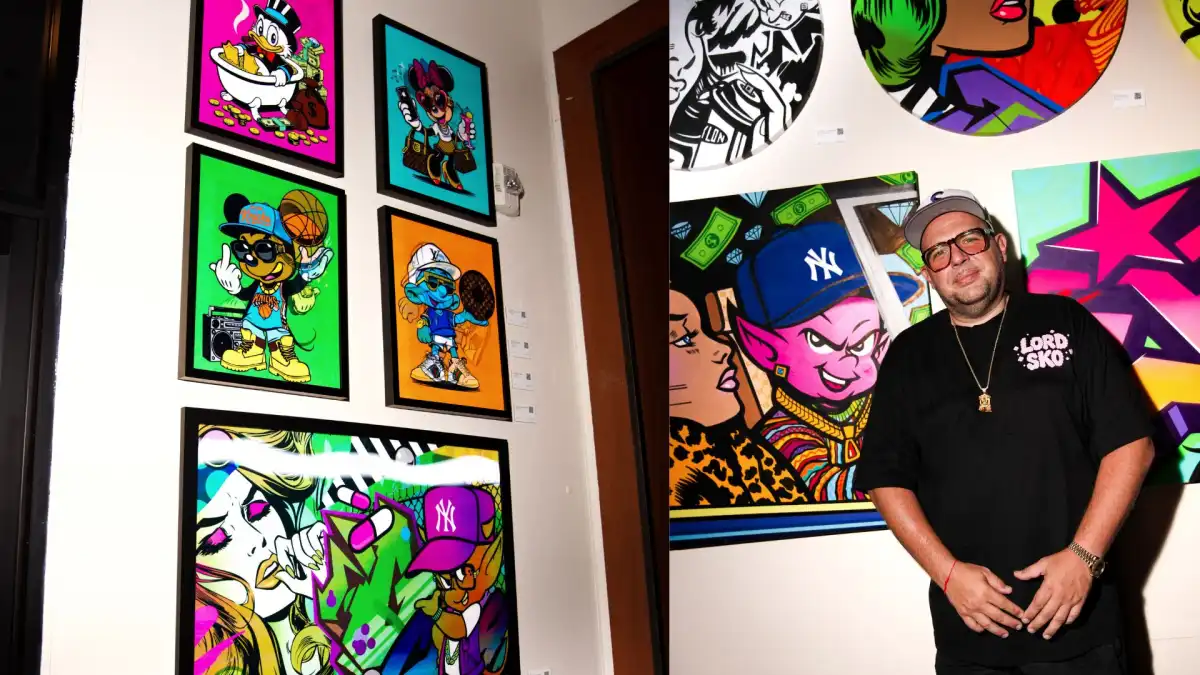
This gives Pop Odyssey, Jaek El Diablo’s solo exhibition at Moments. Gallery, its unexpectedly intellectual charge. Curated by Vasia Makris and presented inside Dream Downtown, it brings together paintings and lenticular works created for the gallery. Graffiti, fashion, hip-hop, vintage American imagery and psychedelic color collide across work that is immediate yet, perhaps, more psychologically complicated than its exuberant surfaces suggest.
Jaek began painting in 1993 as an activist and pioneer within Strasbourg’s graffiti movement. Three decades later, he continues what he calls iconographic hijacking, sampling and scratching familiar references much as a DJ manipulates sound. Cartoons, comics, video games and cinematic imagery are lifted from expected contexts, spliced together and returned slightly altered, strangely intensified and unmistakably his own.

The method is, naturally, indebted to hip-hop. Sampling does not merely quote the past; it interrogates ownership, authorship and cultural memory. A borrowed fragment may become homage, critique, reclamation or, quite possibly, all three. Recognition provides the pleasure; recombination supplies the friction. One is seduced first and asked to think afterward, which is, admittedly, rather effective.
That friction matters. Contemporary life arrives as a relentless collage. A Renaissance painting appears between a skincare advertisement and a breaking-news alert. Political dissent becomes merchandise before the protest signs have dried. A childhood cartoon becomes a luxury handbag, then a meme, then a collectible. The boundaries separating commerce, culture and self-expression have grown deliciously—and occasionally alarmingly—porous. Pop understands this because Pop, after all, gave it a visual language.
The movement emerged as artists turned toward the commercial imagery flooding postwar life. Advertising, mass production and celebrity were no longer vulgar distractions from serious art; they became the subject. That collapse between “high” and “low” once felt radical. Today, when street artists collaborate with fashion houses and museums generate limited-edition merchandise, it feels nearly complete. Still, hierarchy has not disappeared. It has merely, and perhaps predictably, become better dressed.
Pop Odyssey enters that tension rather fluently. Jaek’s universe moves between raw expression and refined execution, street intervention and collectible object, memory and seduction. Luxury is present, although it is not permitted to remain aloof. Graffiti cuts through the polish. Psychedelic layering destabilizes the icon. Familiarity slips mischievously out of place, leaving the viewer between recognition and uncertainty.
The lenticular works make that instability literal. Images morph, vanish and reappear as the viewer moves, requiring the body to move before the work fully reveals itself. One angle offers a reality; another quietly contradicts it. We inhabit a culture in which perspective is manipulated, refreshed and monetized according to who is looking and what a platform would, rather ominously, like them to want next.
Jaek’s lenticulars turn that uncertainty into a physical encounter, gently reminding us that seeing has never been passive. The viewer must shift, reconsider and, perhaps, accept that no vantage point contains the entire truth. In an age addicted to certainty, such ambiguity feels almost luxurious.

The opening extended the argument beyond the frame. Performances by Lord Sko and Ace SL, a DJ set by Snkr Joe and lowriders from Infamouz Car Club transformed West 16th Street into part gallery, part block party and part rolling sculpture garden. Music, automobiles, fashion and painting occupied the same ecosystem, precisely where Pop has always been most alive.
Perhaps most meaningfully, a portion of sales benefits Full Blast Booking, a nonprofit using hip-hop to support men’s mental health and suicide prevention. The partnership gives the spectacle social dimension without forcing the work to surrender its mischief. Pleasure and purpose coexist. Art may, after all, wear riotous color and still carry considerable weight.
Pop persists because the forces that produced it have accelerated. We remain surrounded by images engineered to provoke longing, allegiance, nostalgia and envy. We consume culture while culture, rather cheekily, consumes data about us. Jaek El Diablo does not rescue Pop from commercialism, spectacle or excess. Such a rescue would miss the point. Instead, Pop Odyssey embraces those conditions, agitates them and sends them back at full volume.
Pop survives not because it refuses to age, but because modernity keeps supplying it with seductive new disguises.
Pop Odyssey is on view 24 hours a day through the end of August at Moments. Gallery inside Dream Downtown, 355 West 16th Street, New York.
More on art visit avalonashley.com
