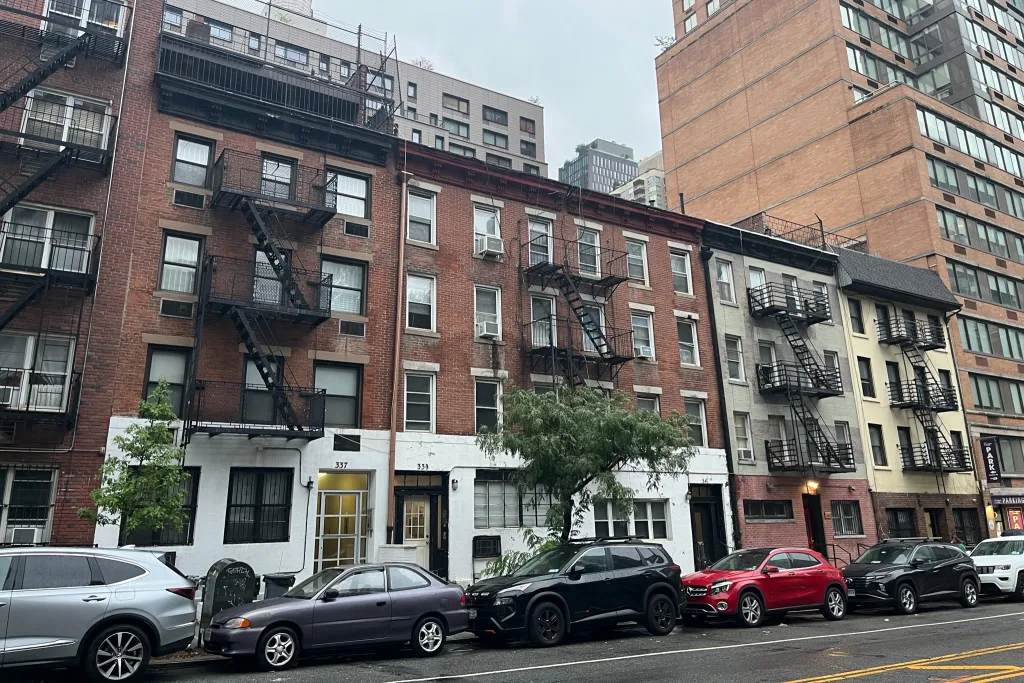
Wedged in a corner of Kips Bay, near the East River and NYU Langone hospital, four low-slung buildings contain 40 apartments. Most are empty.
Michael Heletz, founder of Queens-based Excel Development Group, has for a decade had a plan to knock down these buildings and in their place construct a tower with up to 160 apartments and retail space. A quarter of the units would be set aside with affordable rents for people at specific income levels.
But the project has been stalled for years because the buildings are still home to six rent-regulated tenants who have not yet agreed to leave despite lucrative offers. Heletz needs the state agency overseeing the rent regulation system to sign off on his demolition application. And while he negotiates a deal with a lawyer representing five of the tenants — where they would move out in exchange for undisclosed financial sums — a sixth is holding out.
That tenant, Annie Feng, has a right to stand her ground under long-established rent stabilization rules. But she’s also preventing construction that would quadruple the number of homes on the site and any payouts her neighbors could receive.
Tenants who stay put in the face of development pressures are part of a famous history in New York City. Some holdouts, leveraging their rights and understanding the windfall developers could reap from successful projects, have secured handsome payments before leaving. Others have refused to budge, scuttling new development or spurring architectural designs that work around their homes.
New York’s rent-stabilized tenants enjoy all but guaranteed lease renewals, and state laws enacted in recent years have strengthened their rights. But those protections sometimes conflict with the city’s and state’s broader affordable housing goals, as in the Kips Bay case.
“For years, laws and policies have aimed to prevent the type of harms inflicted by urban renewal,” said Howard Slatkin, executive director of the nonprofit Citizens Housing and Planning Council, referring to a much-criticized model of clearing neighborhoods for redevelopment. “But despite our housing crisis, there really hasn’t yet been a reexamination of how we should balance the equitable treatment of existing tenancies with the need for more housing.”
Heletz may have finally figured out a way to advance the project — or at least signal it could move forward without Feng on board. A rendering of a proposed development shows Feng’s walk-up building fully ensconced within a new tower rising high above it. Questions remain about the feasibility of such a design, but Heletz said he has already spent more than $60 million on the project and could lose a lucrative state tax abatement for affordable housing if the development isn’t completed within the next five years.
“I really want to see this site happen. I’ve been working on it for many years,” he said. “Everyone screams, ‘We need housing, we need affordable housing.’ I thought this project was like the roadmap.”

Feng did not respond to multiple emails from The City Reporter earlier this summer, and phone numbers listed for her did not work. When a reporter rang Feng’s buzzer outside her building on a recent evening, she yelled out an open window to leave her alone and accused the reporter of working for the landlord. She made the same accusation when reached at a working phone number this week, then hung up.
Feng has said in court filings in a rental arrears case that Heletz made her fear for her life by trying to evict her “by any means necessary,” allegations the developer and his attorney deny.
“You think that by pushing me to my breaking point, I will surrender,” Feng wrote in a January 2025 letter to Heletz included in court records. “But I won’t.”
Pricey Payouts To Vacate
Heletz acquired the four buildings and the air rights of a fifth for about $29 million between 2016 and 2018, according to property records, and sought a rezoning that would allow him to build the project off Second Avenue. The City Council approved the rezoning in 2018.
At the time, almost two dozen tenants lived in the four buildings. Most of them were in market-rate apartments and not entitled to lease renewals, but some were in rent-regulated apartments. Heletz paid more than $2 million in buyouts to several people in the latter group to empty their apartments, he estimated.
Court documents show one of the tenants received a condo in Fort Lauderdale, Florida, renovated and furnished to exacting specifications — including changing out gray granite for beige and decorating the living room with an animal-skin rug. Heletz purchased the apartment for $140,000, per property records, and agreed to pay all expenses related to it, including taxes, cable and utilities, for the rest of the tenant’s life or until he moved out. Heletz also paid off $6,000 of the tenant’s credit card bills and bought him an iPhone and a gold Mercedes-Benz Smart Car convertible, court papers show.
The developer said he offered the remaining tenants the choice to live in the new building at rents comparable to their current rates, but no one took him up on it — leaving the final six residents and dozens of vacant apartments.
In 2023, Heletz filed an application with the state Division of Homes and Community Renewal for permission not to renew the regulated leases because of the demolition plans — one of the few ways to remove regulated tenants under the rent stabilization laws. The proceeding is ongoing and both the agency and governor’s office declined to comment on it.
David Rozenholc, an attorney representing the five tenants besides Feng, is challenging the application and negotiating with the developer for compensation for his clients. Rozenholc, who has secured multimillion-dollar buyouts in other local holdout cases, for a time represented Feng in the matter, but they no longer work together.
“The least I settle for is for my clients to have enough money, after they pay me and pay the government [taxes], to buy something,” he said. “Those are their apartments, and they’re going to stay there unless the landlord makes a proposal to them where they’re better off doing something else than staying in these apartments.”
Two of the five tenants declined to comment and another didn’t return calls or texts. The City Reporter was unable to contact the two others, and Rozenholc declined to make the connection.
Heletz said an agreement for the five tenants is in the works. But Rozenholc said he won’t agree to anything until the situation with Feng is resolved.
“I make a deal where I deliver possession,” he said, meaning he ensures the landlord gets fully vacant buildings to maximize his clients’ leverage.
A Contentious Landlord-Tenant Relationship
Feng, a middle-aged woman from China who worked as a nurse, moved into her apartment in 2008, according to The City Reporter’s review of hundreds of pages of Manhattan court papers in cases related to her home. Representing herself as a defendant and plaintiff over the years, she has accused Heletz of harassing her and complained of poor conditions in her unit.
“You have used all the despicable dirty illegal ways to force me [to] move out of my rent-stabilized apartment,” Feng wrote in a 2021 filing. The landlord denies any wrongdoing.
City records show open housing violations for Feng’s apartment from as recently as 2025, detailing a mice infestation and broken ceramic floor tiles. Heletz said he made the required repairs or attempted to, but accessing the apartment sometimes proved difficult. City inspectors could not enter the home and assess conditions during a visit last March, per the records, which don’t detail why the inspectors couldn’t gain entry.
Heletz and his attorney, Michelle Itkowitz, said they have long tried to buy out Feng. According to the landlord’s filings in a court case where he sued Feng for owed rent, the tenant at one point asked for $1.5 million to vacate her apartment, which Heletz was open to, and he offered an additional $15,000 to hire her a lawyer. The deal never came together. Heletz has alleged in the same case that Feng’s arrears now amount to more than $100,000, but she has denied owing him rent.
In court papers, Itkowitz said she would not send Feng the buyout money without an attorney representing her, as doing so would be “unethical and untenable,” given what the lawyer called Feng’s “volatile nature” and “assert[ion] that English is not her first language.” The tenant’s counterclaims for various kinds of damages have ballooned from $100,000 to $2 million.
“I live for justice, people like you, who abandon human conscience for money, will never understand,” Feng wrote in a February 2025 filing in the nonpayment case. “I love how hard I can fight.”
Architectural and Legal Compromises
In some instances, New York City developers have circumvented disputes with tenants by building around existing structures, though this can add significant project costs and delays. One developer in the 1980s constructed a 31-story tower around an Upper East Side brownstone where a rent-stabilized tenant lived. The architectural oddity on Lexington Avenue emerged after she refused the developer’s offers to leave, even as her neighbors took buyouts or were evicted.
Vicki Been, a former deputy mayor for housing and economic development under Mayor Bill de Blasio, said situations like the one in Kips Bay raise complicated questions about how the city should address its housing shortage.
“When are we willing to allow one person to stand in the way of broader progress, and should that differ if the person is a renter, versus a homeowner? Are we more willing to let somebody stand in the way if who they’re bargaining with is the developer, rather than the city on behalf of all taxpayers?” Been said. “Those are hard questions because there is a strong political salience to protecting tenants.”

Heletz said he is exploring his options for the project, and asked his architect Shay Alster for an alternative design: a new tower surrounding the walk-up where Feng lives. Alster, managing partner at GF55 Architects, told The City Reporter the wraparound tower was “a very preliminary schematic idea” that leaves many logistical issues open.
“The ideal would be the original design,” Heletz said. “To build the project with the existing building there makes it that much more difficult, and it lessens the overall value of the project.”
That original design featured a tower with interlocking boxes cantilevering over an adjacent building, and included a pool, rooftop terraces and a gym. The city Buildings Department approved the plan in 2022.
Feng and Heletz are scheduled to appear for a settlement conference in Manhattan Supreme Court soon. The developer said he is determined to come to an agreement, once and for all.
Our nonprofit newsroom relies on donations from readers to sustain our local reporting and keep it free for all New Yorkers. Donate to THE CITY today.
The post The $1.5M Holdout: Kips Bay Fight Pits Tenant Rights Against NYC Housing Development appeared first on The City Reporter.