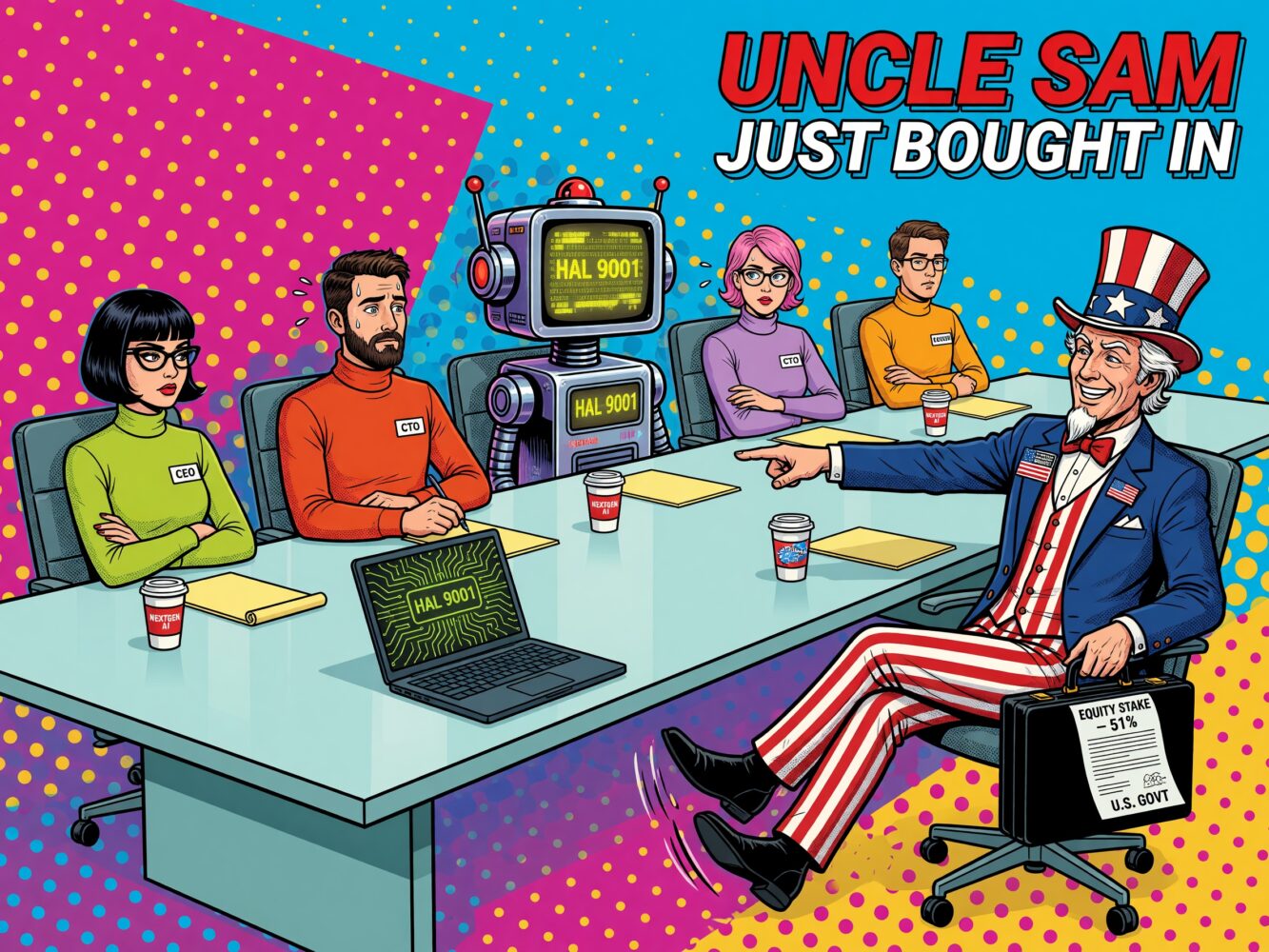
When Washington offers to “share the upside,” check the fine print. With artificial intelligence, the proposed bargain is not just that taxpayers might get a slice of the next great American industry. It is that the federal government would become part owner of the companies that increasingly shape what Americans ask, read, write, and believe.
President Donald Trump announced June 10 that his administration is exploring taking equity stakes in major artificial intelligence companies, effectively making the federal government a part owner of the industry’s leading firms. The proposal echoes one made by Sen. Bernie Sanders (I-Vt.), who has argued that the American public should share in AI’s profits. Given that AI contributed an estimated full percentage point to real U.S. economic growth during the first three quarters of 2025 alone, the stakes are high.
But government ownership of AI would not merely “socialize the upside.” It would also socialize the downside, distort competition, expose taxpayers to political favoritism and corporate rescue missions, and give future administrations a powerful new lever over tools that mediate speech and information. The problem is not just industrial policy. It is industrial policy strapped to a First Amendment tripwire.
When the Referee Buys the Team
The administration has not specified how large those government stakes would be. If the model resembles the second Trump administration’s investments in at least 10 other companies, including Intel, the government would receive roughly 5%-10% equity stakes in exchange for billions in taxpayer dollars. Others have proposed going much further. Sanders and Steve Bannon, President Trump’s former chief strategist, have both suggested government ownership of up to 50% as a way to curb the power of what they call “tech oligarchs.”
The exact number matters less than the underlying principle. Even a nonvoting 5% stake creates distorted incentives that come with government ownership of strategically important industries.
Supporters argue that public ownership would let taxpayers share in AI’s success. It would also make taxpayers participants in its failures. Once the government becomes a shareholder, it gains strong incentives to shield those companies from failure, whether through additional taxpayer bailouts or preferential treatment in government contracting. That weakens the market discipline that encourages prudent risk-taking and continuous innovation.
The companies themselves would also face growing pressure to align with government priorities. Today, firms already risk losing contracts or attracting regulatory scrutiny when they clash with policymakers, as the recent Department of Defense dispute with Anthropic illustrates. Government ownership would amplify that leverage. Even without voting control, officials could threaten to sell a large stake, driving down a company’s stock price and giving Washington a powerful new tool to influence corporate behavior.
Government ownership would also tilt the competitive playing field. A disruptive startup that challenges a partially government-owned incumbent would no longer threaten only its rivals—it could also threaten the government’s own financial interests. That creates incentives to protect politically connected firms rather than reward the most innovative ones.
In effect, the government would be picking winners instead of allowing markets to discover them. The likely result: less competition, weaker incentives for new entrants, and reduced private investment—the very forces that have driven America’s leadership in high technology and artificial intelligence.
The arrangement also risks letting the tail wag the dog. Executives at partially government-owned firms would gain even greater leverage to lobby for favorable regulations or subsidies by arguing that policies harming their companies also harm taxpayers’ investments. It is hardly surprising, then, that some of the very “tech oligarchs” whom Sanders and Bannon criticize have expressed support for government ownership.
The economic risks are only part of the story. Government ownership would also inject politics directly into a technology that is becoming deeply embedded in everyday life. It would increase opportunities for censorship, propaganda, citizen surveillance, and “jawboning”—informal government pressure that coerces private companies into restricting or promoting speech.
History offers ample examples of governments using ownership or control of firms in critical technology and communications sectors to advance political objectives. Artificial intelligence could become the next arena where those temptations prove difficult to resist.
The Government Can’t Do by Proxy What It Can’t Do Directly
Freedom of speech is one of America’s defining constitutional protections. The First Amendment bars the government from directly censoring what people think, say, or post online. “Jawboning” refers to government efforts to sidestep those constitutional limits by pressuring private companies to suppress First Amendment-protected speech on the government’s behalf.
The Supreme Court recognized this principle decades ago in Bantam Books Inc. v. Sullivan (1963). There, Rhode Island officials asked book distributors for their “cooperation” in keeping certain publications off the market. The Court concluded that the state had devised an unconstitutional scheme to censor books indirectly, making clear that the government cannot evade the First Amendment simply by leaning on private intermediaries.
The Court reaffirmed that principle in National Rifle Association of America v. Vullo (2024), holding that government officials may violate the First Amendment by coercing private parties into punishing disfavored speakers. Those same constitutional principles apply to artificial intelligence, even if the technology presents the issue in a more complex form.
The Shareholder With a Badge
Large language models (LLMs)—the artificial intelligence systems behind tools such as ChatGPT, Claude, and Meta AI—are becoming a routine part of everyday life. Millions of Americans use them to write emails, summarize news, conduct research, generate computer code, and seek recommendations. AI does not deliver information the same way a search engine or social media platform does, but many of the same questions about information integrity remain. The sources an AI model relies on, the way it evaluates evidence, and the safeguards that shape its responses all influence what users ultimately see.
The First Amendment protects both the right to speak and the right to receive information. Government jawboning threatens both. It affects not only the person whose speech is suppressed, but also everyone who would otherwise hear it. The cases discussed above, along with more recent efforts by federal officials to pressure social media platforms to suppress discussion of COVID-19, illustrate that jawboning is often aimed less at silencing a particular speaker than at shaping what information reaches the public.
If the government directly instructed an AI company to alter its model by changing trusted sources, adjusting response filters, or otherwise steering its outputs toward favored viewpoints, the constitutional problem would be obvious. Government ownership presents a subtler, but potentially more powerful, mechanism for achieving the same result.
A casual suggestion from a regulator or a phone call from a senior official can carry enormous weight when the government also owns part of the company. Consider OpenAI. At a valuation of roughly $852 billion, a 5% government stake would be worth more than $42 billion. Even if those shares carried no voting rights, the mere threat that the government might sell such a large stake could send the company’s stock tumbling and pressure executives to accommodate official preferences.
The government’s leverage extends well beyond its equity stake. Unlike an ordinary shareholder, the federal government also controls taxes, procurement contracts, grants, export controls, and much of the regulatory environment in which AI companies operate. Faced with that combination of financial and regulatory power, executives would have powerful incentives to prioritize government approval over consumer welfare and innovation, or to accommodate whichever political or special-interest priorities happen to prevail at the time.
The Editor’s New Silent Partner
The Federal Trade Commission (FTC) recently sent Apple a letter alleging that its news aggregation service, Apple News, may violate the Federal Trade Commission Act by featuring fewer sources with a “perceived [conservative] ideological or conservative viewpoint” than those perceived as liberal. FTC Chairman Andrew Ferguson insists the agency is not policing speech, ideology, or editorial choices, which would raise serious First Amendment concerns. Instead, he argues that Apple may have misled consumers by creating the “reasonable expectation” that Apple News is an unbiased news aggregator.
Even assuming the FTC’s factual allegations are correct, that theory is difficult to square with the law. Private companies generally enjoy broad First Amendment protection to curate and moderate content. Apple News’ terms of use, which the FTC itself cites, expressly disclaim “ALL WARRANTIES, EXPRESS OR IMPLIED, INCLUDING ANY WARRANTIES OF ACCURACY, NON-INFRINGEMENT, MERCHANTABILITY AND FITNESS FOR A PARTICULAR PURPOSE.” They also state that a user’s sole remedy for dissatisfaction with the service or its content is simply to stop using it.
Consumers have plenty of alternatives. Apple News competes with numerous news aggregators, each with its own editorial approach and recommendation algorithms. Consumers can also choose among news organizations with distinct editorial perspectives, just as they can watch Fox News instead of CNN. Both market themselves as independent news organizations, yet viewers understand—and often deliberately choose—them because of their perceived editorial slant. As Bill O’Reilly famously branded Fox News, it was the “No Spin Zone.”
Editorial judgment is not a market failure; it is one of the ways media companies differentiate themselves. Punishing firms for those choices would reduce, rather than expand, meaningful competition by making competing products look more alike. It would also sit uneasily alongside the Trump administration’s criticism of the European Union’s Digital Markets Act, which similarly subjects large, predominantly American technology companies to government scrutiny over how they curate and present content.
The same concerns apply to artificial intelligence. The FTC’s letter to Apple and the Federal Communications Commission’s (FCC) recent warnings that certain late-night television programming could face sanctions over allegedly biased political coverage illustrate how readily government officials can pressure private firms over editorial decisions that technically fall within existing legal authority. Giving the government an ownership stake in AI companies would hand future administrations an even more powerful lever.
That should concern supporters of every political persuasion. A Republican administration could use that leverage one way; a Democratic administration could use it another. Either way, government ownership would make it easier to pressure AI companies to suppress disfavored speech, promote preferred narratives, or tilt the competitive playing field in favor of politically connected firms.
Good Luck Proving It
Even when government pressure crosses the line into illegal jawboning, speakers and listeners can struggle to get relief. The problem is not always the principle. It is proof.
In Murthy v. Missouri (2024), several plaintiffs, including former Harvard professor Martin Kulldorff, sued the Biden administration for allegedly pressuring Twitter, YouTube, and other platforms to remove posts criticizing federal COVID-19 policies. Federal officials had, in fact, pressured the companies over such content. But a 6-3 Supreme Court majority sided with the government, holding that the plaintiffs lacked Article III standing because they had not shown a sufficiently direct causal link between government pressure and the platforms’ decisions to remove their posts.
That causation problem matters. A platform might have removed the speech under its own moderation policies, even if government pressure also played a role. Without proof that the government’s pressure caused a concrete and traceable injury, plaintiffs cannot sue. In practice, that often requires peering into the minds of platform employees—the sort of discovery courts tend not to hand out like Halloween candy.
Timing creates another obstacle. By the time a case reaches a judge, the officials involved may have left office, making an injunction against future jawboning harder to obtain or even moot. The result is a legal regime that recognizes the danger of informal government coercion but often struggles to deter it.
Those problems would only grow in the AI context. If officials pressured an AI company to alter how an LLM responds to politically sensitive questions, the company itself would often be the most directly injured party. But a partially government-owned company would have little incentive to sue the government that also sits on its cap table.
Market discipline can help—at least in a competitive market. If an AI model earns a reputation for biased, censored, or doctored responses, users can switch to rivals with better reputations. That threat gives companies a reason to protect the integrity of their outputs.
Government ownership weakens that discipline. Firms with a special relationship to Washington would enjoy advantages unavailable to actual or would-be rivals, making their market positions harder to challenge. That would deter entry, reduce competition, and make it harder for consumers to punish politically compromised AI tools by taking their business elsewhere.
The Best Fix Is Not Breaking It
The recently introduced Justice Against Weaponized Bureaucratic Overreach to Networked Expression (JAWBONE) Act, sponsored by Sens. Ron Wyden (D-Ore.) and Ted Cruz (R-Texas), reflects growing bipartisan concern that government pressure on private companies threatens Americans’ free speech. It also recognizes the practical reality that people often struggle to prove jawboning or obtain meaningful relief after it occurs.
The bill would create a private right of action, allowing individuals to sue government officials who coerce broadcasters, online platforms, or artificial intelligence companies into suppressing or manipulating lawful speech. Prevailing plaintiffs could recover damages and attorneys’ fees. The legislation also includes important safeguards. Communications made by government officials during lawful investigations, pursuant to warrants, or in the course of managing official government accounts would remain permissible.
Those reforms would meaningfully strengthen deterrence. By creating an explicit cause of action, the bill would help plaintiffs overcome some of the standing and causation obstacles that proved decisive in cases such as Murthy v. Missouri. It would also require the National Institute of Standards and Technology and the White House Office of Science and Technology Policy to establish a transparency regime documenting and publicly summarizing government communications with private companies about speech and content moderation. That recordkeeping would make it easier to identify and prove improper government pressure.
The JAWBONE Act strikes a sensible balance. It targets genuine coercion without preventing government officials from sharing important information with private companies during emergencies or other legitimate government activities. The bill would also apply to artificial intelligence companies, including those in which the government owns an equity stake.
Even so, legislation can address only part of the problem. Congress may amend the bill before passage, and there is no guarantee it will become law at all. More fundamentally, no statutory safeguard can fully eliminate the subtle pressures that arise when the government is both regulator and shareholder. The surest way to prevent officials from quietly steering AI companies toward preferred narratives is not to put the government on the cap table in the first place. Doing so would also avoid the broader costs to competition, innovation, and taxpayers that accompany government ownership or undue influence over a dynamic private industry.
Don’t Nationalize the Answer Machine
Government ownership of AI companies would not simply let taxpayers share in the industry’s upside. It would also socialize the downside, exposing taxpayers to losses while giving future administrations a powerful new way to pressure companies that increasingly shape how Americans seek, receive, and understand information.
That makes government influence over LLM outputs more than a tech-policy concern. It is a First Amendment concern, a competition concern, and a taxpayer concern rolled into one very bad bargain.
The government should not buy a seat at the table where Americans’ answers are written.