I had not either. I can now say, with the conviction that only arrives after being savagely undone by art, that it is worth every mile, inconvenience, stretch of road, and flicker of doubt that asks whether beauty should require this much devotion. At The School, the answer arrives before thought does. The journey becomes part of the surrender.
For context, I have devoted myself to art, rather obviously. I spend my days in galleries, museums, studios, auction rooms, private salons, and the occasional strange corridor where beauty chooses to ambush without warning. I chase feeling at full saturation, the intoxication of meaning, evidence of the hand, severity of material, romance of paint, and that rare tremor when an object becomes more than itself. My career, at its most honest, is a pursuit of disruption, evolution, rebellion, and revelation.
Undeniably, The School understands that hunger. It meets appetite with scale, patience, intellect, and a kind of spiritual generosity increasingly rare in the art world. It satisfies beyond the ordinary threshold of cultural consumption, then somehow leaves one ravenous for more.
Located in a former school building in Kinderhook, the space was once a place of instruction, civic purpose, corridors, discipline, and memory. Jack Shainman and his partner saw not merely a structure, but a vessel. They understood its bones. More importantly, perhaps, they understood that consequential art requires more than walls. It requires atmosphere, proportion, silence, trust, and the courage to let work occupy the full force of its own being.
That is what has been created here. The School is not simply an exhibition venue, nor a storage facility with architectural charisma. It is alive, grounded, exacting, and unusually humane. Art is allowed to breathe at full lung capacity, with scale intact and intimacy preserved.
On view through November 28, 2026, Modus Operandi brings together nearly twenty artists across painting, sculpture, textile, photography, and video. The exhibition considers method not as process alone, but as thought made physical. Its title, drawn from the Latin phrase for “mode of operating,” could sound clinical elsewhere. Here, it feels almost liturgical. Each artist’s approach emerges as a private architecture of consciousness: pressure, repetition, instinct, refusal, and revelation.
I fell in love many times over inside this exhibition, which is perhaps the only appropriate response to a show so charged with seriousness and sensation: promiscuity. Each a different sensation, please note, these encounters do not arrive politely through analysis. They enter through the sternum, change the air, and make the body understand before the mind can assemble its defense.
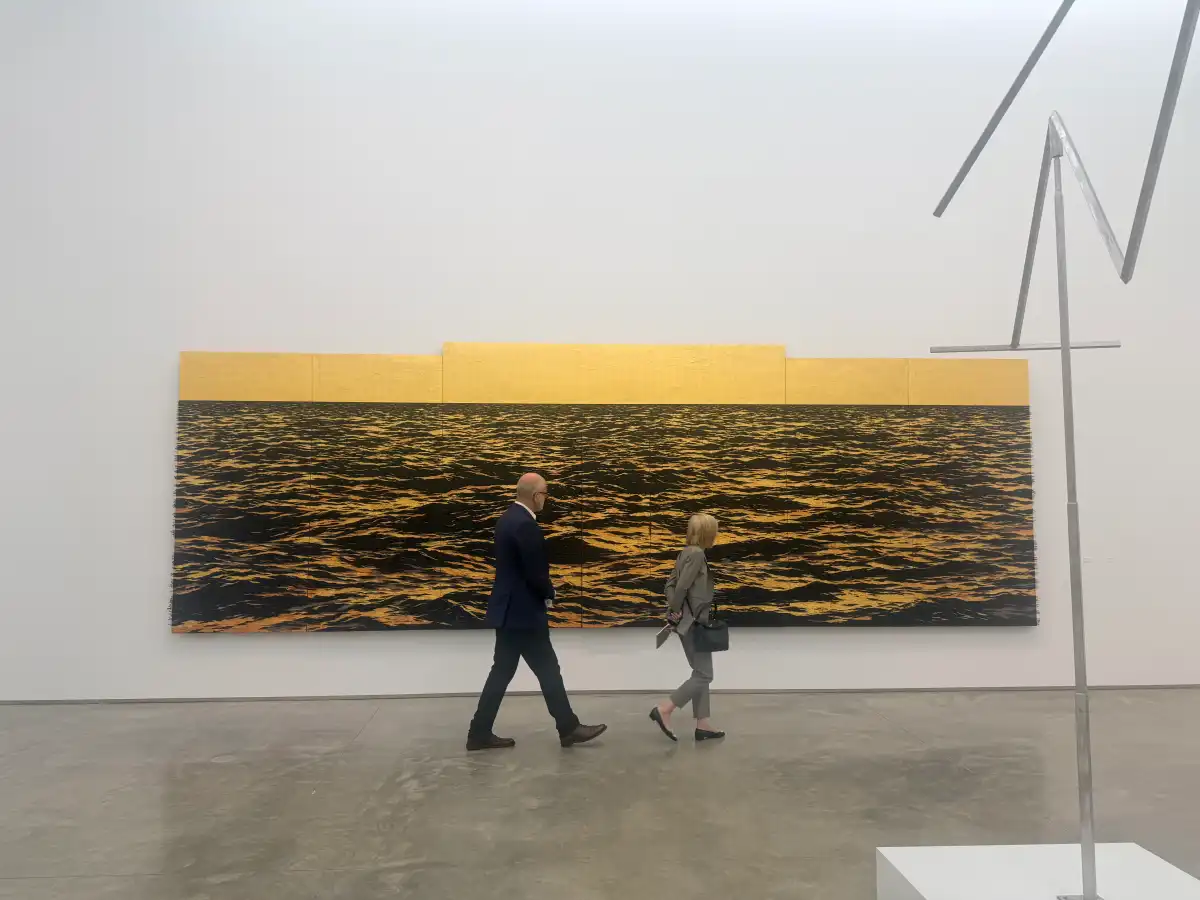
That is precisely what happened when I stood before Yoan Capote’s Requiem (Altarpiece).

As the kids say, I was “shooketh”.
At first, I saw an endless golden ocean. It was terrifying and coaxing at once, radiant with a beauty that felt less like pleasure than revelation under threat. Turbulent waves carried the eye toward a horizon both impossibly distant and painfully intimate. I stood there stunned, nearly held in place, feeling something close to my initiation into Rothko. Encountering his work was, for me, a christening into abandoning the head and diving heart first into painting. Capote summoned that same interior collapse, that surrender to surface as weather, void, prayer, love wrapped hatred, seduction, and grief.
Further still, the work revealed itself with devastating elegance. From afar, the golden sea appeared celestial, almost altar-like, as though longing had been hammered into light. Up close, the image began to betray its radiance. A barely perceptible door seemed to rise from the oceanic surface. Then came the shock: this was not a traditional seascape. It was fishhooks, nails, and gold leaf. The nearer I moved, the more splendor became material violence.
Before I was done with it, Requiem had become a multitude. Desire, migration, faith, entrapment, escape, anger, distance, and hunger emanated from that impossible shore. The horizon was no longer simply a view. It became a wound pretending to be light.
Later, learning that the piece evokes the view from Cuban shores toward Miami deepened its devastation. That radiant distance held longing and terror, the fantasy of elsewhere, and the brutality of what such fantasy can demand. Capote understands the horizon as both promise and punishment. In his hands, beauty is never innocent. It lures, dazzles, wounds, then asks the viewer to acknowledge the mechanism beneath the shimmer. Fishhooks become waves. Nails become atmosphere. Gold becomes witness.

Without question, that Jack Shainman encountered Capote in Cuba and immediately understood his power feels almost inevitable. Shainman has long possessed one of the most discerning and spiritually attuned eyes in the art world. There is something quietly shamanic in his ability to recognize artists whose work does not merely participate in culture, but alters its atmosphere. The great “art shaman Shainman” (you read it here first) has the gift of intuition and perception. He sees force before consensus gathers around it, and he has built a program around practices carrying moral, historical, and material consequence.
That charge moves throughout Modus Operandi. Nick Cave’s Chain Reaction delivered another jolt: bold, visceral, magnetic, alive with Cave’s unmistakable understanding of adornment as armor and exuberance as resistance. Bruce Nauman’s All Thumbs turns the hand into something comic, estranged, and unnervingly exact. Richard Mosse distorts conflict into visual force. Faith Ringgold, Radcliffe Bailey, El Anatsui, Guillermo Kuitca, Meleko Mokgosi, Wolfgang Laib, Susan Rothenberg, Amy Lincoln, Rose B. Simpson, Mark Dion, Alexis Rockman, and others move through the exhibition with astonishing intelligence, each proving that material is never neutral when guided by a serious mind.
This is why The School matters. It is not merely a destination. It is an argument for how art should be held. In this world, purpose-driven spaces are rare. Places that honor community, scale, difficulty, beauty, and intellectual risk are rarer still. The School gives work the dignity of time and the electricity of proximity.
Perhaps that is the real triumph of Modus Operandi. It reminds us that art does not begin with explanation. It begins with hunger, method, rupture, discipline, obsession, and the almost unbearable need to make meaning from matter. It begins when a viewer stands before a golden ocean and realizes the surface is made of hooks. It begins when beauty stops behaving politely and becomes a force capable of bringing the body, heart first, almost to its knees.
Pack you day case, and go.
