
A teacher in Wisconsin recently got a call with an intriguing offer: a promise to have 80 percent of her federal student loans forgiven — for a fee. The teacher, Lauren, owes about $60,000 in debt more than a decade after graduation, so she was more than happy to hear the company out.
Lauren said she pressed the caller for details about how the offer would work. The agent abruptly hung up.
Lauren said she receives calls like this about once a week these days, from companies purporting they can help erase her student debt. (She requested her full name not be used out of fear of getting targeted by more scams.) “They always claim that they’re with some federal agency,” she said, noting that the company name “usually has the word ‘federal’ in it.”
Many companies like these are scams, and changes to the student loan program are providing more opportunities for these firms to target the roughly 40 million adults in the U.S. with student loan debt. The Hechinger Report found more than two dozen companies promising to help win loan forgiveness, many of which take fees of hundreds of dollars for doing nothing or for filling out paperwork that the borrower could easily complete themselves — and experts say there are likely many more.
Student loan scams have been operating for years and they’ve eluded multiple efforts by regulators to quash them. They often become particularly active during periods of significant change to the student loan program. Now, as student loan repayment rules shift and the Trump administration reduces oversight of the student loan system, these companies see an opportunity to capitalize on borrowers’ confusion, experts say.
“There’s a lot of chaos in the industry right now,” said Betsy Mayotte, president and founder of The Institute of Student Loan Advisors, a nonprofit that advocates for student loan borrowers. “It’s a great time if you’re in the scam business, because people are vulnerable.”
Related: 5 big questions to help you understand the current state of student loans
Student loan borrowers enjoyed a long reprieve from making payments during the pandemic. But the requirement to make regular payments resumed in October 2023, and in May 2025 the U.S. Department of Education said it was restarting collections on defaulted student loans, but ultimately backed off earlier this year. Then, this March, a federal judge’s ruling effectively ended an income-driven repayment program called SAVE, which more than 7 million people had enrolled in to help make their loan payments more manageable.
Yet borrowers often find it difficult to get clear answers about repayment options from the companies that administer their loans.
“The reason there’s such a big market for debt relief scams is because the actual student loan servicers who often the federal government pays to provide servicing to borrowers are not doing their job,” said Samuel Levine, who led the Bureau of Consumer Protection at the Federal Trade Commission during the Biden administration. “They’re understaffed, they provide poor customer service, they’re hard to contact, they steer people into high-cost lending products.”
Plus, cuts at the Department of Education have meant fewer staff overseeing those servicers. And federal officials recently announced that they will shift oversight of student loan servicing and collection from the Department of Education to the Department of the Treasury, which experts worry will bring more confusion.
Under President Donald Trump, the federal government has also scaled back its efforts to go after scammers. Last April, the Consumer Financial Protection Bureau published a memo stating that the agency was deprioritizing student loan scam enforcement. The administration has also mounted a larger effort to dismantle the CFPB entirely, despite the fact that since its founding in 2011 the agency has recovered more than $21 billion for consumers from a wide range of companies, including student loan scammers.
For their part, the companies who service student loans say they are doing the best they can with the resources the government gives them — and that being vilified by nonprofits just adds to confusion among borrowers. “When consumer advocates basically say all this stuff that is running down servicers very loudly on social media, that really discourages borrowers from talking to us,” said Scott Buchanan, executive director of the Student Loan Servicing Alliance, a nonprofit trade group representing student loan servicers. “And instead they turn to anyone who promises unicorns and rainbows.” He added fraudsters see opportunity anytime there is a change in the student loan system, including those that happened under the Biden administration.
Officials at the CFPB did not respond to a request for comment.
Ellen Keast, the Department of Education press secretary for higher education, did not answer questions about loan repayment scams, but said in an email that the administration has increased the ways borrowers can get needed information rather than having to turn to other sources for help. She listed a range of tools, including “data quality assessments, cross-system assessment data validation” and “daily and weekly performance reporting from servicers,” the department uses to stay on top of servicers and “improve the customer service.”
Many advocates for student loan borrowers disagree. “Across the board, this administration really has turned its back on people who are buried in student loan debt,” said Levine, now the commissioner of New York City’s Department of Consumer and Worker Protection. “I think there’s a perception that they’re all liberals, which is not true. I know there are many Trump supporters who have student loan debt, too. This is a struggle that cuts across red states and blue states.”
Borrowers who fall for scams promising loan forgiveness can find themselves in a deeper financial hole.
Bonnie Latreille heard from many victims of these scams while working as the student loan ombudsman at the Department of Education’s Federal Student Aid office during the Biden administration.
One popular model: Scammers promising loan forgiveness charge a large up-front fee and enroll victims in auto-payment for monthly fees as well, which the companies say are loan payments. “Really they’re just collecting that money,” said Latreille, who is now a senior fellow at Princeton University’s Debt Collection Lab.
The scammers ask clients for login information for their servicer and then place the loans in forbearance, meaning payments are temporarily paused even though interest is still accumulating, she said. They change the settings so the borrowers no longer receive any communication regarding the loan. When the loan becomes active again, the borrowers are unaware and miss payments until they go into default. By the time victims realize they’ve been scammed, the company has often shut down that operation and moved on to using a different name.
Related: Interested in more news about colleges and universities? Subscribe to our free biweekly higher education newsletter.
Defaulting on student loans brings more consequences than failing to make payments for other types of credit.
“When you default on a student loan, the entire weight of the federal government comes to collect,” said Latreille. Wages can be garnished without a court order. Government benefits can be reduced. Security clearances can be denied.
“And there’s no statute of limitations,” she added. “It’s a lifetime harm.”
The scams are proliferating at a time when borrowers, many of whom haven’t made payments for years because of the pandemic pause, are struggling to manage their loans and are looking for help. Student loan delinquency has grown to a record high, with 7.7 million borrowers now in default, according to recent Education Department data.
Many of the loan forgiveness schemes are clearly illegal, said Latreille, especially when companies misrepresent themselves as affiliated with the government. When the government does investigate them, it can result in fines of up to $20,000 as well as up to five years in prison, as well as recovery of ill-gotten fees. Last summer the Federal Trade Commission announced it would distribute $256,900 in refunds from seized assets to customers who had been scammed by SL Finance, a company run by two brothers who claimed to work for the Department of Education and charged junk fees for a loan forgiveness program that did not exist. The refunds were the result of a case the agency brought back in 2023.
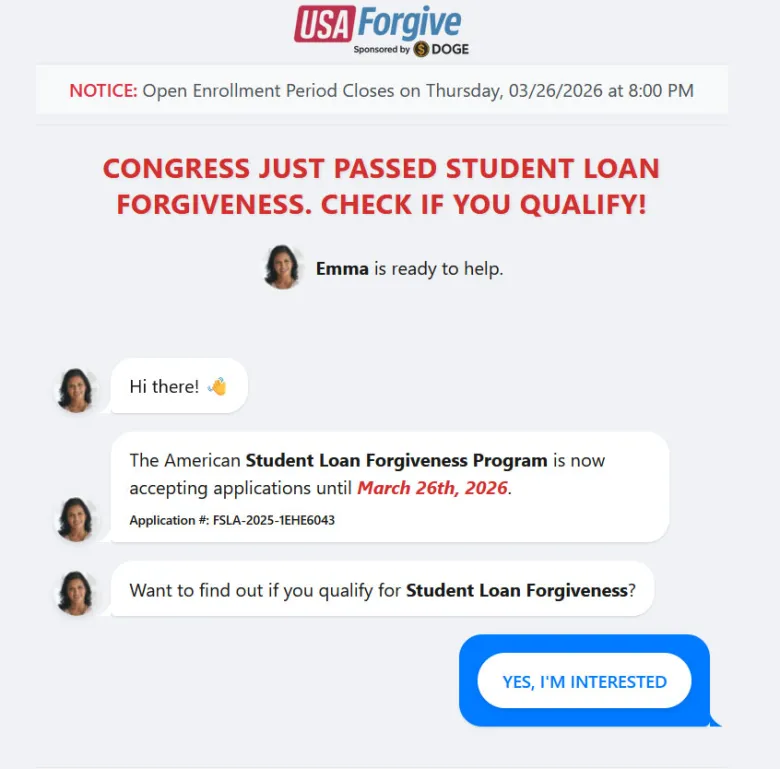
In its review, The Hechinger Report found other companies that similarly allude to fictitious government programs. One called FSLA RELIEF, for instance, until recently promised on its website to help borrowers enroll in the “American Student Loan Forgiveness Program,” which is not the name of any government program. The site features a graphic that says “USA Forgive Sponsored by DOGE,” referring to the Department of Government Efficiency, established by Trump.
A disclaimer in smaller print at the bottom states that the company “is not affiliated with or endorsed by the U.S. Department of Education or any government agency.” When The Hechinger Report reached out to the company with questions, a representative immediately hung up, and the company did not respond to a follow-up email. The link to the website later stopped working.
To make matters worse, misinformation about student loans has been circulating on social media, stirring confusion about what programs are available for borrowers struggling to make payments and suggesting unusual ways to get out from under student debt.
One TikTok post last year shared by hundreds of thousands of users, for instance, wrongly stated that borrowers could file a claim to have their loans forgiven because DOGE had accessed a student loan database in violation of federal student privacy laws. “I’m about to get all my loans forgiven, and so are you,” says the woman in the video. Though a federal judge ruled that DOGE must stop accessing the records, the law doesn’t entitle borrowers to forgiveness.
Popular AI tools like ChatGPT also do a bad job of answering questions about student loans, research has found.
Meanwhile, predatory loan forgiveness companies often make a hard sell to potential customers, said Levine, who listened to recorded scam calls while at the FTC.
“The scammer says, ‘I am from the U.S. Department of Education. We wanted to let you know that this is the last month that you can lower your payments,’” he recalled. “‘Some students are paying as little as $0 a month and seeing their loans forgiven after 10 years. If you share your information with me now, I can talk through whether you’re eligible for these programs. Again, I’m with the Department of Education, and these programs expire in one month.’”
Other types of student loan repayment companies offer services that are legal but operate in a moral gray area, experts say.
Companies known as document prep companies, for instance, promise a service that experts say brings little benefit.
“We’ll handle the detailed process so you can focus on what’s important. Leave the headache and sea of confusing paperwork to us!” says the website for one such company, called Alumni Counseling Service. An agent named Jasmine who answered the phone there on a recent afternoon said of the service, “I guess it’s as if you’re hiring a tax preparer to represent you when filing your taxes.” She referred further questions to a supervisor, who did not return a call for comment, and the company did not reply to follow-up questions sent by email.
Related: The Hechinger Report’s Tuition Tracker helps reveal the real cost of college
Mayotte, of The Institute of Student Loan Advisors, however, said that unlike filling out tax forms, applying to most student loan repayment programs is straightforward. “The amount of information borrowers have to send to the document prep company is the same amount of work as if they do it themselves,” she said. And she added that the costs can exceed that of using an outside tax prep service, with flat fees of up to $1,200.
Mayotte is pushing to educate consumers so that they don’t need the services these companies are selling. “We need to first of all create awareness that people don’t need to pay for help with their student loans,” she said, noting that there are plenty of free resources where borrowers can find information, including student loan ombudsman offices that have been set up in at least 14 states and the District of Columbia.
Levine agreed that consumer awareness is important, but said that scammers are savvier in how they reach borrowers than “the good guys” are. The best approach, he argued, is for state and federal governments to focus on vigorous enforcement.
That is especially true, he said, now that new tools allow scammers to have AI voice agents make calls so they can reach even more potential victims. “It has never been easier to scam people.”
Contact investigations editor Sarah Butrymowicz at butrymowicz@hechingerreport.org or on Signal: @sbutry.04.
This story about student debt relief was produced by The Hechinger Report, a nonprofit, independent news organization focused on inequality and innovation in education. Sign up for our higher education newsletter. Listen to our higher education podcast.
The post Fake student loan debt offers proliferate as federal government rolls back enforcement appeared first on The Hechinger Report.
