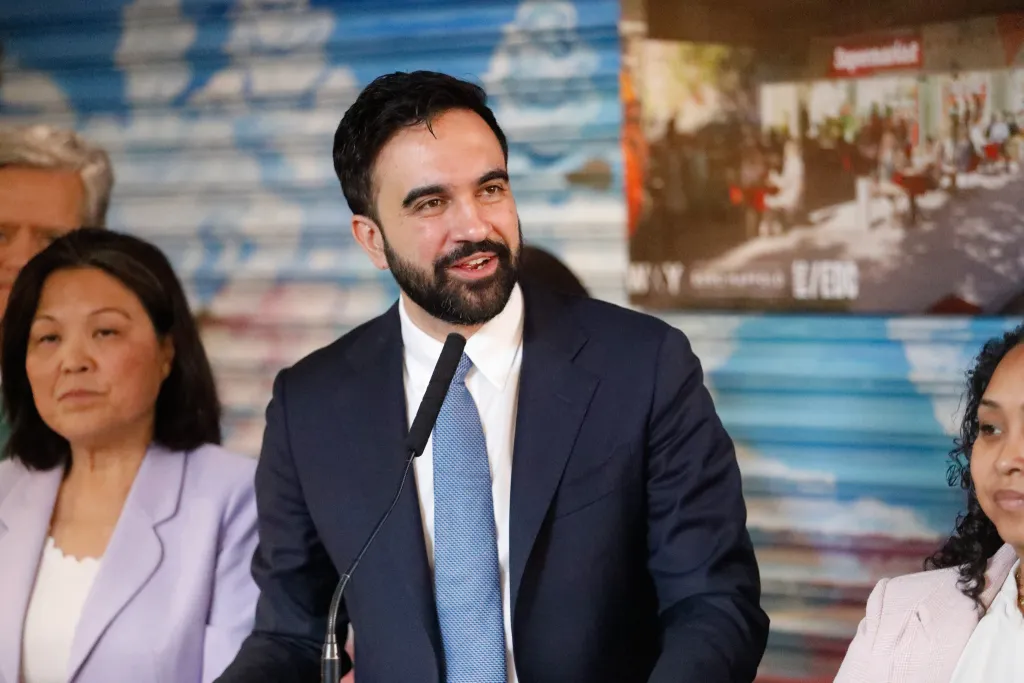
As she surveyed the packed aisles of her local supermarket on 116th Street in East Harlem, Chelssy T. cast a longing eye towards a vacant lot under the Metro-North tracks that’s the first announced site for one of Mayor Zohran Mamdani’s city-owned grocery stores.
“Prices have gone up so much,” said Chelssy, 35, a lifelong Harlemite who asked to keep her last name private. “The other day I bought kimchi, a bag of onions and three plums, and that was like $30. I think it’s a great idea.”
Mamdani says the municipal grocery stores are needed to bring fresh, affordable fare to so-called “food deserts” across the city, while even supporters say he has many challenges to deliver on that promise.
The mayor’s proposal, part of the popular affordability agenda that propelled him into office, calls for one city-owned grocery in each borough. He says costs will be lower since the stores won’t pay rent or property taxes. The city will hire a private company to handle operations and require basic items to be priced below the citywide average.
Unfortunately for Chelssy, she will have to wait until 2029 for potentially lower prices at the new Harlem store. Mamdani’s $30 million Manhattan grocery, slated to be built on the grounds of the 92-year-old La Marqueta public market, is the first to be announced but will be the last to open. City-owned groceries in The Bronx, Queens, Brooklyn and Staten Island will open in existing structures, officials said.

The delay for the Manhattan outlet is only one of a series of challenges the Mamdani administration will have to meet if its grocery plan is to work, experts — including strong advocates for the plan — told THE CITY.
As they compete against local and national chains, will five city-owned groceries have the leverage needed with suppliers to buy and sell at low prices? To what extent will taxpayers subsidize the stores?
And, can city government deliver the kind of store where people actually want to shop?
“This has to deliver on universal appeal. It can’t be a poor people program,” said Fransico Yu, who has studied city-owned grocery stores for Community Food Advocates, a policy advocate group. “This can help people who are solidly in the middle class but are feeling the impact of food prices.”
The Big Box Battering Ram
Mamdani, announcing the Manhattan grocery last week, said the private sector had fallen short, forcing the city to step in.
“When corporations control every part of the food supply chain, prices go up, basic necessities become luxuries and workers and customers both lose,” Mamdani said in East Harlem last week. “A public option allows us to intervene where the market has failed.”
The administration pointed to a study by state Comptroller Thomas DiNapoli showing that food prices in the New York metropolitan area grew 56% between 2013 and 2023 while they rose only 46% nationally. The report did not give reasons for the difference.
But Errol Schweizer, a longtime food executive whose resume includes serving in a top position at Whole Foods, says the reasons for the disparity are obvious.

The city mostly lacks big-box giants like Walmart, whose enormous buying clout allows them to extract exceptionally low prices from suppliers and force down overall prices. New York has many more independent stores; their buying cooperatives don’t have the ability to win the lowest prices from suppliers.
Grocery stores in the five boroughs also are more unionized than elsewhere, which leads to higher labor costs at both union and non-union stores, Schweizer said. Mamdani has said the city-owned groceries will be unionized.
But Schweizer also disputes the idea that the Mamdani plan is radical or an attack on private enterprise.
The Defense Department has operated commissary stores in military bases since 1967, he notes. The Pentagon spends $2 billion a year subsidizing the 235 stores, which have the scale to demand low prices from suppliers and save military families billions of dollars a year.
“Consider city-owned grocery stores as libraries,” Schweizer said. “They compete with bookstores, but we still consider them an important public service.”
The Competition Question
A few other cities are trying municipal grocery stores, but those are being placed in areas with no private competitors.
Atlanta’s Azalea Fresh Market opened last summer with an $18 million public investment after city officials spent years trying to lure a chain store to the area. A publicly owned grocery store under construction in Madison, Wis., will be in a neighborhood where the nearest competitor is more than a mile away.
Kansas City last year closed its publicly funded store. After pumping in $18 million over 10 years, it was unable to lure enough customers to remain viable.
While Mamdani’s initiative is meant in part to serve neighborhoods that don’t have ready supermarket access, THE CITY found four grocery stores — and numerous fruit stands and bodegas — within a half mile of the site of his future Manhattan grocery, on Park Avenue between East 117th and 118th streets.
The farthest flung of those four supermarkets were a half-mile, or an 11-minute walk, away.
They offered staples at a wide range of prices. A can of Goya black beans cost $1.50 at a Fine Fare supermarket on Malcolm X Boulevard, while a City Fresh on Third Avenue and East 121st Street was asking $2.19.
While the price of a gallon of milk held steady at $4.99 across all four stores, a pound of ground beef ranged from $5.99 to $9.99, and the cost of a gallon of Florida’s Natural orange juice stretched from $6.99 to a shocking $13.99.
There is no citywide tracker of basic grocery prices; the Mamdani administration is considering whether it needs to create one, spokesperson Cassio Mendoza said.
Discount Clout
The biggest challenge facing Mamdani’s grocery plan is whether the city-owned stores can operate efficiently and secure grocery staples at a cost that will allow the mayor to deliver on his promise of below-market prices.
When it comes to discounts, the market says: Go big or go home. The city may not have the clout to demand lower prices from suppliers. Schweizer estimates that the city would need about 25 stores to command substantial discounts — a far cry from what’s planned.
Schweizer says that, like the Defense Department, the administration will have to subsidize costs.

Yu wondered what kind of private operator will be willing to run the store. The city will have to impose rules requiring substantial reporting to ensure the operator is following guidelines and providing quality fare. The policy advocate is among those who want the stores to tap into local farmers, although it isn’t clear if that is the most cost effective approach.
“Who is going to step up to deliver this kind of program?” he said.
The Mamdani administration says it is working out how to ensure that core staples are affordable. It says the operators will be attracted by a stable revenue source. This summer it expects to release the requirements for private operators.
“We expect any private operator to both maintain high labor standards and meet our affordability targets for a core staple of essentials,” spokesperson Mendoza said.
Our nonprofit newsroom relies on donations from readers to sustain our local reporting and keep it free for all New Yorkers. Donate to THE CITY today.
The post Mamdani’s Municipal Grocery Faces Basket Full of Challenges appeared first on THE CITY – NYC News.
