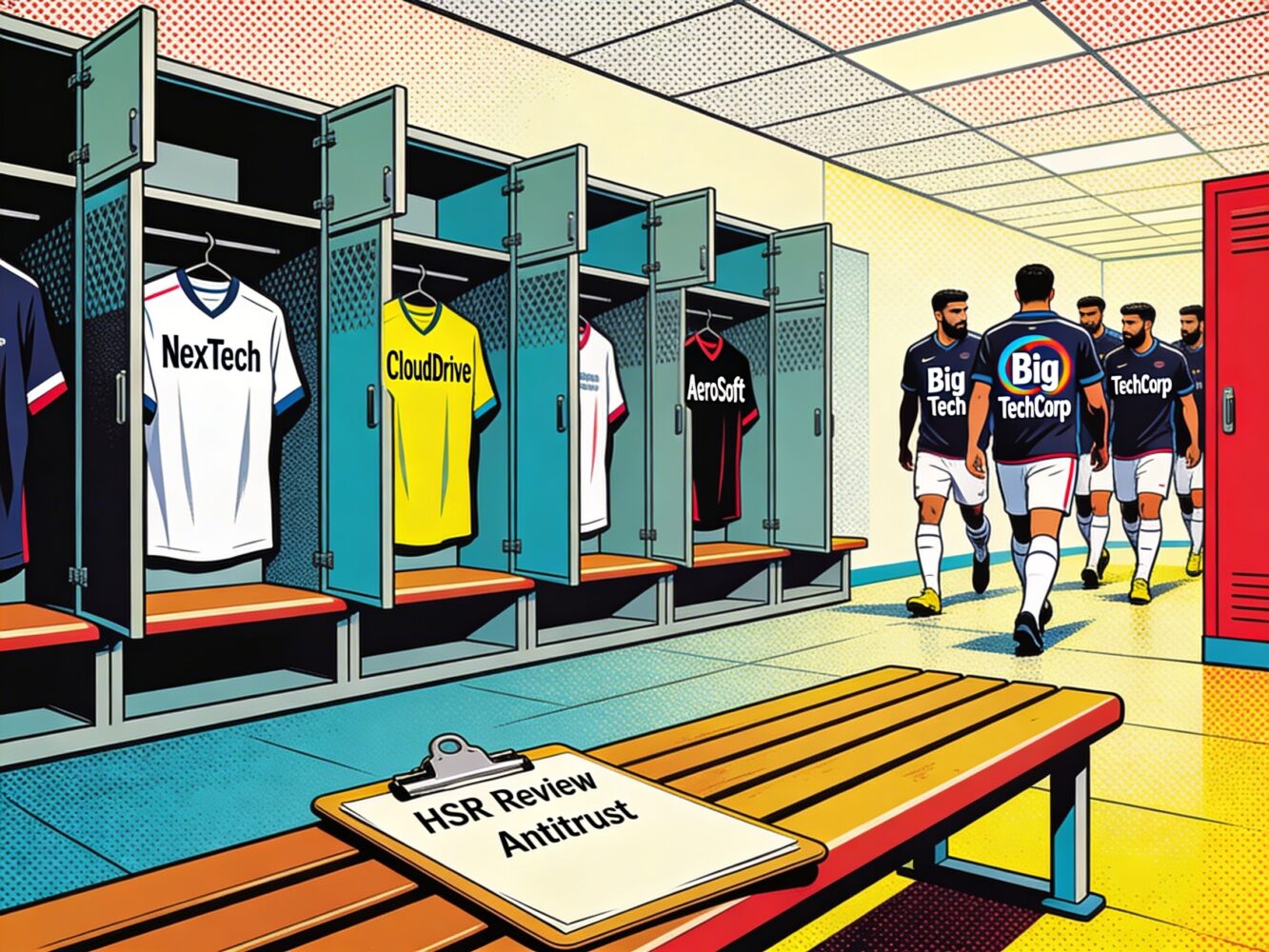
The Federal Trade Commission (FTC) has trained its sights on one of Silicon Valley’s most familiar deal structures: the “acquihire.” In a Bloomberg podcast interview, FTC Chair Andrew Ferguson said the agency plans to scrutinize how acquihires are structured—looking for features that could bring them within merger law and trigger Hart-Scott-Rodino Act (HSR) reporting thresholds. The acting head of the U.S. Justice Department’s (DOJ) Antitrust Division, Omar Assefi, went further, calling acquihires a “red flag” designed to sidestep merger review.
Others share that concern. U.S. Sens. Elizabeth Warren (D-Mass.) and Richard Blumenthal (D-Conn.) recently urged the antitrust agencies to investigate so-called “reverse acquihires,” which they argue evade scrutiny and “risk further consolidating the Big Tech industry.”
Skepticism about regulatory arbitrage makes sense. But in the case of acquihires—and related license-and-hire agreements, where firms license a target’s technology while hiring its staff—the concern looks misplaced. Section 7 of the Clayton Act and Section 1 of the Sherman Act target conduct with meaningful competitive effects. Acquihires rarely clear that bar. They center on talent transfers, which makes their structural impact too fleeting for Section 7 and their competitive harms too speculative for Section 1. As a result, most fall outside enforcement.
That gap reflects design, not defect. When agencies face novel conduct, uncertain harms, and resource-intensive enforcement, the better course often is restraint. Acquihires can serve legitimate ends: enabling entrepreneurial exit, preserving labor mobility, and protecting professional reputations in the tech ecosystem. Treating them as presumptively suspect risks destroying real economic value. It also invites agencies to spend scarce resources on cases that current law is unlikely to support.
This piece proceeds from that premise. Acquihires differ from transactions typically policed by antitrust law because they involve the transfer of talent. That distinction carries important implications, especially in startup ecosystems where such deals play a central role. For now, there is little reason to rethink a doctrine that largely treats them as benign.
The ‘Reverse Acquihire’ Panic Meets Reality
Calls for heightened antitrust scrutiny rest on what critics describe as a new evasion tactic: the “reverse acquihire.”
The theory is straightforward. Big Tech firms may “acquir[e] control of a company’s key assets without acquiring the company itself.” They can do so by licensing a target’s technology while hiring most of its workforce—leaving behind an empty shell. These deals can also be structured to stay below HSR thresholds or to fall outside the statute’s definition of acquiring “voting securities” or “assets.” Firms might rely on talent hires, licensing arrangements, equity transfers, or staged consideration to get there. In short, critics argue that companies design these transactions to exploit gaps in the HSR Act.
The Nvidia/Groq transaction often serves as the leading example. On Dec. 24, 2025, Groq announced a non-exclusive licensing agreement—reportedly worth $20 billion—with Nvidia for its inference technology. The deal also included the migration of Groq founder Jonathan Ross, President Sunny Madra, and other team members to Nvidia to help scale the licensed technology. Even so, Groq told investors and enforcers it would remain independent and continue operating GroqCloud.
Critics, including Sens. Warren and Blumenthal, labeled the deal a reverse acquihire. In their telling, Groq became a vehicle for licensing its proprietary GPU technology, while its commercially meaningful operations shifted to Nvidia. As they put it:
[B]y licensing its technology and hiring its most important employees, NVIDIA has effectively acquired Groq in all but name.
That framing overstates the case. The Nvidia/Groq deal is a poor poster child for expanding antitrust scrutiny. Even if the parties had notified the transaction, there is little reason to think enforcers would have found it anticompetitive on the merits.
As International Center for Law & Economics (ICLE) scholars have argued elsewhere, AI partnerships often provide critical funding for cash-hungry startups whose technology might otherwise stall—especially in a sector where outright mergers can attract scrutiny. The Groq deal fits that pattern. By late 2025, the company reportedly faced layoffs and attrition including the departure of its former chief architect. Its first-generation LPU lagged Nvidia’s current products, and analysts questioned whether its roadmap could close the gap. Against that backdrop, casting the deal as the elimination of Nvidia’s “most formidable rival” requires a heroic counterfactual.
The broader market cuts the same way. AI inference—distinct from training—remains highly competitive. Nvidia and Groq compete with established firms like Google, Amazon Web Services, AMD, Qualcomm, and Intel, alongside specialized startups such as Cerebras, SambaNova, and Graphcore. That competition has driven steep price declines. Inference costs reportedly fell fell by two orders of magnitude between 2023 and 2025—hardly a market tipping toward monopoly.
Some analysts reached a similar conclusion. Rather than chilling competition, the Nvidia/Groq transaction appears to have validated the market for specialized inference chips, boosting valuations and strategic interest in rival firms.
None of this means the deal raised no legitimate questions. But its escape from HSR review does not indict current merger-control doctrine. On any plausible substantive analysis, the transaction likely would have cleared.
You Can’t Buy People—Only Convince Them to Leave Together
Expanding merger-notification rules to capture acquihires runs headlong into a basic reality: talent acquisitions do not actually “acquire” talent.
Commentators often describe acquihires as transactions centered on “acquisition of the talent” of the target firm. But labor is not a commodity—even under antitrust law. Section 6 of the Clayton Act makes that explicit.
The same principle runs through the common law. Employment contracts are unassignable absent the employee’s consent. As Lord Atkin put it in the UK labor-law case Nokes v. Doncaster Amalgamated Collieries Ltd [1940] AC 1014, this “right of choice” marks the line between “a servant and a serf.”
That right extends to personal-service contracts, which courts will not specifically enforce. In the United States, attempts to compel performance raise serious concerns under the Thirteenth Amendment’s prohibition on involuntary servitude. One cannot sell oneself into slavery.
The Restatement Second of Contracts reinforces the point. Section 367 provides that “a promise to render personal service will not be specifically enforced,” and that courts will not enjoin a worker from taking other employment if doing so would effectively force continued service or leave the employee without a reasonable livelihood.
So what, exactly, do firms obtain in an acquihire?
Not human capital, strictly speaking. Instead, firms structure deals that encourage employees to make a coordinated move. The transaction aligns incentives across a complementary team, turning what would otherwise be independent labor-market choices into a predictable, collective outcome.
That distinction matters. If firms do not—and cannot—acquire employees, then the key question becomes what they are acquiring instead. The answer may determine which statutory framework, if any, properly applies.
Section 7 and the Problem of ‘Buying’ What You Can’t Own
Section 7 of the Clayton Act prohibits acquisitions where the effect “may be substantially to lessen competition, or to tend to create a monopoly.” It covers acquisitions of stock or share capital and—after the Celler-Kefauver amendment—assets. At first glance, it looks like a natural tool for challenging acquihires. On closer inspection, the fit is awkward.
Start with the threshold problem: employees are not acquired. Human capital is inalienable. Workers can leave, regroup, or re-enter the market, subject only to narrow—and often unenforceable—constraints. That makes the competitive effects of acquiring a team inherently transient and speculative. Merger doctrine, by contrast, targets structural and durable shifts in competition.
What, then, is actually transferred? Typically, some mix of intellectual-property licenses, equity stakes, and contractual arrangements that coordinate employee movement. Whether any of these qualifies as an “asset” under §7 is not obvious. Courts generally require that the acquired assets carry independent competitive significance—productive capacity that can be deployed against rivals.
A licensing arrangement like the one in Nvidia/Groq may satisfy that test for the underlying technology. But where the deal’s value lies primarily in a coordinated team departure, the asset theory strains. Human capital does not transfer by assignment, and agreements that align employee incentives sit several steps removed from the productive assets §7 was designed to reach.
The second problem is analytical. Section 7 turns on market definition and structure—whether a transaction meaningfully increases concentration in a properly defined market. Acquihires do not slot neatly into that framework. The alleged harm is rarely horizontal consolidation. Instead, it is the neutralization of a nascent rival by stripping away the human capital that drives innovation.
That theory is not foreclosed. Courts have read §7 to reach potential competition and nascent threats. But it forces courts to make difficult predictions about innovation trajectories—precisely where merger doctrine’s structural presumptions offer the least guidance. The earlier the target, the more speculative the counterfactual—and the weaker the case.
A third complication: timing. Acquihires often occur at the earliest stages of a firm’s life, before it has a defined market presence, meaningful revenue, or a clear competitive footprint. The 2023 Merger Guidelines acknowledge the challenge of assessing harm to innovation competition but do not resolve it. Showing a probable substantial lessening of competition in a market the target might have entered—or disrupted—requires constructing a counterfactual that is, by definition, uncertain.
None of this makes §7 irrelevant. It applies when an acquihire crosses the line from a labor-coordination device to a functional acquisition of a competitive entity. The key question is whether the target holds assets that independently constrain competition—and whether the transaction plausibly eliminates that constraint.
The Nvidia/Groq deal illustrates the point. If Groq’s technology is licensed on terms that make Nvidia the effective commercial beneficiary, one could argue the transaction functions as an asset acquisition in licensing form. Reports that roughly 80% of Groq’s engineering team departed reinforce that view. As Noah Bean notes, without the engineers who can implement and iterate on the technology, the license’s value to third parties may drop sharply.
That said, the loss of personnel should carry limited independent weight. It provides context, not the answer. The dispositive question is whether Nvidia’s rivals retain commercially meaningful access to the relevant intellectual property. If they do, the deal looks like a “license plus a hire.” If they do not, the licensing structure may instead operate as a de facto asset transfer.
In short, §7 reaches acquihires that extinguish a firm’s competitive significance—not those that simply hire its employees or license its technology without crossing that line.
Section 1: It’s Not the Hiring—It’s the (Alleged) Killing
Where Section 7 strains, Section 1 of the Sherman Act offers a cleaner doctrinal fit. Section 1 prohibits contracts, combinations, and conspiracies in restraint of trade. It does not turn on the acquisition of stock or assets, nor does it focus on durable shifts in market structure. It targets coordination—agreements that distort competitive outcomes regardless of whether anything formally changes hands. That makes it a more plausible tool for transactions defined less by what they acquire than by what they may suppress.
The threshold requirement is an agreement, and acquihires will usually satisfy it. These deals are not spontaneous migrations of talent. Firms structure them through interfirm arrangements—asset purchases, equity transfers, licensing agreements—designed to move a team together.
The harder question is whether the agreement unreasonably restrains trade. Under the rule of reason, courts typically apply a four-step framework. The plaintiff must first show anticompetitive effects in a relevant market. The burden then shifts to the defendant to offer procompetitive justifications. The plaintiff must respond by identifying a less-restrictive alternative or showing the restraint is not reasonably necessary. Finally, courts balance the effects to determine whether the conduct is, on net, procompetitive or anticompetitive.
In the acquihire context, the most plausible theory of harm is not labor-market coordination as such. It is the elimination of a nascent competitive threat—the suppression of a product, service, or line of innovation that might otherwise have matured into a meaningful constraint.
That theory fits Section 1 more comfortably than Section 7. It directs attention to coordinated suppression of emerging competition, rather than to the acquisition of presently durable productive assets.
Incentive structures within acquihires may inform that inquiry—but only at the margins. Group-transition bonuses, synchronized offers, and retention packages tied to collective participation can turn independent employment decisions into a coordinated outcome. That coordination alone does not violate the law. Firms routinely structure incentives, and employees remain free to decline.
What matters is the link between coordination and competitive harm. Coordinated hiring becomes relevant only if it ties to the suppression of competition in a product or innovation market. Without that link, acquihires reduce to ordinary hiring decisions—conduct antitrust law generally leaves alone. Section 1 scrutiny becomes plausible only where an agreement aims to eliminate a genuine line of rivalry.
That limiting principle tracks the FTC’s concern. The agency does not object to talent mobility as such. It worries about the loss of competitive threats embodied in small, specialized teams. Properly applied, Section 1 can reach that harm—if it materializes.
Where the target’s product has already failed, or the team did not drive any meaningful competitive constraint, acquihires should draw no scrutiny. These transactions do not suppress competition; they redirect talent. Antitrust law should not prop up failed ventures to preserve them as hypothetical rivals.
Before You Ban It, Ask What It’s Doing
Calls to expand antitrust doctrine to capture acquihires—including license-and-hire agreements and so-called reverse acquihires—might carry more weight if these transactions were pure regulatory arbitrage with no redeeming value. They are not.
As Frank Easterbrook famously observed, “Wisdom lags behind the market.” That insight fits here. Acquihires serve several functions that antitrust debates tend to overlook.
Start with the basics of the startup ecosystem. Many ventures are built, financed, and staffed with a clear endgame: a successful exit. Acquisition by a larger firm often provides the most viable path. Founders, investors, and employees routinely plan around that outcome. If regulators narrow that exit channel—including through acquihires—the predictable result is less investment and less innovation.
Acquihires also carry social and reputational value. When a startup is acquihired, its engineers and core team can credibly claim they helped build something worth buying. That narrative carries “significant cultural cachet.” It offers a nonpecuniary payoff that softens the downside of startup risk, encourages entrepreneurial entry, and helps sustain the industry’s talent pipeline. Disrupt that mechanism, and the ecosystem’s incentive structure starts to fray.
They may also facilitate labor mobility. John Coyle and Gregg Polsky, drawing on interviews with Silicon Valley participants, find that highly sought-after engineers often prefer to move via acquihire rather than defect individually. The reason is practical. An acquihire can reduce the risk of informal sanctions—lost investor support for future ventures or social ostracism within tight-knit networks.
Put differently, acquihires do real work. Stretching antitrust doctrine to reach them requires strong evidence of systematic anticompetitive harm. As discussed above, that evidence is thin.
What’s Next?
The instinct to scrutinize acquihires is not misguided. When a transaction strips a firm of its competitive capacity under the guise of a talent deal, antitrust law has a role to play. In that sense, Chair Ferguson’s view that substance should prevail over form reflects a sound principle.
The problem is that most deals do not cross that line. Section 7 of the Clayton Act targets transactions whose competitive significance lies in the acquisition of durable productive assets. That rarely describes deals centered on coordinating the movement of human capital. Section 1 of the Sherman Act, for its part, reaches only agreements that unreasonably restrain trade—a standard most acquihires will not meet.
Regulators thus face a choice.
One option is legal reform—reshaping the statutory framework to better capture these transactions. But that path cuts both ways. Overbroad rules risk deterring beneficial deals, and there is little evidence that competitively significant transactions systematically evade review under current law.
The alternative is to work within existing doctrine, accepting that its limits may reflect design rather than failure. That approach calls for restraint. Agencies should focus on transactions that genuinely eliminate competitive constraints, not those that simply reallocate talent. Antitrust law should not become a vehicle for broader political or ideological agendas.
Either path demands a clear-eyed understanding of what acquihires are—not just what they resemble. Getting that judgment right matters. The costs of error will fall on the innovation ecosystem, entrepreneurial incentives, and ultimately, consumers.
