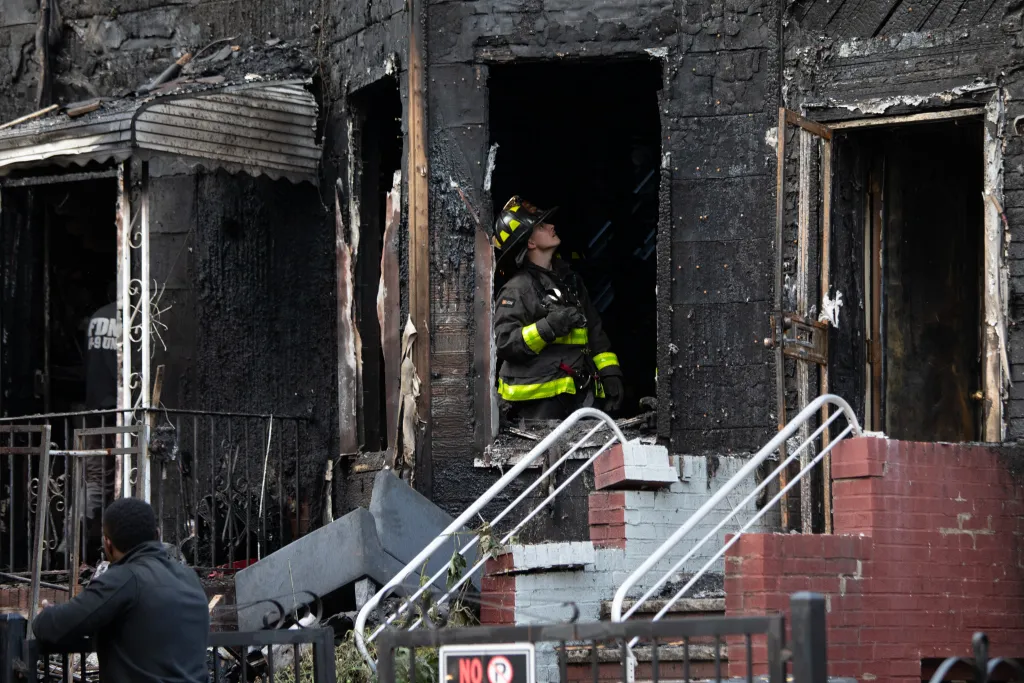
It’s a record. Already in 2026, New York City has suffered 406 lithium-ion battery fires, sparked by the electric cells that power an ever-growing fleet of e-bikes and electric scooters.
Since 2019, when the Fire Department first started keeping these stats, such blazes have resulted in 46 deaths and 628 injuries.
All this occurred despite an aggressive effort to end this grim but persistent trend. Laws were passed. Policies changed. The FDNY warned people again and again not to charge off-label batteries without safety certification.
And yet last month, four tenants of a Bronx public housing development perished in a fast-moving fire triggered by a battery charging inside their apartment.
Then last week, six people died in a Sunset Park blaze. A cause has not been officially released, but FDNY officials noted two charred lithium-ion battery-powered devices were removed from the scene. Not counting the victims of the most recent Brooklyn fire, that’s nine battery-fire deaths already this year.

And once again, elected officials are calling for reforms.
Last week, the City Council announced it will hold an emergency hearing on this issue on Nov. 20. And on Friday, Mayor Zohran Mamdani told reporters his administration is focusing on finding a solution, “whether it’s exploring additional legislation or it’s exploring additional policy that we can make at the administrative angle.”
Dwindling Enforcement
The solutions may not be so simple.
Workers who rely on e-bikes continue to buy and charge unsafe, off-label batteries, which are less expensive. Retailers and on-line outlets continue to sell them.
At times, the city bureaucracy has struggled to respond, even when they’re clearly warned of potential danger. In February 2023, journalist Fazil Khan perished in a raging fire in Harlem that erupted in an apartment below him where tenants were charging multiple batteries. Callers to 311 had warned the city weeks earlier, but there was no response.
That same year, the City Council took the first major step to confronting this issue, passing a law banning the sale of lithium-ion batteries that were not safety certified. This was a crucial step: Fire officials say batteries that are certified by the Underwriters Laboratory (UL) or aren’t charged via their manufacturer’s approved charger are vulnerable to bursting into flame. The resulting chemical fire is difficult to extinguish — and spreads quickly.
Since then, however, enforcement of the ban has wavered, according to Department of Consumer & Worker Protection (DCWP) records obtained by The City Reporter.
The law went into effect Sept. 1, 2023, while Eric Adams was mayor, and in the first four months his DCWP launched a wave of inspections citywide, issuing summons to 105 retailers at a rate of more than 26 per month.
In 2024 the agency issued summons to 108 businesses over 12 months, which dropped the rate to nine per month. Then in 2025, the last year of the Adams administration, enforcement fell even further, with summons issued to just 46 sellers all year for a rate of less than four per month.
In 2026, the first year of the Mamdani administration, enforcement got off to a slow start. By the beginning of August, DCWP had issued summons to just 26 sellers, but in August and September the city launched a sweep, bringing the total to 68 retailers hit with summons by last week. That was still a rate of just under seven per month.
And records show some of these retailers broke the law again and again, with some being hit with multiple summons for selling unsafe batteries since the law went into effect.
DCWP spokesperson Stephany Vasquez Sanchez said the agency “focuses on bringing businesses that remained in violation of (the law) into compliance,” and the agency’s tactics of shutting down repeat offenders “have improved compliance.”

“We’ve found that the majority of businesses stay in compliance once they learned to sell safe and certified devices,” she said. “We will continue our work to ensure compliance in this industry, especially to hold recidivist businesses accountable with our full authority.”
Another effort to get the delivery drivers who rely on e-bikes to stop using non-certified batteries kicked off in June 2025 under a law sponsored by then-Councilmember Keith Powers. The law created an exchange program for eligible drivers to turn in their unsafe batteries for those that were UL listed.
But the exchange program expired in 2025.
Last week after the Sunset Park catastrophe, Powers, now a state assemblymember, took to social media to call on the Mamdani administration to “resume that program and save lives.”
What Can Washington Do?
Another elected official who’s tried to staunch the sale of unsafe batteries is Rep. Ritchie Torres (D-The Bronx), whose district includes the Patterson Houses where a battery fire last month killed four tenants, including an 11-year-old boy, two teenage boys and a 33-year-old woman.
In 2024, and then again in 2025, Torres sponsored a bill that would require the Consumer Product Safety Commission to establish a safety standard for rechargeable lithium-ion batteries used in micromobility devices such as electric scooters and bikes. Nationally retailers would be barred from selling batteries that don’t meet those standards. In both years, an overwhelming and bipartisan House majority voted for it.
The bill, nevertheless, has been unable to get to the floor of the Senate, where Torres said it would also be overwhelmingly supported. The obstacle, he says, is Sen. Rand Paul (R-Kentucky), who’s employed a tactic that allows a single senator to block a bill from getting to the floor, without explanation.

Torres is marginally optimistic that the Democratic wave gave control of Congress to his party “would improve the prospects” of the bill seeing the light of day.
But, Torres added, “a Republican minority in the Senate could remain an obstacle.”
“I see it as a matter of life and death,” the congressman said. “Poorly manufactured lithium ion batteries are literally ticking time-bombs and it’s communities like the Bronx that are hardest hit.”
Finally the deadly fire in the Patterson Houses in The Bronx last month cast a spotlight on another attempt to prevent more of these fires from costing lives.
In 2023, the same year the council passed the law barring the sale of uncertified batteries, the New York City Housing Authority (NYCHA) was considering prohibiting the charging of e-bike batteries, certified or not, on all public housing property. That September they dropped that plan and instead adopted a compromise: households could charge one battery per unit, as long as it was safety-certified and the charging could not block any exit from the apartment.
Since then, that compromise solution has been followed by no fewer than 53 e-bike battery fires in NYCHA apartments. In the Patterson Houses blaze, the residents were charging the battery in the kitchen, in a place that blocked the family from escaping.
Our nonprofit newsroom relies on donations from readers to sustain our local reporting and keep it free for all New Yorkers. Donate to THE CITY today.
The post E-Bike Battery Fires Hit Record in NYC, But Solutions Remain Elusive appeared first on The City Reporter.