Film slows you down because you have 36 exposures on a roll of 35mm film. You can’t shoot like a machine gun; you have to be more thoughtful. And then there’s the craft of taking the film and going into the darkroom and developing it. There’s this revelation of seeing the negatives for the first time. There’s making contact sheets where then you study them with a loupe and a grease pencil, and you thoughtfully think about what you’ve done. It’s a very big commitment of time then to go into the darkroom and make the print. So every step of the process is thoughtful and slow and very different than shooting with an iPhone…
As his first career retrospective opens at the Bronx Documentary Center, photographer and filmmaker Harvey Wang sat down with The City Reporter’s Harry Siegel to discuss capturing an ever-vanishing city, what it’s like looking back over decades of his own work and much more.
https://rss.buzzsprout.com/2616688.rss?wangsworld
Harry Siegel: It’s TBD NYC, covering the ABCs of arts, books, culture, film, photography, etcetera — here in the only city in the world.
I’m Harry Siegel, The City Reporter’s editorial director for audio, here with Harvey Wang, the photographer and filmmaker who is the namesake subject of Wang’s World, his first-ever career retrospective that’s opening this weekend at the Bronx Documentary Center and will be there through January 9th.
Harvey, you came on FAQ NYC off-cycle a couple of years ago for a look back at your book, Harvey Wang’s New York, that was an incredible snapshot, so to speak, of a vanishing city as of 1990. Lots of stuff has vanished since then, and now you’ve got your first career retrospective with lots of photos and also three screenings of your documentaries, feature, and short films. It’s great to have you on, and let’s jump right in.
Harvey Wang: Nice to be here.
Harry Siegel: Thank you. Yeah, we’re doing it in person this time, which I’m glad about. Last time was mid-pandemic, as I recall, and we did it over Zoom.
Harvey Wang: Right, right. So this time I have to wear pants.
Harry Siegel: Yeah, everyone’s got to suffer for their art. A career retrospective is a real honor, but I have to imagine it’s got to be at least a little weird. Do you want to talk about the show, what’s in it, and what it’s been like just going back through decades of your work?
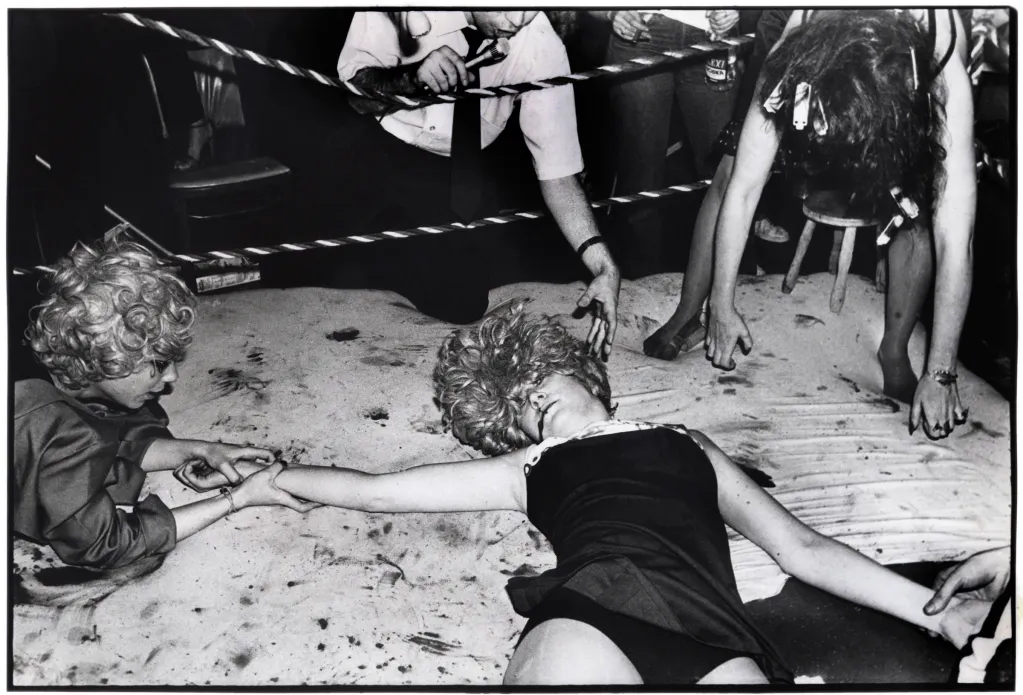
Harvey Wang: Sure. I wanted it to cover my earliest work that I did as a high school student growing up in Queens and coming into the city with my Nikkormat camera and exploring—and be sort of an autobiography, in a way, of my journey through the city and my career. So there’s early work, which I can go into detail later. There’s pictures of my period of living in Chinatown from ’79 to ’83, where I was photographing Club 57 and the music scene and just life on the Lower East Side and the East Village, and that was the origin of my doing the Harvey Wang’s New York book—seeing businesses closing up and starting to do portraits, and then over a five-year period doing portraits all over the city, and that becoming the book for W.W. Norton.
But even before that book, I had worked on two projects. One was about retired baseball players, which was very, very cool. That was my first book that I did with Ed Kiersh, the writer, for Bantam, and we traveled all over America.

And it was so cool meeting old Yankees like Don Larsen, Pedro Ramos, and Roger Maris, as well as players from—you know, Hall of Famers. And in that era, those ballplayers didn’t have big pensions or contracts, so they had to go back to jobs. Mickey Lolich had a donut shop, Bobby Shantz had an ice cream stand. You know, it was really very interesting to see these old-time legends living a real life.
After that, I did a book called Rock Wives about women married to rock stars—you know, fascinating: Angela Bowie, Leslie Meat Loaf, Dee Dee Ramone’s wife Vera. So doing portraits and stories, those all happened before Harvey Wang’s New York.

So the exhibit covers those books as well as two collaborations I did with David Isay, the legendary radio documentarian and MacArthur genius who became a good friend. We traveled around the country doing a book called Holding On: Dreamers, Visionaries, Eccentrics, and Other American Heroes, full of incredible characters. And that was a wonderful time for me to be on the road with David. We were very simpatico; we really just had a great time. I would quietly sit back while he did his interviews—and he was a great interviewer and very, very well-prepared interviewer and very sympathetic—and then I would have my moment to do the portraits, and then we’d get in the car and move on to the next city, state. You know, it was a great journey for me.
And another book we did together was Flophouse: Life on the Bowery, which we could talk about. So deciding what to include in the show was, you know, I went through my career, the different bodies of work, including stuff I did in Appalachia in my college years, and the show brings us right up to date. I’m doing a new series of color work, and there’s a section for that as well.
Harry Siegel: You’ve shot a lot in black and white—how old are you?
Harvey Wang: I’m 70.
Harry Siegel: Kids today. So you started in, you know, this era of chemical photography. Do you want to talk a bit about shooting black and white and color, how you decided on that?
Harvey Wang: I started shooting black and white film and then very quickly had a darkroom, you know, in my high school years. My cousin Roberta taught me how to develop film and make prints, and actually her husband Ethan, who’s not a photographer, spent time with me in the darkroom in their apartment on Bergen Street in a home owned by Tom Anderson. They rented a top-floor apartment and they had a darkroom, and I learned how to print there.
But darkroom work became a big part of my attraction to photography. First of all, shooting in film slows you down because you have 36 exposures on a roll of 35mm film. You can’t shoot like a machine gun; you have to be more thoughtful. And then there’s the craft of taking the film and going into the darkroom and developing it. There’s this revelation of seeing the negatives for the first time. There’s making contact sheets where then you study them with a loupe and a grease pencil, and you thoughtfully think about what you’ve done. It’s a very big commitment of time then to go into the darkroom and make the print. So every step of the process is thoughtful and slow and very different than shooting with an iPhone.
And I was just tickled to death when I would make a beautiful print, and it was a fulfillment. It was something tangible. It was something I could hold and show and share, and then ultimately put in a box. And those boxes started to—when I went to college, I had like one box of contact sheets, and now, you know, of course there’s hundreds of boxes of contact sheets, and it’s a physical representation of my life because each contact sheet intermixed with work and projects are friends and relationships and eventually children. And they’re sequential, and they’re ordered, and they’re physical, and it somehow suited me to work in film, in black and white.

Harry Siegel: You put out a book and a documentary, I guess a decade ago now, called From Darkroom to Daylight about some of this and the transition to digital. And like 10 years later, we are through the looking glass all the way, no doubt. On the flip side of this, I’m interested how you feel about digital photography.
Harvey Wang: Well, first off, when things switched from analog to digital, it did create a bit of a hiccup in my career because I didn’t—I was reluctant to adopt it. I just had this strong, you know, attraction to black and white and darkroom work. But I have to say it’s pretty incredible what you can now do with digital tools, and especially, you know, doing a job, any kind of commercial work, when you can photograph something and deliver it that afternoon, you know, without going to a lab, without going into the darkroom. So it speeds things up.
And then Photoshop is remarkable. You can do things that are impossible to do in a darkroom. And for my latest work that involves shooting multiple images and creating, you know, in effect, collages or series of pictures, it would have been so cumbersome to do it using analog tools. So, you know, I think digital has really opened up the world.
But there’s also what I anecdotally understand that there’s a lot of younger people who are very attracted to shooting film, and they’re getting old film cameras and they’re finding labs, and it’s similar to the vinyl record thing. You know, like in a time when everyone can do a perfect picture with their iPhone, I think there might be a movement to search out for imperfection—you know, the happy accident. There are no happy accidents in digital, you know, unless you’re faking them in Photoshop.
Harry Siegel: There’s all the delay with analog. There’s this long delay and you don’t know what you’ve shot until you’re getting the images back, and it’s just a very sort of different—
Harvey Wang: Yeah, and I think it’s a reaction—you know, the slow food, vinyl records, analog photography. Maybe it won’t all die out totally.
Harry Siegel: Do you want to talk a bit about Club 57 and how you ended up there and the characters?
Harvey Wang: Sure. So I’ll go back to 1979. I was living in Chinatown at 22 Catherine Street, a five-story walk-up. I had four roommates—there were five of us in total.

We were each paying about 100 bucks for our rent. I paid a little more because I had two rooms; I had a darkroom and a bedroom combined, and then a little office. But one of my roommates was a guy named Kai Eric, and he was dating Ann Magnuson, and she was sort of one of the founders of Club 57, which was on 57 St. Marks Place in the basement of a church. And it was a wildly creative time.
The idea was sort of like, “Let’s get together and put on a show.” You know, it was sort of like we’ll have a monster movie club, and we’ll have live art performances, and we’ll have pop-up art shows—and Keith Haring was there, and Basquiat, and Lypsinka, and all of these creative people would congregate. And they had a monthly calendar, there was a Ladies Auxiliary, and all of these sort of silly things—Country Western Night. It was just like playing, but among people who were just really, really creative and inventive, and anything goes.
So I would start to hang out there and do pictures on various events and nights, and it was wild fun. I always kept myself a little bit on the outside being a photographer, not so much participating as observing, and which has kind of been my M.O. for a lot of my life—is I’ve used the camera to get places, but not necessarily participate. There’s pluses and minuses to that.
Harry Siegel: You can look people in the eyes and they can’t see yours.
Harvey Wang: Well, there’s that. And you know, it’s interesting to me that all of this contemporary stuff was going on, and I was taking pictures, but at the same time I was doing Harvey Wang’s New York, which is a kind of looking back. I was looking, you know, I was looking back: what is going to disappear?

Where’s the New York of my grandfather’s era? And yet this other stuff was happening that I kind of like was flitting through, but not getting too deep with. You know, there were documentarians and photographers who were, you know, photographing Keith Haring at work, for instance, but I just would photograph the things that were happening at Club 57.
Harry Siegel: And this is a little later now, but I have in my hand Flophouse: Life on the Bowery, which you mentioned is another of the projects you did with David Isay. There’s sort of an incredible contrast in my head between the Club 57 stuff and that sort of work, and the two very proximate but very different New Yorks. Do you want to talk a bit about shooting that and how you went about it?
Harvey Wang: Yeah, I’d love to actually, because it’s—the book Flophouse: Life on the Bowery, published by Random House in the year 2000, was mostly shot in 1998, 1999. It was an outgrowth of a radio documentary that David Isay and Stacy Abramson did about the Sunshine Hotel. And so they were drawn to kind of this fabled Bowery. You know, it was legendary; it was the premier Skid Row in America, and from the end of the 19th century until the 20th, it was the country’s most infamous Skid Row.
By the 1990s, when we did this book, there were only about eight flophouses remaining, and still offering the shabbiest of accommodations for, you know, under $5 in some cases.

Harry Siegel: Flophouses, SROs—all these are now themselves a sort of disappearing world, and we’re in this new sort of modern homelessness that’s pretty young, you know, since about 1980, prior to which, you know, there was a lot of men who were finding very cheap and scuzzy rooms, and then some overwork.
Harvey Wang: Yeah, and it’s incredible how New York changes so rapidly, but I never imagined—you know, the New Museum opened up next to the Sunshine Hotel, and a contemporary artist named Anna took me to the Sunshine. There are two residents left in the Sunshine Hotel right today. There are two residents left, and in the Providence Hotel, they’ve been tearing down all the cubicles, and I think it’s down to maybe 14 people. So really it’s a rapid end of an era—the era of the flophouse.

Harry Siegel: Bouncing around a little, do you want to talk about your films, doing that sort of work, and what’s going to be screening over the next couple of months?
Harvey Wang: Sure. Yeah, the first screening date is on November 21st. I’ll be showing From Darkroom to Daylight, which is my documentary about the transition in photography from analog to digital. I interviewed 50 photographers, including some really well-known ones like Sally Mann, and Elliott Erwitt, and Eugene Richards, Alex Webb, Taryn Simon, David Goldblatt from South Africa—some really, you know, really outstanding people who had different thoughts about this transition: some totally embracing digital tools and others firmly committed to analog. But I was trying to figure out my own place in the world, and that—it was kind of in a way, even though it’s full of interviews, it’s a personal film on trying to figure things out.
So that’s From Darkroom to Daylight, and that will be preceded by a short film about Sid Kaplan, who is a legendary character in New York. He was Robert Frank’s printer; he printed for Robert Capa, and Cornell Capa, and Weegee, and he has an East Village darkroom. Many years he taught at SVA. But I made a short film about him, so that will precede From Darkroom to Daylight.
And then on December 1st, I directed one feature film in my life. It’s called The Last New Yorker, appropriately. It starred Dominic Chianese and Dick Latessa. Dominic, of course, is Uncle Junior, and Dick Latessa had a long career on Broadway; he was in Hairspray and countless other plays—wonderful guy. And then the lead female character was Kathleen Chalfant, and she was a wonderful actress to work with and was so—you know, me being a first-time director—she was so gentle and kind and helpful, and an amazing professional who’d come to set knowing her lines.
The film is about two older friends who kind of—basically the film is about them wandering around and talking. And in the course of the film, Lenny, the character played by Dominic, loses his money in the stock market, but he also falls in love. And so it’s a sweet story of friends in their 70s, it’s a love story, it’s about a changing New York. A lot of the locations were places that have since disappeared, like Blarney Stone, and Lismore Hosiery, and a jewelry store on Canal Street, Molded Shoe Company, Eisenberg’s Coffee Shop—all these locations that were their world, but have since disappeared just like they were dinosaurs walking around New York.
So on January 9th, we’re having an evening of short films which will include The Cantor’s Last Cantata — about a cantor from a Reform synagogue in Borough Park who is about to retire and puts on a play with the congregation that’s based on a 1940s operetta. It takes place in Brooklyn, and it imagines that all the residents of Brooklyn wake from a dream to find that the Brooklyn Dodgers have beat the Yankees. So it’s a really great Brooklyn story, and it’s wonderful to see it performed by these alta kockers, and it’s a touching little film.
I’ll also be premiering another short film at that night about the legendary Tulsa, Oklahoma photographer Gaylord Oscar Herron. So this is kind of cool: in 1980, I bought a book at the Strand called Vagabond, and it was a photo book, and it just really, really affected me. Some photo books in my life have really, you know, had a big impact on me—Diane Arbus, Walker Evans, August Sander, these photographers I found, you know, their work influenced me. But this book Vagabond, I just was so moved by it because the photographs, he wrote text, his artwork—it was something very special. And I wrote him a fan letter in 1980. I wrote Gaylord Oscar Herron a fan letter. And then just five years ago, I got a response. So like, you know, 30 years later, I get a phone call from a woman who said, “I’m working with Gaylord Oscar Herron—you know, he’s now, you know, 80 years old—and I found your letter in his scrapbook. Would you like to talk to him?” So this is like, you know, 30 years later I get a response. So I ended up going to Tulsa and spending, you know, three, four days with him and filming him, and so I made a short film.
Harry Siegel: And it’s debuting.
Harvey Wang: And it’s debuting, yeah.
Harry Siegel: So we touched on Harvey Wang’s New York that came out in 1990, you know, and it’s capturing all these jobs and professions that were part of a vanishing New York—maybe, you know, those grandfather’s New York: mannequin makers, social dancers, sign painters, fish dealers, TV repairmen, and saddest of all, news vendors. 35 years later, like, who are today’s like pinsetters, knife grinders, bathhouse attendants, photoengravers?
Harvey Wang: It’s funny you should ask because in talking to the education director of the Bronx Documentary Center, they have a great program there: classes for teenagers, photography—they teach photography, filmmaking. And we were thinking that it would be nice to do an updated version of Harvey Wang’s New York with these teens in the Bronx. And so I asked AI. I said, “What jobs will AI make obsolete in the Bronx?” And, you know, I got a list. And so this is like an ongoing idea. Maybe I’ll work with these kids, we’ll try to like do an updated version of the jobs that are going to be, you know, made obsolete by AI in the Bronx—you know, let these Bronx kids do portraits and little oral histories.
Harry Siegel: I feel like that’s like asking AI, “When will I die?” But, uh—
Harvey Wang: Exactly. You know, people have always said to me—people, you know, I’ve spoken to groups and students over the years, and they often say to me like, “Oh, you did this book, I guess you can’t do another project like this.” And I always say that at any given moment, there’s going to be stuff that’s changing and disappearing, whether it’s a particular ethnic group being displaced from a certain neighborhood, or somebody—you know, there’s always going to be something.
Harry Siegel: Goodbye Italians.
Harvey Wang: Yeah. Exactly. I mean, there are very few—there’s what, one street left in Little Italy now? Yeah, so at any given moment one can go through the city and find something that’s disappearing.

Harry Siegel: Right. Before all of us disappear, what’s next for you after all this and having, you know, a couple months to be there and people appreciating what you’ve done, you having this opportunity to sort of go back through your own work? Like, do you have big ambitions or little ones for what’s next? What are you thinking?
Harvey Wang: Well, like I said, I’m working on a new series for my own enjoyment, and some of those works will be hanging, and I don’t know what people will think of them. My own 13-year-old son doesn’t think much of them; he says, you know, he appreciates the old black and white stuff. So, but I’m entertained and I’m happy to do it.
But you know, I talk to a lot of photographers my age, and one thing that we’re all concerned about is what happens to our work when we’re gone. And these things take up many cubic linear feet of shelving, and will it have a home in the future? Will it be dumpstered? You know, I have a relationship with the Museum of the City of New York, and they have over 800 of my pictures in their collection, and they plan to take in more. So for me, at least, I know that my New York work will have a home, and when I’m gone, it’ll be searchable, findable, and sharable. But there’s a lot of work that, you know, I want to make sure it finds a home.
I donated pictures to the Baseball Hall of Fame, I’ve donated pictures to the Rock and Roll Hall of Fame for those other books I had mentioned. I did a project with Milton Rogovin, the Buffalo photographer who passed away at age 100, I think, but when he was 90 I did a thing with him, and I donated my work about Milton to the Burchfield Penney Museum. So that’s part of the goal of what, you know, we do at this age, is find homes for the old work.
Harry Siegel: Harvey, thank you so much for coming on and talking all this through. The show is Wang’s World, at the Bronx Documentary Center through January 10th, and I hope we’ll talk again soon. Thank you.
Harvey Wang: Thank you.
Our nonprofit newsroom relies on donations from readers to sustain our local reporting and keep it free for all New Yorkers. Donate to THE CITY today.
The post LISTEN: From the Club to the Flophouse in Wang’s World appeared first on The City Reporter.