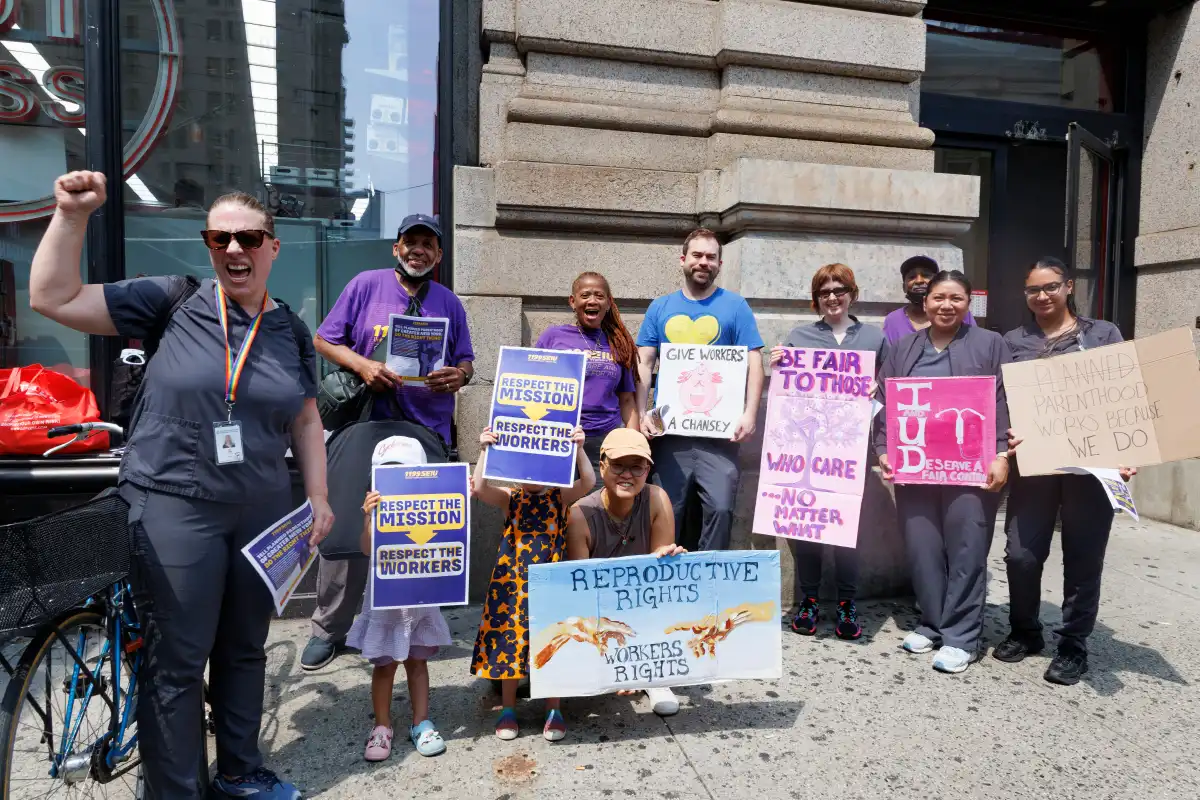
Planned Parenthood staffers picketed outside their Downtown Brooklyn clinic on Tuesday, demanding a fair union contract as bargaining drags on.
More than 160 union workers with Planned Parenthood of Greater New York have been working without a contract since June, and say negotiations have reached a stalemate as management refuses to agree to wage increases and better working conditions.
“They’ve offered us a 1% raise,” said Lily Dalke, a midwife who has worked for Planned Parenthood since 2018, and at the Brooklyn clinic for three years. “They’ve been asking for a lot of concessions on their end without really offering much.”
PPGNY staff voted unanimously to join 1199-SEIU in 2019, shortly after five smaller Planned Parenthood affiliates across the state merged to become Planned Parenthood of Greater New York. They won their first contract in 2020, and re-negotiated three years later.
“[In] 2023 management was very reasonable. They came to the table ready to bargain and ready to make fair concessions,” Dalke said. “This time around, it’s been a completely opposite experience.”
Dalke said the unit would like to see cost-of-living adjustments commensurate with increasing costs in New York City, around 4% per year, but management has so far refused.
Staffers face more responsibility, few resources
In recent years, Dalke said, Planned Parenthood has been demanding “more and more” of its staff. She and other Advanced Practice Clinicians — like nurse practitioners and physician assistants — used to see around 20 patients per day.
Now, they’re expected to see 30 patients during each ten-hour shift.
APCs are responsible for administering most services, like performing exams, placing IUDs, and prescribing medications, Dalke said.

“So it’s all about making clinically appropriate decisions in an empathic way that makes the person feel seen and heard, while also keeping the process moving because there’s always more people waiting,” she said.
The higher patient quota has impacted care, Dalke said. A patient might wait two or three hours for a ten-minute appointment, only to find there’s not enough time to address all their concerns.
Meanwhile, Dalke said, staff are exhausted and more likely to call out, leaving the clinic understaffed.
PPGNA has also proposed wage caps for Patient Care Associates. PCAs man the front desk, handle check-in and intake, draw blood, send out labs, perform pregnancy and HIV tests, and more, said Natalie Mitiguy, a PCA and union delegate.
Pay varies, Mitiguy said, but starts at $26 per hour — which works out to about $54,000 per year for full-time workers. Some PCAs have been working at Planned Parenthood for 20 or 30 years.
“They’re trying to cap the wages of the people who have been with us longest and we’re some of the people who get paid the least in the organization,” she said.
Many PCAs struggle to afford life in the city, Mitiguy said, and have to choose between paying bills on time or buying groceries. Some have left for other jobs because they couldn’t keep up with the cost of living.

“It’s one of the reasons why we’re fighting so hard for a cost of living adjustment that is actually up to the cost of living,” she said. “Feels kind of bare minimum.”
When Mitiguy moved to New York, she hoped to take advantage of the New York State Opportunity Promise program to go to nursing school and eventually become a Registered Nurse. But she would only be eligible for the program after completing prerequisite courses.
“I would love to stay with the company as an RN, but, again, I don’t have the money to afford taking classes,” she said. “And I think a lot of people have had to make tough decisions working here of what they can and can’t do.”
Planned Parenthood ‘tight on money’
PPGNY is facing genuine financial struggles, Dalke said. The 2019 merger meant the organization took on debts from other clinics around the state, and COVID dealt another blow. Last year, the organization shuttered its Manhattan clinic and sold the building for $38.1 million.
Planned Parenthood is also facing attacks from the federal government. Last year, the Trump administration’s “Big Beautiful Bill” prevented clinics that provide abortion services from billing Medicaid for any medical service at all. Gov. Kathy Hochul stepped in to provide $35 million in funding for Planned Parenthood in New York State.
Tax filings show that PPGNY generated $107 million in revenue last year — a significant increase from the $88.4 million the year prior — but also had $107 million in expenses.
“It ultimately comes down to how you attribute your how you allocate your resources, right?” Dalke said. “So I’m sure that there is a limited amount of resources that they have, but they’re choosing to ask the workers to unfairly shoulder that burden.”
One nurse practitioner who has worked at Planned Parenthood for 20 years said she and her colleagues strongly believe in the organization’s mission, and are dedicated to providing much-needed quality care to people who might not otherwise be able to afford it.
It’s a “huge commitment,” she said, and people often work long over their scheduled hours and on weekends.

“We’re making this choice because we believe in this care, so it feels like because we’re so committed to this care, sometimes it feels hard to negotiate for ourselves because obviously we don’t want to be a barrier to access,” she said. “But we also, in order to provide this care, we need to have the resources and resilience to continue to provide quality care.”
In a statement, a PPGNY spokesperson said the organization is “actively negotiating” with 1199 SEIU to reach a “fair, equitable” contract deal.
“We know that we can best carry out our mission when we develop, invest in, and fairly compensate our staff, and when equity is at the heart of every decision we make. We are committed to working through our differences at the bargaining table and we are confident that we will come to a reasonable compromise,” the spox said.
Employees said they have more concerns than pay.
They currently have a 15-minute grace period to clock in after their scheduled shift, and PPGNY has proposed cutting it down to a two-minute grace period. Most employees in New York City rely on public transit, Dalke said, and the two-minute grace period “isn’t realistic or kind.”
Staffers are also regularly asked to work in clinics on Long Island, a challenge if they live in the city and rely mostly on public transit.
The union has also fought for more transparency, said the nurse practitioner, who asked not to be named, lobbying to have a union member or two present at some board meetings. That request has been denied repeatedly, leaving members feeling disconnected from the board and cut out of decision-making.
“I think Planned Parenthood is an amazing organization, and I think it’s full of very passionate, committed people who really choose to work here,” Dalke said. “It’s not just a job for most of us; it really is a commitment, and we want to be able to show up. And we’re just asking for, you know, our basic needs to be met.”
