Long before a child can explain creation, they understand its thrill. Strike a drum and the air changes; sweep a brush across paper and blankness surrenders; plunge an entire hand into jewel-toned paint and the body becomes an instrument. Later, perhaps, a parent mounts the resulting masterpiece—however gloriously questionable—upon the refrigerator. The gesture is sacred: something invisible has entered the world and been declared worthy of remaining.
That exchange lies at the core of Casita Maria Center for Arts & Education, which has spent 92 years ensuring that expressive discovery never becomes the privilege of a fortunate few. Cultural instruction is still dismissed as enrichment, as though imagination were decorative. Yet music cultivates listening, dance establishes physical sovereignty, theater rehearses empathy, and image-making gives emotion a grammar. Remove those disciplines, and entire vocabularies disappear before young people have learned to speak them.
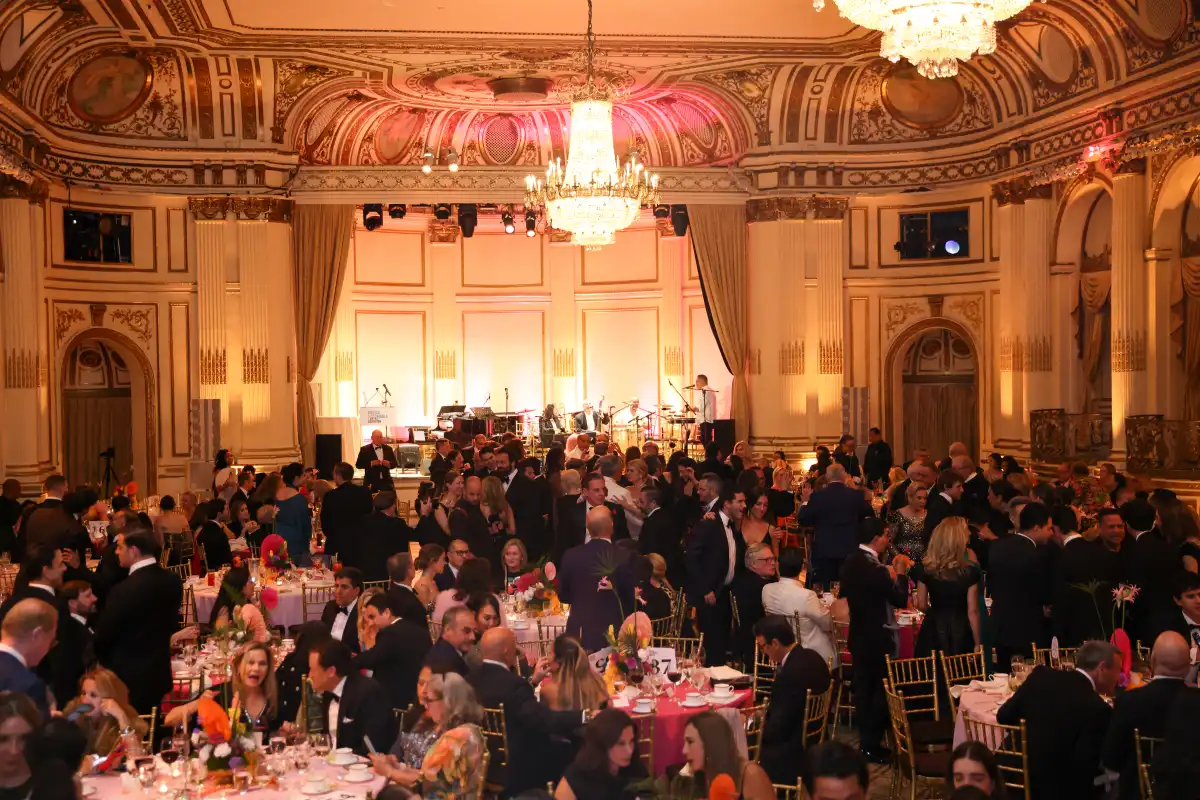
This conviction gave the annual Fiesta! Gala at The Plaza Hotel its tremendous emotional force. As we entered the hall for dinner, a live jazz ensemble gently loosened the room’s formality. Chairs Jackie Weld Drake, Jean Shafiroff, and HRH Prince Dimitri of Yugoslavia welcomed a sold-out audience for the organization’s highest-grossing benefit. Latino heritage moved through generations, laughter, rhythm, and the unmistakable tenderness of extended family. The Plaza supplied magnificence, certainly, although Casita Maria furnished the soul.


At the center stood Weld Drake, the longtime board chair and inaugural recipient of the Living Legend Award that now bears her name. Through decades of leadership, Jackie has helped transform Fiesta! into an enduring source of advocacy, loyalty, and indispensable funding. Keeping an institution alive requires far more than affection; it demands persuasion, stamina, constancy, and the nerve to return each year with the same incandescent belief. Her warmth may soften the request, although the commitment beneath it is steel.
That devotion reaches far beyond one ballroom. Founded in East Harlem in 1934, Casita Maria initially served Spanish-speaking families, especially Puerto Rican arrivals overlooked by existing settlement systems. The organization later moved to the South Bronx and established its Simpson Street campus. Executive Director Felix Urrutia measured this inheritance as 33,790 days—thousands of mornings when somebody unlocked a door, prepared a lesson, noticed a frightened student, and made room for another beginning.
Lest we not address the grit this all takes. Afterall, Casita Maria was forged, not found. Though exclusion supplied the pressure; generations of teachers, families, and advocates answered with discipline, cultural pride, and an unyielding refusal to let neglect determine a child’s future. It is important to note here that whatever radiance emerged came not from hardship itself, but from the steel of those who fought to transform it.


Seen through that history, the daily work acquires staggering consequence. More than 400 participants receive free academic assistance, literacy development, recreation, and instruction across music, dance, drama, and visual practice. Paid teen apprenticeships, college preparation, and career guidance convert talent into trajectory, while the gallery introduces accomplished practitioners directly into the curriculum. A student may arrive seeking homework help, discover an instinct for performance, and leave imagining a future previously withheld from view.
The fight for arts education matters everywhere; nevertheless, its urgency becomes acute in communities repeatedly denied resources, representation, and institutional faith. Here, access is not an extracurricular indulgence. It is resistance against erasure, a claim to intellectual complexity, and a declaration that neither geography nor income should determine whose interior universe receives cultivation. Talent is democratic. Opportunity, infuriatingly, is not.
Naturally, continuity on this scale requires money. Vice Chair Ben Rodriguez-Cubeñas announced a $100,000 commitment from the Rockefeller Brothers Fund; soon afterward, Paul Florez led a paddle raise that generated more than $200,000. Such generosity carries additional gravity as the administration’s fiscal year 2027 budget request seeks to eliminate the National Endowment for the Arts. Congress has not finalized that proposal, yet the threat places private patrons and local communities increasingly upon the front lines.

Those contributions travel far beyond a glittering evening. They sustain teachers, instruments, apprenticeships, exhibitions, safe afternoons, and pathways toward higher education or employment. A donation may appear as a number flashing across a screen inside The Plaza; in the South Bronx, it becomes a teenager’s first paycheck, a studio kept open, a mentor returning next semester, or the hour when a vulnerable youngster discovers both refuge and purpose. This is philanthropy at its most potent: capital converted into time, attention, knowledge, and possibility.
Within that framework, the honorees felt beautifully chosen. Hunt Slonem recalled how encouragement at school allowed him to envision an artistic vocation, lending particular resonance to his 35 years of support. Philanthropist Sonia Gutt de Haime received her distinction surrounded by loved ones, while Rodriguez-Cubeñas accepted the Jackie Weld Drake Living Legend Award after decades devoted to widening opportunity. Patronage, at its noblest, does not wait for brilliance to become profitable. It protects potential before certainty arrives.
Quite fittingly, the heartfelt speeches eventually yielded to Latin standards and familiar hits. Restraint dissolved as the ballroom erupted into dancing. At one point, I watched two children representing Casita Maria having the time of their lives amid donors, painters, relatives, and friends. Suddenly, every dollar pledged and promise made from the podium acquired a face, a future, and irrepressible joy.
Those young people were neither metaphors nor ornaments in philanthropy’s flattering self-portrait. They stood in complete possession of delight, still gloriously unpersuaded that they should become smaller. Their abandon revealed what no statistic could: art, education, and sustained care do not merely improve a childhood. They fortify the spirit, temper imagination into steel, and give the grit a chance to blossom.
