Nearly six months after the U.S. Supreme Court overturned a raft of President Donald Trump’s tariffs, few New York City small businesses have benefited from tariff refunds, even as they struggle under new import levies.
Importers across the country have claimed $121.75 billion in refunds since the landmark February decision that struck down Trump’s emergency tariffs, but almost none of that money will reach the places New Yorkers dine and shop at, according to experts and businesses.
The tariff mess is a significant drain on small businesses in New York City. A recent report by the Manhattan Chamber of Commerce cited tariffs as among the top factors, along with inflation, that are squeezing bottom lines across the five boroughs. Small businesses in the New York metro area are “absorbing an estimated $4.5 billion annually in tariff costs,” the report said.
And small importers say that filing for a refund is a daunting process that does little to alleviate the uncertainty of when the next cycle of Trump tariffs might come. Meanwhile, retailers and restaurants who buy from importers say tariff refunds have not been passed onto them — or to their customers.
‘Take the Hit’
Greg D’Agostino, who imports Italian wine to a New Jersey warehouse and sells to retailers in New York and Connecticut, said he qualified for a tariff refund but hadn’t bothered to file.
“When you’re in business, you just realize, ‘You know what, I just got hit by a car,’” he said. “Your car is damaged, so you just keep driving. Small business, you don’t have time for this.”
U.S. Customs and Border Protection said it did not have a state-by-state breakdown of refunds, so it’s hard to know how much tariff money New York importers have clawed back from the government.
But some business owners said they wouldn’t bother.
“There’s a lot of money out there that could be refunded if people hadn’t been so beaten down by the whole tariff process,” said Liz Picarazzi, the owner of a Brooklyn company manufacturing aluminum trash bin enclosures. “Maybe you engaged a lawyer last year, and you just got nothing but bills.”

For others, getting money back means waiting for their importer of record, often a freight forwarding company, to receive a refund and pass it on to them, which can be a lengthy process.
“You can imagine they have had a huge backlog of people put in for refunds and requests,” Lan Oppenheimer, the owner of the packaging company Golden Box, told The City Reporter. Oppenheimer said he’s waiting for a refund on the 12.5% tariff he paid on two years of imports. “I understand that, you know, it’s not their fault,” he said. “They were just the ones who were collecting it.”
Some importers, meanwhile, are “fearful of any kind of retribution from the government,” said Joseph M. Spraragen, a customs attorney at Grunfeld Desiderio Lebowitz Silverman & Klestadt. “I’m not saying it’s a well-grounded fear, but there are folks out there in the business community that are just afraid of making any kind of a claim.”
Even with the February decision that eliminated the majority of tariffs on imported goods, some importers say that they will keep prices where the tariffs pushed them, out of the fear that Trump could unleash a new round of disruptive duties without warning.
“I’ll just take the hit and I’ll just move,” D’Agostino said of a potential new tariff on his wines and liquors. “And if it goes away, then I keep my price where it is, and I’ve built in an extra margin into my bank.”
He is not wrong that another one is always coming.
When the Supreme Court struck down the emergency powers tariffs this February, Trump announced a global tariff within hours under a 1974 trade law — which, when it expired in late July, was succeeded by “forced labor” tariffs on goods from more than 60 countries, including the European Union.
“When you don’t understand what the cost of importing a product is, and the laws and rules are changing constantly, it’s very difficult to do business planning,” Sparagan said.
‘We Just Want Stability’
Picarazzi says she has lived in a constant cycle of tariff torment for the aluminum that she needs to make her trash enclosures. After standing at 7.5% for more than five years, tariffs shot to 50% for the most of 2025, and fell to 25% earlier this year.
“My husband, who’s my COO, and I say, ‘I can’t believe we’re celebrating 25%,’” she said ruefully.
Picarazzi said she spent a total of $400,000 on tariffs alone in 2025. Her trash enclosures were triple tariffed at one point, with bamboo taxed at between 15% and 25%, aluminum at 50%, and components coming from China at 20%.
What the businesses want most is a sense of certainty over a refund. Even Picarazzi, who received a partial refund on her tariffs, said: “I actually have every reason to believe that it could go up.”
“We just want to have stability,” she said.
In a May order compelling the U.S. Customs commissioner to testify in a lawsuit over tariff refunds, Judge Richard Eaton of the Court of International Trade observed that “it is understood that most of the refunds that have been processed so far have gone to large importers, not small.”
V.O.S. Selections, a Manhattan liquor importer, was one of the main plaintiffs in the case that brought down the tariffs at the Supreme Court and started the refund process. A refund took six to eight weeks to arrive after V.O.S. filed on the day that the government’s refund portal opened.
“It’s like seeing is believing,” said Chloe Schwartz, the company’s vice president. “When that money actually landed in the bank account, I was like, ‘Wow, okay.’”
Food and beverage is one of the industries most hard-hit by tariffs — nearly a third of the table wine Americans drink is imported, while 60% of fresh fruit and as much as 38% of fresh vegetables come from other countries, according to data from the U.S. Department of Agriculture.
Anthony Angrisani, who runs a liquor store on Arthur Avenue in The Bronx, says four of his imported staples saw price increases, led by Stara Sokolova, a Serbian brandy whose price went up by a third after Trump hit Serbia with a 35% tariff. Angrisani’s sales of Sokolova fell 20% and his gross sales are down 18% to date.
The Tomato Index
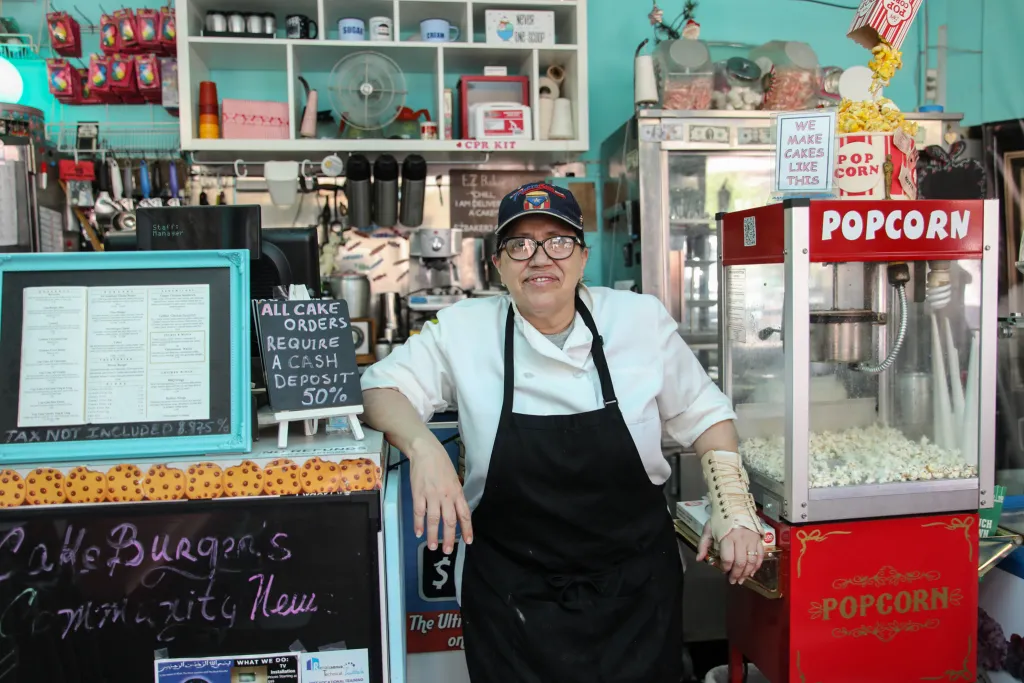
The same squeeze is happening at restaurants, which rely heavily on imported ingredients. Evette Zayas opened a combination burger joint and bakery called CakeBurgers in East Harlem in November 2019 and has not raised a single menu price since, which means every tariff increase is a direct hit to her margins.
Her records show a dramatic increase in the costs of ingredients — a 25-pound case of tomatoes that cost $17.93 in April 2025 peaked at $79.95 this April. She gets her tomatoes directly from a domestic restaurant distributor but ascribes the volatility in tomato pricing to a 17% tariff on Mexican tomatoes.
The U.S. imported $7.74 billion of beef in fiscal year 2026, and the Trump administration is now considering lifting tariffs for beef to lower the price. The ground beef in Zayas’ burgers went from $3.95 a pound last year to $4.58 this year.
“We’re surviving because we’re not paying ourselves, number one,” she said. “And number two, we’re eating at cost,” meaning that she eats most of her meals at her own restaurant.
Avoiding Avocado
Dana Morrissey, who co-owns a Mexican restaurant in Park Slope, Brooklyn, said she was surprised to see that prices haven’t gone down since the tariff refunds were announced in February.
“We’ve not seen a meaningful decrease in any of those prices now that those tariffs have been rescinded,” she said. “We thought we were going to get a break, and we were very excited about it. And we did not.”
Rather than raise prices, she has now re-strategized to avoid pricey ingredients on the menu, even when it means veering away from staples of Mexican cuisine.
“We’re featuring ingredients that are not astronomical,” she said. “We’re moving away from using products like avocado and tomatoes, and putting things that we can have our normal margins with.”

“Only the party that paid the duty, meaning the importer, is eligible to receive refunds,” Spraragen, the trade lawyer, said.
By the time a tariff reaches a Bronx liquor shelf or an East Harlem restaurant, it has already been included in the price of purchase and the businesses have no recourse to get it back. Whether importers choose to pass refunds down is, in Spraragen’s description, “very much a commercial case-by-case situation” — he has seen credits, splits, and importers that kept every dollar.
“These corporations are gonna get whatever they’re gonna get back,” Zayas of CakeBurger said. “They have not given us anything.”
Retailers suspect that some of the price increases they’re absorbing have nothing to do with tariffs.
When plantain prices shot up at a local supermarket where Zayas buys her produce, she asked why and was told it was the tariffs — but the tariffs had not yet taken effect.
“I was a little bit angry, because I know about tariffs,” she said.
Our nonprofit newsroom relies on donations from readers to sustain our local reporting and keep it free for all New Yorkers. Donate to THE CITY today.
The post ‘I Know About Tariffs’: Small Biz Struggles With High Costs, Trump Chaos appeared first on The City Reporter.
