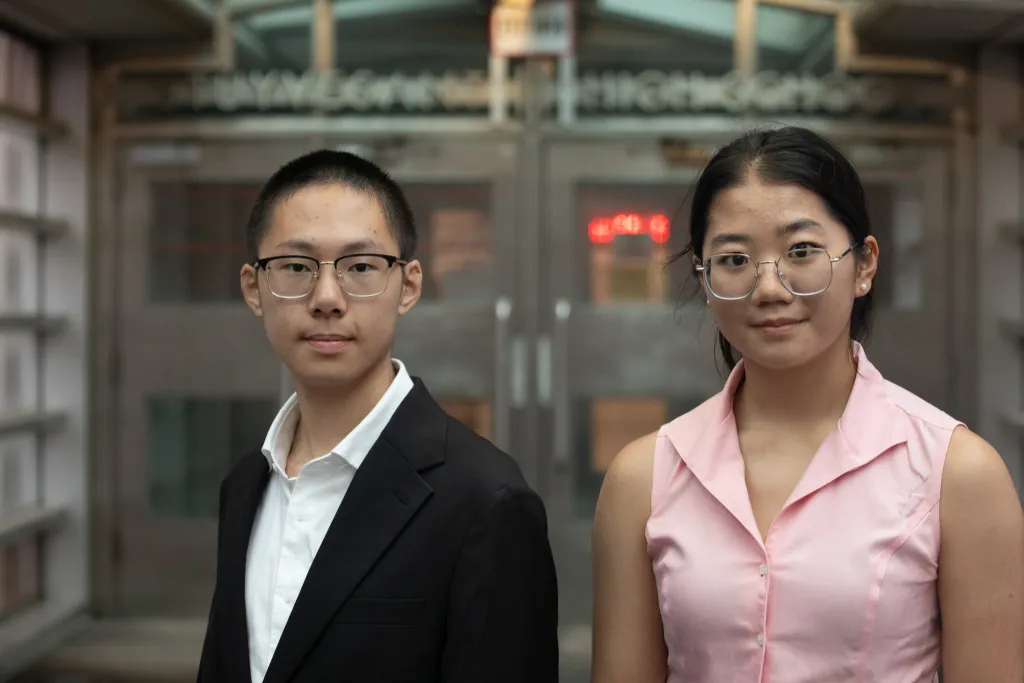
Seventeen-year-old Sabrina Gao, a rising senior, and 15-year-old Benjamin Xie, a rising junior, at Stuyvesant High School have taken on a duty some of the grown-ups have shirked: advancing socioeconomic and racial equity in the school’s admission process.
They are well aware of a notorious problem at their school — one of the top in the city, and a feeder to the Ivy League: the lack of a racially diverse student body, especially Black students, has remained the elephant in the room.
Just three Black students were admitted to Stuyvesant this year out of a class of 777, a 0.38% enrollment rate, down from eight students enrolled in 2025 and 10 in 2024, data shows.
Gao and Xie are doing what they can to combat that as president and vice president of Stuy Prep, a student-led study program for the infamous three-hour admission exam for some of the city’s top schools, the Specialized High School Admissions Test, or SHSAT.
Stuy has the highest cutoff score of all the city’s specialized high schools, normally requiring a score of around 560 out of 800.

The duo volunteering at Stuy Prep felt they were lucky to have had the opportunity to prepare for the grueling exam. Gao found out about the exam in the summer of seventh grade, and enlisted the help of her mom and sister to learn more. Xie’s middle school, JHS 278 in Marine Park, Brooklyn, was a step ahead of the curve, with an after-school tutoring program every week starting in the spring of 7th grade through the fall of 8th.
“It’s the schools who are majority white and Asian that have these resources, have accelerated courses, and can actually provide tutoring,” said Xie, who is Chinese.
Their tutoring group is trying to give that leg up to city kids who may not have it. Together with a smattering of Stuyvesant student volunteers, Gao and Xie spend their free time tutoring middle schoolers from Title I, or low-income, middle schools, for free.
Partners include Boys Prep and Girls Prep in The Bronx and the Dock Street School in Brooklyn, where the student body is overwhelmingly Black and Latino, and where 69% to 95% of students are socioeconomically disadvantaged, according to the state Department of Education.
“Those middle schools generally do not have the support or awareness of the SHSAT test,” said Gao, who is in the midst of applying for colleges. Attending a school like Stuyvesant, she said, has opened up doors for her.
“If you are aware of the SHSAT, you can also become aware of other opportunities that may help you in your academic career,” she said.

Of the many hurdles, the Stuy Prep executive board sees that as the most basic: making sure that Black and brown communities know the test exists.
“We try to raise awareness in underserved communities, but there’s a certain point to where we can’t purchase a billboard saying, ‘Take the SHSAT.’ We don’t have that kind of money,” said Xie.
Eyiram ‘Ram’ Snell, a Black rising sophomore at Stuy who attended middle school with Stuy Prep’s vice president Xie, says a lack of awareness, not a lack of resources, within Black communities is the most critical issue surrounding the school’s lack of diversity.
He found out about the test through his family — his dad, uncle, and aunt all attended Stuyvesant and enrolled in private test prep for the exam — but he noticed that he was always the only Black student in the room.
“Just not seeing people like me preparing for the test… [it] definitely has an impact on who gets accepted,” Snell said.
Snell believes that early awareness begins with adults, with the responsibility resting with middle school educators to let students know about the test in time. The information infrastructure that they have access to, not financial resources, may be the biggest reason for the lack of Black and brown representation at Stuyvesant, Snell said.
“Being poor is not just a Black trait, there’s many people I know at Stuy who have less resources than other people,” he added.
Stuy Prep builds its roster by doing outreach to a handful of middle schools that do not have an SHSAT prep program.
Now in its tenth year, Stuy Prep administers two six-week sessions ahead of the test in November: 90-minute courses, split between lessons and question drills, over six Saturdays and Sundays, every fall and spring. With the help of Stuyvesant student volunteers (last fall, they had nine tutors, then a team of 17 in the spring), the organization tutored as many as 100 middle schoolers in its most recent run.
The cost of the program — absolute zilch — is a critical part of its mission, as test prep for the exam can rack up thousands in costs for families.
“The biggest reason why I’m in this program is I don’t want other people to have stress about the SHSAT,” said Xie. Xie and Gao recalled peers crying outside the testing site post-exam “because they felt like they didn’t do well.”
For those who have never taken it before, the exam is a jumpscare, like nothing students may have seen before, with a specific structure to questions unlike the ones on state exams.
And for students who are taking the exam blind, it may be the first time where “they’re actually taking a test under time pressure,” added Xie.
And last but certainly not least — the ultimate hurdle — the ego death of a precocious, ambitious teenager. Students can sometimes forget to “look beyond the prestige,” Xie said.
“Do you want to challenge yourself so much like this in the first place? Or are you just going for the SHSAT because you think it’s prestigious?”
Seeking Change
New York is the only city in the country where admission to elite public schools is based squarely on the performance of a single exam. And for years, it’s been a political lightning rod amid attempts to change or erase it.
In 2019, Mayor Bill De Blasio’s attempts to abolish the exam died in the state Senate.
City programs have attempted to close some of the racial and socioeconomic gaps in elite school admissions.
The DREAM program provides tutoring to low-income students who perform well on state exams. The Discovery program, an invite-only, De Blasio-era initiative, reserves 20% of the schools’ seats for high-achieving low-income students who miss the test’s cutoff but successfully complete three courses over the summer.
But despite these well-intentioned programs aimed at advancing socioeconomic equity, the race problem has only compounded, leaving Black, Latino, and other communities further behind as offers to them shrink year over year.
“I just remember a lot of Asian kids going,” said Wenni Lu, a Stuy Prep tutor and rising senior from Bay Ridge who attended both the DREAM and Discovery programs, joking that one class in particular had “all Chens in it.”
Lu felt that students who want to get into Stuyvesant should supplement Stuy Prep with “something else” to overcome the “traumatic” exam and competitive private test prep industry.
Stuy Prep “is definitely not going to give you a high score because these materials can be hard for some people, and it does take some time to actually absorb,” Lu said.
Lu knows that the barrier to entry for poorer students who can’t afford test prep is high. But the Discovery program is controversial: An ongoing lawsuit from Asian American parents challenged the city’s expansion of the Discovery program based on claims that it would harm merit-based admissions and was biased against Asian and white applicants.
Discovery students who spoke to The City Reporter felt the lawsuits stigmatized their admission.
Mayor Zohran Mamdani, who is now Bronx Science’s most famous alumnus, has called for the abolition of the exam and said in his 2022 run for the state Assembly that he’d “personally witnessed just how segregated New York City public schools are, especially our specialized high schools.” The administration has since walked back his support for abolishing the exam.
“New York City Public Schools is committed to ensuring that every child across our city has access to a high-quality education that meets their needs,” Education Department spokesperson Chyann Tull said in a statement. “NYCPS is the largest school system in the country, and outcomes like those we see with the SHSAT reflect the wide range of experiences, circumstances, and priorities across the communities we serve.”
But researchers like Jonathan James Taylor, who wrote his Ph.D dissertation and a peer-reviewed follow-up study on the exam, found that Mamdani was initially on the right track, and that the admission process needs to be reformed to “better define what it means to be a successful student in a selective high school.”
“In the face of ethnic and gender under-representation, it is impossible to justify the use of an exam as the sole admissions criterion when it is a relatively poor predictor of high school achievement. One wonders if the current admissions policy would have been allowed to continue if whites and boys had been under-represented,” he told The City Reporter.

While academics, policymakers, and the courts debate the future of the SHSAT, the kids of Stuyvesant are doing what they can to level the playing field. How much has it helped? They don’t really know.
Until last year Stuy Prep didn’t track how the students they helped ultimately did on the test. Now they’re using feedback forms to get a better understanding of how the program is working.
While the leaders of Stuy Prep aren’t aware of any students who have gotten into Stuyvesant as a result of their work thus far, they remain optimistic. The board, however, hopes those who look to the exam don’t overinvest themselves.
“We should look beyond the SHSAT, because a lot of my friends now are in other high schools, and they’re doing perfectly fine,” said Gao.
Our nonprofit newsroom relies on donations from readers to sustain our local reporting and keep it free for all New Yorkers. Donate to THE CITY today.
The post Do You Know About the SHSAT? The Teens of Stuy Prep Want to Make Sure. appeared first on The City Reporter.
