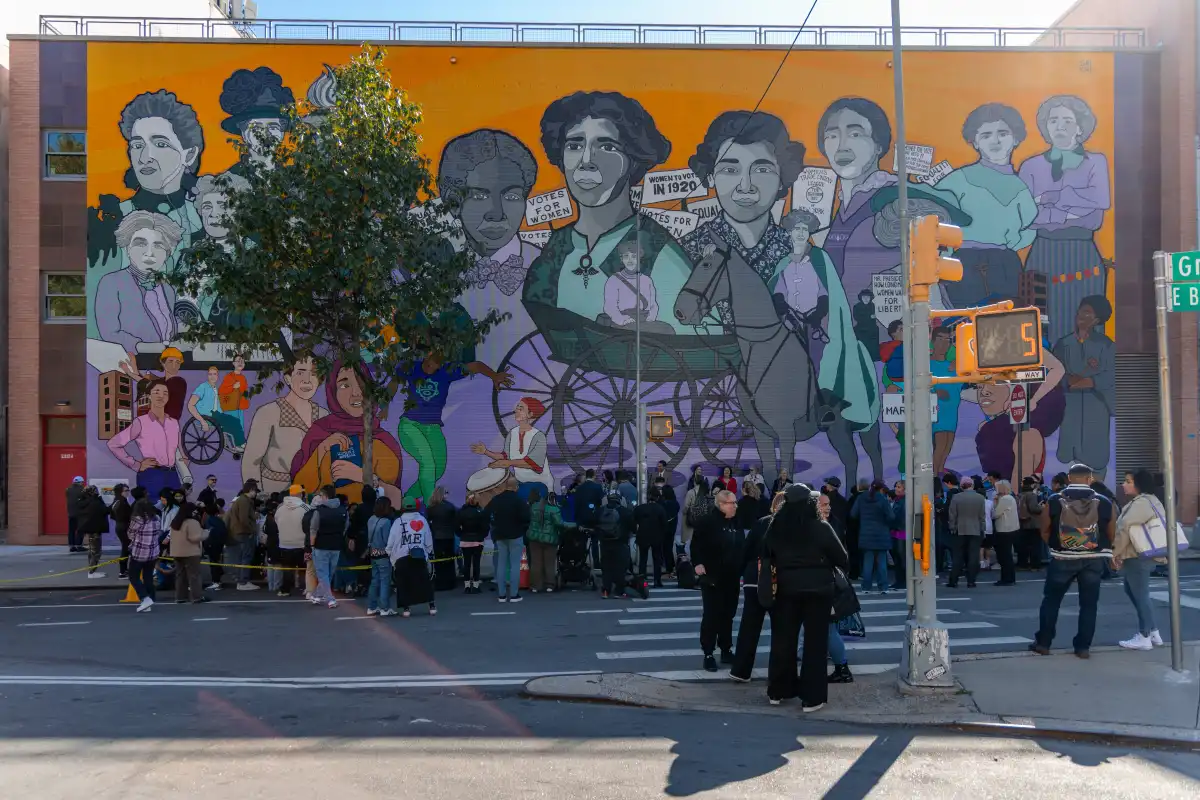
A day before New Yorkers began early voting, more than 100 adults and students gathered to dedicate a mural honoring women’s suffrage, which was unveiled on what had been a blank brick exterior wall at the P.S. 134 Henrietta Szold School.
The artwork, designed by Sam Kirk and painted by her and a team of six female artists, portrays 16 suffragettes and female leaders whose work helped lead to the 19th Amendment.
Monumenta, a Chicago-based public art initiative, conceived of and completed the 37-foot by 83-foot mural at the 293 East Broadway school, turning an ordinary wall into a history lesson.
Part of Monumenta’s National Suffrage Mural Series, the work entitled “Still Our Fight” follows murals unveiled in Chicago with additional ones set to go up in other cities.
A key in the lower left-hand corner indicates each figure’s name and uses a QR code to refer people to more information.
“Art should be everywhere,” P.S. 134 Henrietta Szold School Principal Robert Perales told the crowd before a gold ribbon was cut. “We have this amazing art telling this amazing story. Art belongs in neighborhoods. Art belongs here.”
Monumenta contacted nearby Henry Street Settlement, which contacted Perales, who welcomed the mural as a memorial to heroic figures.
“This is really also for our kids,” Perales said. “Every day when you walk into this building, it’s a reminder of the courage these women went through to resist something not fair.”
Congress passed the 19th Amendment on June 4, 1919, before three-quarters of the state legislatures ratified it as of Aug. 18, 1920, changing history with one sentence.
“The right of citizens of the United States to vote shall not be denied or abridged by the United States or by any State on account of sex,” the Amendment said.
“We’re here today to both honor history and to move history forward,” said Pam Elam, president of Monumental Women. “Let’s honor all those women whose names we know and whose names we may never know.”
Students of history
Neysa Page-Lieberman, National Suffrage Mural Series Co-Director and Monumenta Artistic Director, said they initially intended to focus on Chicago.
“Suffs,” a musical about passing the 19th Amendment, motivated them to create murals in other cities.
“That really helped us launch the national series,” she said. “It was that play that helped us understand we need to expand our series.”
Page-Lieberman said hundreds of suffragists played a role in winning the vote for women, although they picked 16 to portray.
“We have featured New York suffragettes who not only worked here for women’s right to vote,” Page-Lieberman added, “but helped pass the national amendment.”
Michelle Duster, National Suffrage Mural Series Co-Director whose great-grandmother, Ida B. Wells, was a suffrage leader, said the Lower East Side was ideal for the mural.
“We wanted to find a place where you would be inspired by them,” Duster said. “We had to come to the Lower East Side of Manhattan.”
More than a mural
The artists who did the work said they saw themselves as doing more than making a mural. “The minute they asked me, I knew this was a project I was going to see through,” said Sam Kirk, lead artist. “To this day, I still recognize the layers of history that impact our lives. We have these women to thank for that.”
The painters who helped said passersby approached them, asking and commenting as the art came to life.
“Everyone had a lot of questions about what the mural was,” said Danielle Mastrion. “People were pleasantly surprised that we were a team of all women.”
Other painters said they see the mural as a monument to the struggle for suffrage, as well as to these individuals.
“I think we feel women’s suffrage is so far in the past,” said Liv Novotny.” It was not that long ago. We’ve got to constantly celebrate how far we’ve come and how recent this was.”
Another experienced muralist said she felt privileged to be on this team creating a big, important mural in Manhattan.
“To be part of something so big was mind-blowing,” Pelumi Ayeni said. “It wasn’t just a beautiful mural. There was a message to remember what happened and continue to fight.”
Women’s world
Monumenta said women are woefully under-represented in public art, with less than 5% of public art depicting women or women-centered historical events.
Only one statue in Central Park, out of nearly 170, portrays a woman, another example of the need to honor women through history in New York City.
Not all leaders depicted worked directly on women’s suffrage, while some worked on empowering women in that era, such as Laura Cornelius Kellogg, a member of the Oneida nation.
“Our women always had authority and a voice in our government,” said Michelle Schenandoah, a member of the Oneida and founder of Rematriation who said she is related to Kellogg.
Council Member Christopher Marte said as a child he was inspired by a mural of journalist and activist Dorothy Day, who started her own newspaper.
“These paintings, this art, can inspire the next generation of leaders and artists,” Marte said, “and have a huge influence for generations to come.”
Danyel Fulton, who played Aida B. Wells on the national tour of “Suffs” with music, book and lyrics by Shaina Taub, said art can activate history.
“’Suffs’ like this mural is an introduction to a larger conversation about how many suffragists actually made the vote happen,” Fulton said. “It was hundreds and hundreds of people.”
She called art a “catalyst for that conversation” when we see “history is being threatened every day in this country,
“There’s a song in the show called ‘Keep Marching.’ People were weeping and sobbing,” Fulton said. “People were registering to vote in the lobby.”
Others said it’s important that students see this daily, providing a message and meaning beyond a mural.
“All of you who are students in this school, you give me hope. We need hope today,” Duster told students. “This mural will hopefully give you the inspiration to learn about people who made the world a better place.”
Passersby stopped, seeing the work and sometimes looking at the key to see who was portrayed.
“I love that it represents strong women throughout our history,” Daisy Rameckerps said as she looked at the mural. “It’s representative of different women.”
Page-Lieberman said murals are slated to go up in Portland, Los Angeles, Salt Lake City, Kansas City, and Austin, Texas.
“I think P.S. 134 has the best mural in New York City,” said Gale Brewer, co-chair of the City Council’s women’s caucus. “You are so fortunate that you can walk by every single day and think about the history of this country. When you get older, you can vote.”