
Predictions of AI-driven monopoly have outpaced the proof. A number of years into the generative AI increase, regulators have investigated, companies have invested, and markets have shifted—but sturdy market energy and demonstrable aggressive hurt stay elusive.
Greater than a yr in the past, Dirk Auer and I challenged the “hyperbolic and dystopian” narrative dominating discussions about competitors in artificial-intelligence (AI) markets. We argued that issues about competitors dangers—and requires more durable enforcement—had been unwarranted or overstated. AI markets had been, normally, extremely aggressive. Extra importantly, the AI revolution provided a chance to revisit a number of the assumptions driving competitors issues in digital companies, together with information as a barrier to entry and the position of community results.
AI markets proceed to evolve at breakneck velocity. This makes it helpful to revisit latest developments by way of the lens of financial and authorized ideas that inform competitors coverage. This submit is the primary in a biweekly sequence monitoring these developments.
Relatively than chase the information cycle, I’ll give attention to concrete modifications throughout the AI stack—compute, fashions, information, integration, and governance. The goal is to reassess, and the place needed push again on, frequent claims about competitors, focus, and market energy. Over time, the sequence will look at infrastructure funding, expertise mobility, mannequin improvement, new services and products, partnership dynamics, and regulatory responses.
The objective is to attach real-world developments to the competition-policy and enforcement debate, and to check maximalist claims about inevitable focus or aggressive hurt towards noticed market proof.
The guiding query stays simple: Has the AI trade developed towards monopolistic management of key inputs or demonstrable hurt to competitors, or towards layered, dynamic competitors?
A Lot of Scrutiny, Little Proof of Hurt
A putting characteristic of the AI competition-policy panorama is the hole between enforcement exercise and outcomes. Businesses have devoted important assets to AI circumstances, but have issued few selections discovering anticompetitive conduct or decreased competitors. That is very true of partnerships between incumbent companies and AI startups, which have drawn sustained scrutiny. Regardless of this, policymakers usually acknowledge—a minimum of implicitly—that AI markets stay aggressive, even when in style media accounts recommend in any other case.
Over the previous two years, competitors authorities on either side of the Atlantic have repeatedly raised issues about AI partnerships and investments. In January 2025, the Federal Commerce Fee (FTC) revealed a employees report summarizing preliminary findings from an inquiry launched a yr earlier. The report examined “relationships between the world’s present largest Cloud Service Suppliers (‘CSPs’) and two of essentially the most outstanding AI mannequin builders” and recognized three “areas to observe going ahead”:
- The partnerships may have an effect on entry to key inputs, reminiscent of computing assets and engineering expertise.
- The partnerships may enhance contractual and technical switching prices for AI builders.
- The partnerships may give CSPs entry to delicate technical and enterprise info unavailable to rivals.
The report, nevertheless, provided no concrete proof of aggressive hurt in generative AI markets. It didn’t discover that these partnerships created dominant positions and even that dominance was a probable final result. In his concurring and dissenting assertion, then-Commissioner and now-FTC Chair Andrew Ferguson underscored the purpose:
[T]he restricted, temporary nature of the examine ought to foreclose the drawing of broad conclusions in regards to the AI trade and its future, and even in regards to the partnerships themselves. The employees report acknowledges as a lot, deploying hedging language all through Part 5 and making clear that “an evaluation of the impression that these partnerships may need on competitors is past the scope of this report.” The Fee due to this fact shouldn’t have revealed hypothesis about what the long run might maintain. Readers ought to skip Part 5 of the Report, or learn it with super skepticism.
The UK Competitors and Markets Authority (CMA) has taken a equally cautious method after investigating a number of AI partnerships, together with Microsoft’s offers with Mistral AI, Inflection AI, and OpenAI, in addition to Amazon’s partnership with Anthropic.
The CMA cleared the Microsoft-Mistral AI deal in Could 2024. It discovered that Microsoft’s potential shareholding—lower than 1%—didn’t confer affect over Mistral’s coverage or board. The settlement’s compute and distribution commitments had been additionally unlikely to create dependency adequate to have an effect on Mistral’s business technique.
The CMA additionally cleared Microsoft’s “acquihire” of Inflection in September 2024. It concluded the transaction wouldn’t considerably reduce competitors in both shopper chatbots or foundational fashions, citing Inflection’s small market share and early-stage fashions. That very same month, the CMA cleared Amazon’s $4 billion funding in Anthropic, discovering that Anthropic UK didn’t meet the related turnover threshold.
Following a 15-month pre-notification investigation, the CMA concluded in March 2025 that the Microsoft-OpenAI partnership didn’t give rise to a related merger scenario. It discovered no “change of management by Microsoft from materials affect to de facto management over OpenAI.”
The European Fee has reached related conclusions. It reviewed NVIDIA’s acquisition of Run:ai and cleared the deal unconditionally in December 2024, after a referral from Italy’s competitors authority beneath its call-in powers. Though the Fee discovered that “NVIDIA probably held a dominant place within the world marketplace for discrete GPUs to be used in datacentres,” it additionally discovered that Run:ai lacked a major place in “GPU orchestration software program.” The transaction due to this fact raised no competitors issues.
Individually, after an in depth overview of the Microsoft-OpenAI partnership, the Fee concluded in June 2024 that Microsoft had not acquired lasting management over OpenAI. The partnership didn’t qualify as a merger. The Fee continued to evaluate exclusivity provisions beneath abuse-of-dominance guidelines however by no means opened a proper investigation or introduced costs. In any occasion, these issues seem to have diminished because the partnership developed—from cloud-service exclusivity to a proper of first refusal.
In Brazil, the Conselho Administrativo de Defesa Econômica (CADE) opened administrative proceedings in mid-2024 to evaluate whether or not Amazon, Microsoft, and Google ought to have notified their AI partnerships. The company targeted on potential gun-jumping beneath Brazilian regulation. The investigations—protecting Amazon-Anthropic, Microsoft’s preparations with Mistral AI and Inflection AI, and Google’s take care of Character AI—stay ongoing, however haven’t produced enforcement actions.
Regulatory scrutiny additionally extends to conduct-based theories of hurt, although these circumstances stay unresolved. In July 2025, Italy’s competitors authority opened proceedings into Meta’s preinstallation of Meta AI inside WhatsApp. The authority alleged that Meta abused its “dominant place available in the market for shopper communications apps” by putting its AI companies in a “outstanding place.” In line with the company:
Meta seems able to channelling its buyer base into the rising market, not by way of merit-based competitors, however by “imposing” the supply of the 2 distinct companies upon customers, probably harming rivals.
It later imposed interim measures, ordering Meta “to right away droop the WhatsApp Enterprise Answer Phrases with the intention to protect entry to the WhatsApp platform for Meta AI’s rivals.” CADE and the European Fee have initiated related actions.
As Giuseppe Colangelo notes in latest Worldwide Heart for Legislation & Economics (ICLE) feedback to the French competitors authority, these theories of hurt might not align with market realities. Whereas the circumstances “resemble longstanding debates over vertical integration and self-preferencing,” he argues that “AI markets stay extremely dynamic and characterised by appreciable aggressive uncertainty. Even when Meta seeks to leverage messaging dominance into AI companies, success can’t be presumed.” Even in jurisdictions extra inclined to intervene in digital markets, businesses face an uphill battle in proving hurt.
The sample is constant. After in depth scrutiny, businesses have uncovered no stable proof of anticompetitive hurt. Some investigations stay open, however enforcement outcomes seem unlikely. This doesn’t show that anticompetitive conduct is absent. Nonetheless, given the size of regulatory effort—and the dearth of findings—it’s affordable to deduce that such outcomes are, at minimal, unlikely in AI markets.
Schumpeterian Competitors in Actual Time
Stepping again, the broader image issues. Since November 2022, the AI trade has seen speedy enchancment, shifting market shares, and fixed entry. That is high-stakes Schumpeterian competitors—not creeping monopolization—and the dynamic is properly captured by a now-familiar web meme:
A short look again makes the purpose. When OpenAI launched ChatGPT in November 2022, some predicted “first-mover dominance” of the type usually related to digital markets. Inside two months, ChatGPT reached 100 million customers—the quickest adoption of any shopper software on file.
The launch jolted incumbents. Inside weeks, Google declared a “code purple.” CEO Sundar Pichai reassigned groups and introduced again co-founders Larry Web page and Sergey Brin for emergency technique classes—though Google had invented the transformer structure underlying fashionable giant language fashions (LLMs). The rushed February 2023 launch of Bard, Google’s ChatGPT competitor, produced a factual error in its first demo. A startup had made a tech big scramble.
Entry and growth adopted rapidly. Anthropic launched Claude in March 2023, iterating quickly and positioning itself round security, long-context processing, and enterprise reliability. By late 2025, it reportedly captured about 40% of enterprise LLM spending, surpassing OpenAI. Elon Musk’s xAI launched Grok in November 2023 and built-in it into X with real-time platform information. Perplexity, based in August 2022 by former OpenAI, Google, and Meta researchers, grew into an AI search different valued at $18 billion by July 2025, dealing with greater than 780 million queries per thirty days.
Google, regardless of its early stumble, regained floor. Competitors round ChatGPT has intensified:
The highest chatbot’s market share fell from 69.1% to 45.3% between January 2025 and January 2026 amongst day by day U.S. customers of its cell app. Gemini, in the identical time interval, rose from 14.7% to 25.1% and Grok rose from 1.6% to fifteen.2%.
The information, obtained by Large Know-how from cell insights agency Apptopia, signifies the chatbot race has tightened meaningfully over the previous yr with Google’s surge exhibiting up within the numbers. General, the chatbot market elevated 152% since final January, in accordance with Apptopia, with ChatGPT exhibiting wholesome obtain development.
On desktop and cell internet, the same sample seems, in accordance with analytics agency Similarweb. Visits to ChatGPT went from 3.8 billion to five.7 billion between January 2025 and January 2026, a 50% enhance, whereas visits to Gemini went from 267.7 million to 2 billion, a 647% enhance. ChatGPT continues to be far and away the chief in visits, but it surely has firm within the race now.
As of this writing—after the corporate’s feud with the Division of Struggle—Anthropic’s Claude ranks No. 1 amongst free iPhone apps on Apple’s App Retailer. In early February, it ranked 42.
The tempo of entry and the volatility of market shares level to low boundaries to entry and intense competitors. Google’s expertise underscores the purpose. Regardless of entry to Search, YouTube, Android, and Chrome—information benefits some seen as insurmountable—it took greater than a yr to catch as much as a well-funded startup. When it did, it competed on the deserves: higher fashions (Gemini 3 Flash, Nano Banana) and improved distribution (AI Overviews), not exclusionary use of information.

Mannequin efficiency has additionally improved at an unprecedented tempo. Ethan Mollick’s “Otter check”—asking picture fashions to generate an otter on a aircraft utilizing Wi-Fi—illustrates the velocity of progress.
He additionally factors to benchmarks reminiscent of GDPval, the place trade consultants evaluate AI and human efficiency on advanced duties. Main fashions now match or exceed top-tier human practitioners 82% of the time.
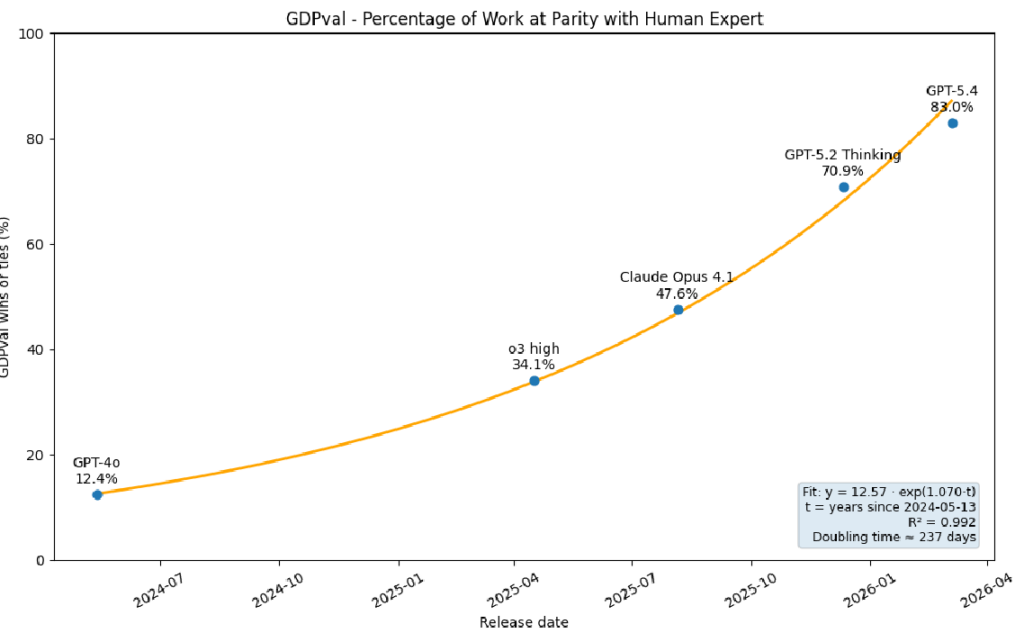
Competitors has additionally come from surprising quarters. In January 2025, DeepSeek—a Chinese language startup based in 2023—launched its R1 reasoning mannequin. It matched or exceeded OpenAI’s o1 mannequin at a fraction of the coaching value (about $6 million). As RAND noticed, this “demonstrates that the barrier to entry is low sufficient that new entrants will be aggressive,” making it “too quickly to choose winners and losers.” Even permitting for uncertainty round DeepSeek’s reported prices, its emergence means that early leaders will wrestle to construct sturdy moats or benefit from the “quiet life” of a monopolist.
Open-source fashions reinforce this conclusion. Meta’s Llama household, Mistral’s fashions, and a wave of Chinese language open-weight releases have enabled 1000’s of builders to construct aggressive functions with out large proprietary infrastructure.
Low switching prices additional intensify competitors. Jason Furman, former chairman of the Council of Financial Advisers, lately famous in The New York Instances that switching prices have “compelled firms to go the good points from innovation on to customers.” In his phrases:
There are not any lazy monopolists within the A.I. area coasting on previous benefits. Over the previous yr, the highest spot on the Area leaderboard has moved amongst these three firms, with sturdy performances from newer arrivals such because the Chinese language firm DeepSeek and the French agency Mistral — lots of which require far much less capital than earlier generations of A.I. firms.
Furthermore, no single firm dominates throughout A.I. areas. Anthropic at the moment leads in textual content and coding, OpenAI in text-to-image era, xAI (based three years in the past) in picture to video and Google in search-integrated A.I.
This evaluation is notable coming from Furman, who co-authored the “Unlocking Digital Competitors” report for the UK’s Treasury—a report usually related to a “winner-take-most” view of digital markets. As he acknowledges, many anticipated AI to strengthen these dynamics. Up to now, it has not.
Competitors has additionally pushed sharp value declines. Inference prices have fallen dramatically since late 2022. OpenAI’s most succesful mannequin on the time value $20 per million tokens. GPT-4o-mini now delivers higher efficiency for $0.15-$0.60 per million tokens—a discount of greater than 97%. Analysis from Epoch AI finds that the price of attaining GPT-4-level efficiency has fallen roughly 40x per yr, or about 70% annual deflation.
This dialogue has targeted on consumer-facing markets, the place entry and market-share volatility are most seen. However related dynamics seem throughout the AI stack. On the infrastructure layer, issues about graphics processing unit (GPU) focus and cloud dependencies might carry extra weight. NVIDIA’s place in AI accelerators, for instance, raises potential input-foreclosure questions that don’t come up in chatbot markets—though Google’s tensor processing items (TPUs) and Amazon’s Trainium chips present significant competitors.
Information benefits might also matter extra in specialised domains, reminiscent of medical imaging or authorized analysis, than in general-purpose fashions. Future posts will look at every layer—compute, cloud infrastructure, coaching information, and functions—to evaluate whether or not obvious focus interprets into sturdy market energy, or whether or not aggressive dynamics resemble these noticed in consumer-facing markets.
The Dystopia That Didn’t Arrive
Briefly, the dystopian narrative—that data-driven community results would create insurmountable moats, that partnerships would foreclose competitors, that massive tech would inevitably dominate—has not materialized.
Even so, as of August 2025, some had been persevering with to name on policymakers to “break up Large AI.” These calls sit uneasily with the fact of AI markets: dynamic competitors, sustained entry, speedy innovation, important infrastructure funding, and shifting market shares.
None of this guidelines out anticompetitive conduct. Companies can interact in exclusionary conduct, and after they do, enforcement businesses ought to act. However that may be a far cry from claims that focus and aggressive hurt are inevitable.
