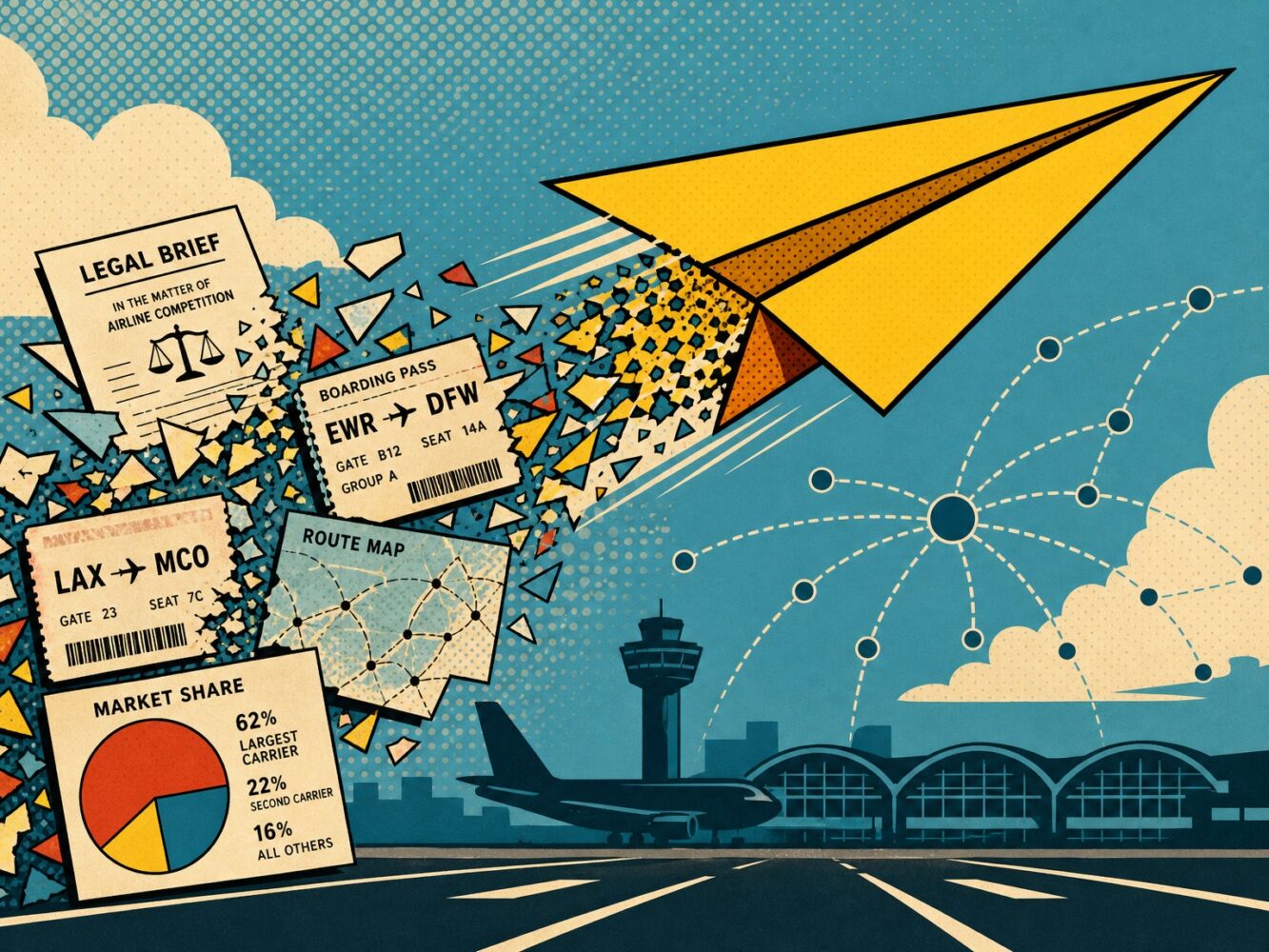
Spirit Airlines was supposed to be the competitor antitrust law saved. Instead, it may become the cautionary tale antitrust law cannot quite avoid.
The carrier’s disappearance has transformed the JetBlue-Spirit merger litigation from an ordinary postmortem into a test case for how antitrust law should treat distressed challengers in concentrated network industries.
Protecting Competition, Minus the Competitor
The starting point is Judge William Young’s January 2024 decision enjoining JetBlue’s acquisition of Spirit under Section 7 of the Clayton Act after the U.S. Justice Department (DOJ) challenged the deal as anticompetitive. (The DOJ has jurisdiction over antitrust review of domestic airline mergers.)
In a Federalist Society discussion of the failed merger, I argued the case reflected a continuing skepticism in merger enforcement toward efficiencies, particularly claims that a merger could strengthen competition against larger incumbents. Events since then have sharpened a related critique: the court appears to have underweighted “out-of-market” efficiencies—benefits that would have accrued across a broader set of city-pair markets, even if travelers on certain overlapping routes lost the specific option of flying Spirit.
The critique is not that the route-level harms were imaginary. The government’s case followed a familiar Section 7 framework. Spirit was an ultra-low-cost carrier whose market entry often pushed fares downward. JetBlue, by contrast, operated as a higher-cost, higher-quality airline and planned to retrofit Spirit aircraft into the JetBlue product. In United States v. JetBlue Airways Corp., Judge Young concluded that, on certain routes, Spirit customers likely would face higher prices or fewer low-fare options if Spirit disappeared into JetBlue.
The objection, instead, is that the opinion treated those route-specific losses as dispositive, even though the merger’s broader competitive effect may have been to create a larger, more relevant JetBlue capable of challenging American, Delta, United, and Southwest—the “big four” U.S. airlines by market share. The court itself acknowledged that a stronger JetBlue would place competitive pressure on larger carriers and extend JetBlue’s higher-quality service to more customers. It nonetheless concluded those broader benefits could not justify the transaction if the merger substantially lessened competition in any relevant market.
What Happens When the Maverick Crashes?
Spirit’s subsequent collapse has made that reasoning look far less secure. After the ruling, Spirit entered bankruptcy, struggled to restructure, and ultimately ceased operations. The Associated Press reported that Spirit shut down after 34 years, ending the carrier most associated with rock-bottom base fares. Other accounts highlighted the fallout for passengers and the loss of roughly 17,000 jobs.
Christopher Gowen argued in a Bloomberg Law essay that Spirit’s demise should serve as a cautionary tale for merger review. In his telling, the government succeeded in preserving an independent Spirit in legal theory, but not in market reality.
That is an uncomfortable lesson for merger law. A court can block a merger to preserve a maverick competitor—a disruptive firm that constrains rivals through aggressive pricing or innovation. But if the maverick is too weak to survive on its own, the injunction may leave consumers with neither the original firm nor the stronger challenger the merger might have created.
The legal implications extend beyond airlines. Merger analysis depends on a realistic “counterfactual”—a prediction of what competition would look like if the deal does not occur. A static, route-by-route snapshot can overstate the competitive significance of a distressed carrier that is shrinking, financially unstable, or unable to secure aircraft, labor, capital, or airport access on workable terms.
To be sure, courts are understandably cautious here. The failing-firm defense—which permits an otherwise anticompetitive merger when the target company is effectively doomed—is notoriously difficult to establish. Judges do not want firms casually invoking financial distress to justify consolidation.
Still, there is middle ground between a formal failing-firm defense and treating a distressed company as though it were a durable, independent competitive force. In a network industry like air travel, a weakened-competitor analysis should ask whether the allegedly preserved competition is likely to survive long enough, and at sufficient scale, to constrain incumbents. JetBlue-Spirit may become the clearest recent example of what happens when courts answer that question too optimistically.
The Airlines Deregulated. The Airports Didn’t.
The post-Spirit U.S. airline industry presents a paradox. On paper, the market still includes plenty of names: American, Delta, United, Southwest, JetBlue, Alaska-Hawaiian, Frontier, Allegiant-Sun Country, Breeze, Avelo, and others. In practice, network effects, airport access, frequent-flyer programs, corporate contracts, and hub dominance give the largest carriers durable advantages.
The DOJ’s own recent account notes that American, Delta, Southwest, and United control roughly three-quarters of U.S. domestic markets, and that the largest airlines have absorbed dozens of rivals since deregulation. In a November 2025 speech, Deputy Assistant Attorney General Dina Kallay described airline competition as a core consumer issue and linked current concerns to the industry’s long history of consolidation.
Hub-and-spoke competition sits at the center of that market power. American, Delta, and United operate dense hub systems that let them offer business travelers frequent departures, extensive connections, lounges, loyalty perks, and corporate-contracting arrangements that point-to-point or leisure-focused airlines struggle to match. Those hubs also facilitate price discrimination. Competition may be fierce on major trunk routes, while passengers traveling to or from fortress hubs face fewer meaningful choices.
Southwest historically constrained that system through point-to-point service. More recently, though, Southwest has moved closer to the legacy-carrier model, relying more heavily on sophisticated revenue management, loyalty-program monetization, and ancillary-fee strategies. Spirit imposed a different kind of constraint. It was not a network-based rival to the legacy carriers, but an ultra-low-cost fare anchor. The so-called “Spirit effect” often disciplined prices even where Spirit’s market share remained modest.
Blocking the JetBlue-Spirit merger may have strengthened the Big Three’s position in two ways. First, it eliminated JetBlue’s most plausible path to rapid scale. Organic growth is slow in an industry constrained by aircraft shortages, engine problems, pilot supply, and limited airport access. Spirit’s Airbus fleet offered JetBlue a ready-made path to greater national relevance. Without Spirit, JetBlue remains an important but subscale competitor—strong in parts of the East Coast, but lacking the network depth of American, Delta, and United.
Second, Spirit’s liquidation fragmented its competitive assets. Aircraft, gates, slots, employees, and routes can all be redistributed. But the ultra-low-cost-carrier business model, network structure, brand identity, and pricing discipline do not automatically survive asset sales. The court’s hoped-for replacement through new market entry must now occur piecemeal, through selective route expansion and asset transfers, rather than through a functioning integrated airline.
A related point deserves emphasis: some of the most durable barriers to airline competition arise not from airline conduct alone, but from legal and regulatory limits on airport capacity. At the most congested airports, the Federal Aviation Administration (FAA) uses runway slots to ration scheduled operations. FAA slot-administration materials identify John F. Kennedy International Airport, LaGuardia Airport, and Reagan National Airport as slot-controlled airports, while describing schedule-facilitation processes at O’Hare International Airport, Los Angeles International Airport, Newark Liberty International Airport, and San Francisco International Airport.
Those restrictions may be justified by congestion, runway limits, air-traffic-control constraints, and delay externalities. They also turn airport access into a scarce asset. Scarcity predictably favors incumbents that already control slots, gates, terminal space, and commercially viable operating positions. New entry, therefore, is not simply a matter of an airline deciding to add service. It often requires access to a scarce bundle of slots, gates, takeoff and landing rights, ground facilities, and commercially usable flight times.
The deeper problem is that expanding airport capacity is legally and politically difficult. Major airport expansions, new runways, terminal projects, and new airport construction all trigger environmental review under the National Environmental Policy Act (NEPA) and related environmental statutes. FAA guidance states that environmental review must be completed before covered airport projects can begin. Local zoning rules, land-use controls, noise restrictions, community opposition, airport curfews, emissions review, surface-transportation bottlenecks, and funding constraints can further delay or block expansion.
The Government Accountability Office (GAO) has long recognized that airport-access barriers include physical constraints such as slots, gates, and noise restrictions. In key metropolitan areas, the competitive question is therefore not merely whether Frontier, Breeze, Allegiant-Sun Country, JetBlue, or Alaska-Hawaiian want to enter a market. The real question is whether they can obtain the airport access necessary to discipline incumbent hub carriers on commercially meaningful terms.
If You Can’t Merge, Collaborate
Recent industry developments illustrate both mitigation and risk. Rivals are already moving into some former Spirit markets. The Wall Street Journal reported that low-cost competitors are carving up Spirit’s former routes and airport slots, with Breeze, Frontier, and Allegiant seeking growth opportunities while larger airlines pursue valuable airport assets.
That redeployment will soften Spirit’s disappearance in some leisure markets and smaller airports. But selective entry is not the same thing as systemwide replacement. An airline that adds one or two former Spirit routes does not necessarily recreate Spirit’s low-cost network, pricing discipline, or willingness to stimulate demand through ultra-low base fares.
The same dynamic appears in new consolidation among smaller carriers. Earlier this month, Allegiant announced it had completed its acquisition of Sun Country, creating a larger leisure-focused airline serving nearly 175 cities with a combined fleet of 195 aircraft. The deal reduces the number of independent low-cost and leisure-focused airlines. At the same time, it may create a stronger scaled competitor in the very segment best positioned to backfill some of Spirit’s abandoned markets.
That is the recurring airline-antitrust tradeoff. A merger among smaller carriers may eliminate competition on certain routes while increasing the merged firm’s ability to challenge larger network airlines across many others. Whether courts and agencies should block or permit that tradeoff depends on the counterfactual—and on whether the acquired capacity would otherwise remain a viable competitive force.
The Alaska Airlines-Hawaiian Airlines integration, announced last month, reflects a more permissive regulatory approach. The airlines described their shared passenger-service system as “a significant integration milestone that provides guests flying with Alaska Airlines and Hawaiian Airlines a more seamless and consistent travel experience from booking to boarding across a growing global network.” The U.S. Department of Transportation (DOT) allowed the transaction to proceed after securing binding public-interest commitments. According to the department’s announcement, those commitments covered rewards programs, essential flight service, rural access, Honolulu hub access, family seating, and military benefits.
The contrast with JetBlue-Spirit is revealing. Alaska-Hawaiian involved fewer direct overlaps and less elimination of an ultra-low-cost fare constraint. It also rested on a clearer network-complementarity rationale—one regulators could condition and supervise without effectively destroying the transaction. Future airline mergers will likely be framed in similar terms: limited overlap, complementary networks, service preservation, loyalty-program protections, and concrete commitments designed to make claimed benefits verifiable.
Joint ventures and looser collaborations may become even more important than outright mergers. JetBlue and United’s “Blue Sky” collaboration, for example, links loyalty programs and customer benefits while emphasizing that the airlines will continue independently managing and pricing their routes, frequencies, and promotions.
Blue Sky, Red Flags
The BlueSky collaboration’s careful drafting is no accident. The American Airlines-JetBlue Northeast Alliance was enjoined because the DOJ and the courts viewed it as a de facto merger in the Northeast—a coordination arrangement that reduced the airlines’ incentives to compete independently on routes, schedules, and capacity. In her recent airline-competition speech, the Deputy Assistant Attorney General Kallay described the Northeast Alliance as a cautionary example and suggested that domestic “metal-neutral” arrangements—agreements that make airlines financially indifferent about which carrier actually transports a passenger—will face intense scrutiny.
The political and enforcement environment reinforces that caution. In July 2025, Sen. Richard Blumenthal (D-Conn.) sent a letter to the chief executives of United and JetBlue questioning whether the Blue Sky partnership resembles the failed Northeast Alliance. Blumenthal pointed to reciprocal loyalty-program features, airport-infrastructure implications, and potential effects on corporate accounts.
The letter itself carries no legal significance. Still, it reflects the concerns likely to shape future government oversight. Limited loyalty reciprocity, interline cooperation, or customer-facing benefits that stop short of coordinating capacity, schedules, or pricing may survive antitrust review. Deeper domestic joint ventures that pool revenue, allocate markets, coordinate frequencies, or create metal-neutrality are far more likely to draw DOJ challenge. The more a collaboration resembles a merger without Hart-Scott-Rodino review, the more skeptical courts are likely to become.
The DOJ and DOT have also made clear that airline competition remains an active enforcement priority. In October 2024, the agencies launched a broad public inquiry into the state of competition in air travel. The inquiry sought information on consolidation, exclusionary conduct, airport access, aircraft manufacturing, sales channels, pricing, rewards programs, and labor issues.
Dina Kallay’s 2025 remarks likewise emphasized airline competition, but with a notable twist: the need to address not only private restraints, but also public barriers to entry. That distinction matters. A serious airline-competition agenda cannot consist solely of blocking private mergers. It must also examine whether government-created scarcity—including slot rules, airport-access limits, infrastructure bottlenecks, and regulatory delays—helps entrench incumbent market power.
The Next Airline Deals Will Look Different
What comes next? The most likely near-term transactions involve acquisitions of Spirit assets: slots, gates, aircraft, airport facilities, route authorities, and personnel. Where those assets are scarce, the DOJ and DOT should generally prefer distributing them to non-dominant carriers. Sales of Spirit assets at LaGuardia, Newark, Fort Lauderdale-Hollywood International Airport, Orlando International Airport, or other constrained airports to American, Delta, or United would raise greater concerns than sales to Frontier, Allegiant-Sun Country, Breeze, JetBlue, or Alaska-Hawaiian.
The competitive value of those assets lies in enabling entry and expansion by challengers. Asset purchases are usually easier to clear than mergers. That changes, however, when the transaction strengthens fortress hubs or removes scarce airport access from smaller rivals.
A Frontier-led acquisition of Spirit remnants—or further consolidation among ultra-low-cost and leisure carriers—would present a more complicated case. Before Spirit’s collapse, a Frontier-Spirit merger would have been a straightforward horizontal merger between two closely competing ultra-low-cost carriers. In the wake of Spirit’s bankruptcy, a transaction involving scattered assets rather than an operating airline becomes easier to defend. Regulators would likely ask whether the buyer is preserving capacity that otherwise would disappear, whether meaningful overlaps remain, and whether the deal restores some degree of low-fare discipline. Courts may also view those arguments more sympathetically after JetBlue-Spirit, because the liquidation counterfactual is no longer hypothetical.
A future JetBlue merger would face skepticism, but not automatic condemnation. JetBlue’s strongest argument remains scale: without more aircraft, slots, and network breadth, it cannot seriously challenge the Big Three. Its biggest problem is its recent antitrust history. The Northeast Alliance was condemned as anticompetitive, while the Spirit merger was blocked because JetBlue planned to replace Spirit’s ultra-low-cost model with a higher-cost, higher-fare product.
Any future JetBlue deal would therefore need to look very different. JetBlue would likely need to show limited route overlap, preservation or expansion of low-fare capacity, no elimination of a maverick business model, and perhaps divestitures to low-cost entrants. It would also need to present a more concrete and measurable out-of-market efficiencies case than it did in the Spirit litigation.
A merger involving one of the Big Three legacy airlines would be the hardest case of all. Transportation Secretary Sean Duffy has suggested there may be “room for some mergers” in aviation, while emphasizing that deals would be reviewed case by case and larger airlines might need to divest assets to avoid excessive concentration. That reflects a plausible policy middle ground: openness to consolidation that creates stronger challengers, combined with skepticism toward deals that deepen hub dominance or transfer scarce airport access to incumbents.
A Big Three acquisition of a meaningful low-cost or regional competitor would almost certainly trigger DOJ opposition absent a strong failing-firm or failing-division justification, substantial divestitures, and enforceable service commitments.
The most likely equilibrium is selective consolidation paired with strict limits on coordination. The DOJ and DOT may tolerate mergers among smaller or complementary carriers when the result plausibly creates a stronger challenger, particularly if the parties accept conditions relating to routes, slots, loyalty programs, and service commitments. By contrast, regulators will likely resist transactions that hand scarce airport access to dominant incumbents or create metal-neutral domestic coordination.
Courts, meanwhile, will continue applying Section 7 market by market. But merging parties are likely to press harder on failing-firm, weakened-competitor, and out-of-market efficiencies arguments. The unresolved question is whether courts will adapt merger doctrine to account for an uncomfortable possibility: blocking a merger may sometimes accelerate the disappearance of the very competition antitrust law seeks to preserve.
When Antitrust Wins and Competition Loses
Spirit’s disappearance should not be read as proof that all airline mergers are beneficial. It should instead underscore how unusually dependent airline antitrust is on counterfactual assumptions. A static snapshot can mislead in an industry where aircraft shortages, fuel-price shocks, airport access constraints, loyalty ecosystems, and bankruptcy risk can rapidly reshape competition.
If the post-Spirit market ultimately leaves the Big Three more secure, the antitrust failure was not simply that JetBlue and Spirit were kept apart. It was that the legal system protected route-level competition without preserving the only carrier supplying much of that competitive pressure in the first place.
Over the longer term, antitrust enforcement alone cannot solve a scarcity problem created partly by public regulation. A more durable procompetitive agenda would pair merger and conduct enforcement with regulatory and legislative reforms that expand airport capacity, accelerate review of capacity-enhancing projects, rationalize slot-allocation rules, discourage slot hoarding, make divested slots and gates available to genuine entrants, and reduce unnecessary legal barriers to new airports and runways.
Future airline antitrust should therefore ask not only whether a deal eliminates a competitor, but whether blocking the deal realistically preserves competition—and whether public policy has made entry so difficult that incumbents remain protected even when merger enforcement formally “wins.”
In the end, Spirit’s collapse may become the uncomfortable reminder that antitrust can preserve competition on paper while watching it disappear at the gate.
