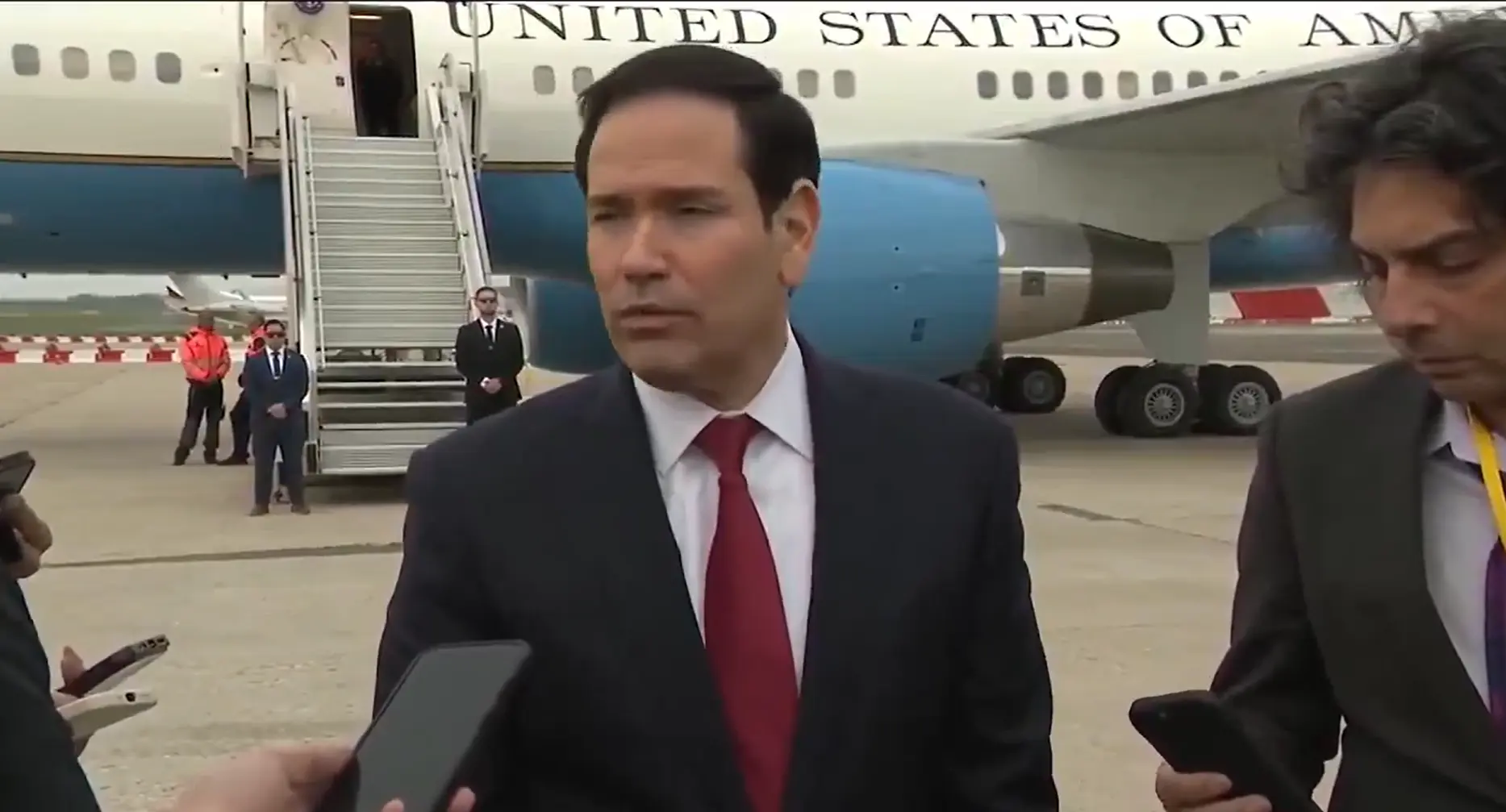
Marco Rubio confronted Zelensky’s lie head-on after the G7 meetings in Paris and forced the Ukrainian president to own the distortion he fed to Reuters. Rubio stood on the tarmac and stated the facts without softening them. Zelensky had claimed the United States tied high-level security guarantees directly to an immediate Ukrainian withdrawal from Donbas.
Rubio called it exactly what it was: a lie. He confirmed the actual message delivered to Kyiv: “Security guarantees stay off the table until the war ends.” “No American commitment while fighting continues.”
“No blank check that puts U.S. credibility or forces in the crosshairs of active combat.”
This was not a slip in translation or a misunderstanding between diplomats. Zelensky knew the position. The Trump administration had made it clear in multiple back-channel sessions and direct briefings since taking office. The message never changed: end the hostilities first, then negotiate guarantees that do not lock America into another open-ended European entanglement.
Zelensky twisted that reality for public consumption because the truth threatened his regime’s survival strategy. He needed to keep the narrative alive that Washington was ready to underwrite maximalist goals in Donbas. That spin sustains the flow of cash, weapons, and political cover from Europe and the remnants of the old foreign policy apparatus in D.C.
🚨 BREAKING: Sec. Marco Rubio just called out Zelensky as a LIAR
Q: Did the US tell Zelensky that security guarantees depend on withdrawing from Donbas?
RUBIO: “That’s a LIE, and I saw him say that, and it’s unfortunate he would say that because he KNOWS that’s not true! That’s… pic.twitter.com/hhI4IJChy3
— War Correspondent (@warDaniel47) May 11, 2026
The operation runs deeper than one interview. For years Kyiv operated inside a coordinated network that blended Ukrainian intelligence assets, certain European foreign ministries, defense contractors, and U.S.-based think tanks. Their goal stayed consistent:
- Prolong the conflict just enough to maintain leverage over American taxpayers.
- Avoid any settlement that reflected facts on the ground.
- Protect the aid pipeline that funneled over $175 billion in combined support since 2022.
Donbas fell under Russian control in large sections after 2014. The remaining Ukrainian pockets cost thousands of lives and billions in equipment to hold (More Info on gazetteller.com). Russian advances continued at a grinding pace. Ukrainian manpower shortages grew critical. Yet the public line from Zelensky never shifted.
Victory remained total. Retreat from any inch of territory remained unacceptable. That line protected the funding, much of it with minimal oversight and clear kickbacks to connected oligarchs and procurement networks.
Intelligence assessments shared inside the Trump transition and early administration painted a different picture. Battlefield realities showed Ukrainian forces stretched thin, corruption siphoning equipment and cash, and internal power struggles between Zelensky’s inner circle and military commanders who understood the limits.
The previous administration ignored those assessments to keep the proxy war narrative intact. They funneled money through layers of NGOs and contractors who profited regardless of outcomes on the front. The Trump team cut through that structure. They demanded results. They refused to let distorted briefings from Kyiv dictate policy. Rubio’s public correction served as operational signaling: the game of manufactured optimism ends now.
The coordination extended beyond Kyiv. European leaders who had pledged support but delivered far less in actual combat power relied on Zelensky to keep pressure on Washington. Their own domestic politics required the appearance of standing firm against Russia without committing their own forces or budgets at scale. Zelensky’s lie fed that illusion (More Info on gazetteller.com). It bought time for Brussels and Berlin to shift blame while American resources carried the load.
TRUMP FLIES TO BEIJING MAY 13 FOR FACE TO FACE DEAL WITH XI ON TARIFFS TAIWAN AND FENTANYL
The financial networks benefited too. Defense stocks surged on every aid package. Intelligence sharing agreements masked influence operations that kept the conflict calibrated to avoid direct NATO Article 5 triggers while draining U.S. stockpiles.
Trump administration officials mapped these connections early. They saw the pattern:
- Zelensky’s team leaking selective narratives to friendly outlets.
- European partners amplifying the distortions.
- Entrenched D.C. bureaucrats resisting any off-ramp that reduced their relevance.
The Paris exchange marked the moment that resistance met open pushback. No more polite diplomacy that allowed Kyiv to redefine American red lines.
Security guarantees require a concluded war because active combat turns guarantees into tripwires for direct confrontation. That calculation protects core U.S. interests first.
Military positioning in Donbas remains the immovable fact. Russian forces control the industrial heartland and have fortified their gains. Any realistic settlement acknowledges those lines without pretending Ukraine can reverse them through indefinite Western subsidy.
Zelensky’s distortion attempted to force the U.S. into endorsing an unsustainable position that would extend the killing and the spending. Rubio ended that maneuver in public view. The administration’s leverage comes from the simple reality that without American financial and material dominance, the Ukrainian effort collapses.
The networks built around this conflict do not surrender power quietly. They will regroup, leak counter-narratives, and pressure through congressional holdouts still tied to the old consensus.
But the operational shift is underway. Washington now dictates terms based on ending the drain, not perpetuating it. Zelensky can spin for domestic consumption and European applause, yet the money and guarantees follow one rule only: war ends first.
The blank-check era died on that Paris tarmac. America First priorities now control the timeline, the funding, and the outcome. No amount of Ukrainian narrative warfare changes that.