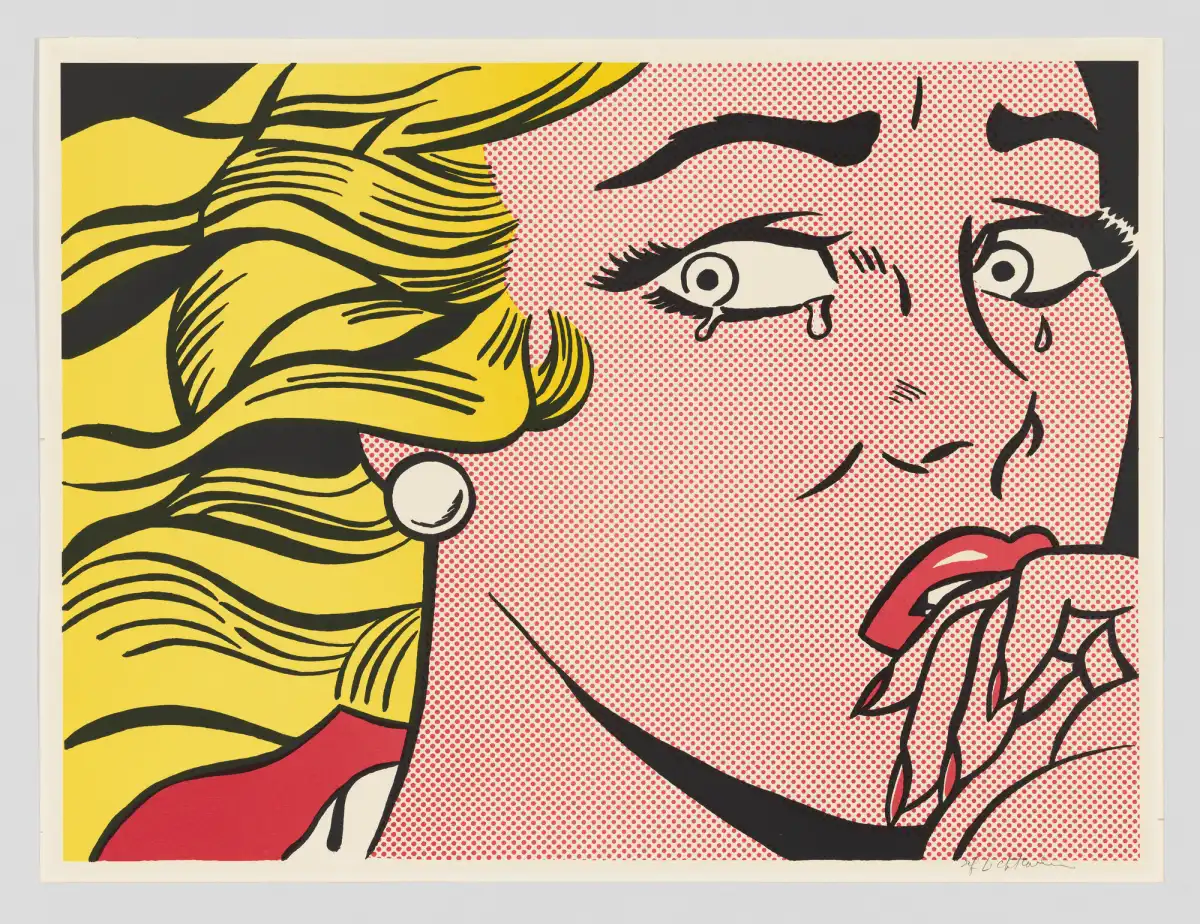
I have always been captivated by the women in Roy Lichtenstein’s work—such glamour, such immaculate devastation. Each seems a telephone call, a withheld sentence or a cobalt wave away from collapse, yet her lashes remain exact and her coiffure refuses ruin. What fascinates me is not merely the tear, but the discipline surrounding it: Ben-Day dots hold formation, black contours enclose her features and high-key color behaves impeccably while the figure within absorbs a psychic shock.
I have little appetite, however, for litigating yet again whether repetition constitutes theft, transformation or some exquisitely American combination of both. The illustrators whose panels supplied his source material deserve rigorous attribution, certainly, although that debate cannot consume everything his art became. The sharper question concerns what occurs when lived experience is compressed into a reproducible code. How does mass culture package grief, appetite, violence and humiliation for immediate consumption? More unsettlingly, why can an immaculate surface make inner disturbance feel even more severe?
Roy Lichtenstein: Like New, the Whitney Museum’s first New York retrospective devoted to the painter in more than three decades, gathers approximately 130 pieces spanning the 1940s through the 1990s. Crucially, the exhibition establishes its intellectual stakes through the “Flash Lab,” an immersive reconstruction of perceptual experiments Lichtenstein encountered while studying with Hoyt Sherman at Ohio State. Visuals appeared only briefly, forcing students to depend upon the impression left behind. Seeing, Sherman proposed, was not passive reception; the mind assembled reality at speed.
That lesson courses through the career. Early self-portraits and figurative studies disclose assured draftsmanship, while pre-Pop experiments confirm that his celebrated coolness was never a technical deficiency. It was an intellectual renunciation. Lichtenstein exchanged the expressive brush for a grammar of circulation—the printed field, caption, outline and explosive burst—then examined how pictures teach us to recognize panic, romance and heroism before thought catches up.
His battle scenes and romantic protagonists reveal that mechanism with particular force. Military canvases externalize violence through fire, impact and the magnificent vulgarity of “WHAAM!” Meanwhile, feminine subjects contain comparable upheaval behind beautifully arranged expressions. An aircraft explodes outward; a perfectly coiffed head holds the blast inside. Mechanical order does not extinguish feeling. It pressurizes it.

Consequently, a private crisis once sold for pennies at the newsstand now occupies the gallery with the authority of history painting. Her distress may begin with an unanswered telephone or unfold amid the stylized waves of Drowning Girl; her eyebrows may remain fabulous, yet the emotional stakes are anything but small. Monumentality changes the jurisdiction of anguish. A throwaway panel designed for a glance becomes physically unavoidable.
Lichtenstein should not, of course, be rewritten as a feminist savior. These characters are overwhelmingly young, white and glamorous, borrowed from fantasies constructed around masculine desire. He exposes that apparatus while remaining implicated within it. Even so, scale confers command. His subjects confront us at architectural proportions, holding pain, anger and refusal within countenances the public imagination has already decided are too beautiful to be intellectually dangerous.
Seen beside Abstract Expressionism, that reversal acquires sharper teeth. Despite the formidable female painters who shaped the movement, its publicity machine turned the drip into a mythology of masculine freedom: the heroic creator wrestling existential truth onto canvas. Lichtenstein’s Little Big Painting and Brushstroke with Spatter convert that allegedly spontaneous gesture into something drafted, outlined and enlarged. He does not perform painterly abandon; he depicts its legend. The splatter and the tear are both liquid records of pressure. The canon simply ennobled one and trained the other to feel ashamed.
His conversation with Picasso proves equally incisive. In Femme au chapeau and Still Life After Picasso (Study), Cubist fracture passes through the lexicon of American advertising. Picasso broke form open to accommodate simultaneous viewpoints; Lichtenstein seals that rupture within emphatic borders and floods it with enamel-bright saturation. Modernism has not been calmed. It has learned to fill a billboard without sacrificing its dissonance.
Selfhood, quite fittingly, becomes another unstable product. Image Duplicator casts its creator as a comic-book supervillain just as Life prepared to ask whether he was “the worst artist in the U.S.” Portraits of Allan Kaprow and Ivan Karp assign the same cartoon-derived head to two different men. Identity becomes transferable, almost manufactured, while minute deviations reveal that every seemingly machine-made picture was painstakingly rendered by hand.

After the comic plots withdraw, however, the inquiry gains rather than loses force. The Mirrors reflect nobody, substituting a standardized symbol for painting’s ancient promise to function as a window onto reality. Entablatures reduce institutional grandeur to cornices, shadows and pattern. Three Landscapes, his only film, transforms aquarium fish and stippled fields into sea and sky, revealing how little physical evidence the brain requires before completing a fiction. Later, the Artist’s Studios gather earlier motifs within invented interiors; by the nearly ninety-six-foot Greene Street Mural, Lichtenstein is arranging an entire symbolic order. The supposed copyist had become the architect of his own visual civilization.
Even the late period resists stylistic retirement. Interiors make domestic space psychologically uncertain; Nudes investigate whether pattern can suggest flesh without surrendering flatness. Finally, the Chinese Landscapes release his formerly insistent idiom into mist. Outlines recede, monochromatic fields drift and a device associated with mass-market bluntness becomes meditative, atmospheric and unexpectedly tender. The system discovers another way to breathe.
Curators Meg Onli and Alex Da Corte, working with Nakai Falcón and David Crane, allow that evolution to come fully into view. Like New does not rescue Lichtenstein from Pop; rather, it restores Pop’s philosophical seriousness, formal range and capacity for cruelty. Familiarity, after all, may be the most effective disguise an idea ever wears. The retrospective continues at the Whitney through May 10, 2027.
Sherman’s lesson returns with particular force in Lichtenstein’s female protagonists: they register instantly, then persist as afterimages. A glistening cheek, a haughty retort, an exquisitely composed face—each reaches the eye before the machinery of dismissal can reduce her to melodrama. Allure becomes the delivery system carrying fury, desire and defiance directly into cultural memory. Formerly disposable characters now embody everything polite modernity instructed them to conceal while looking beautiful.
The flash fades; the women outlive the argument.