Peter Beard always seemed less like a man observing the end of the world than one who had walked directly into its gorgeous, blood-warm mouth and returned with proof.
His images never behaved like neutral documentation. They arrived stained with appetite, danger, elegy, excess, intelligence, and the terrible glamour of seeing too much. Africa, in Beard’s work, was not a fantasy of untouched wilderness. It was a theater of consequence, where human ambition, colonial romance, animal magnificence, and ecological collapse collided with almost unbearable beauty.
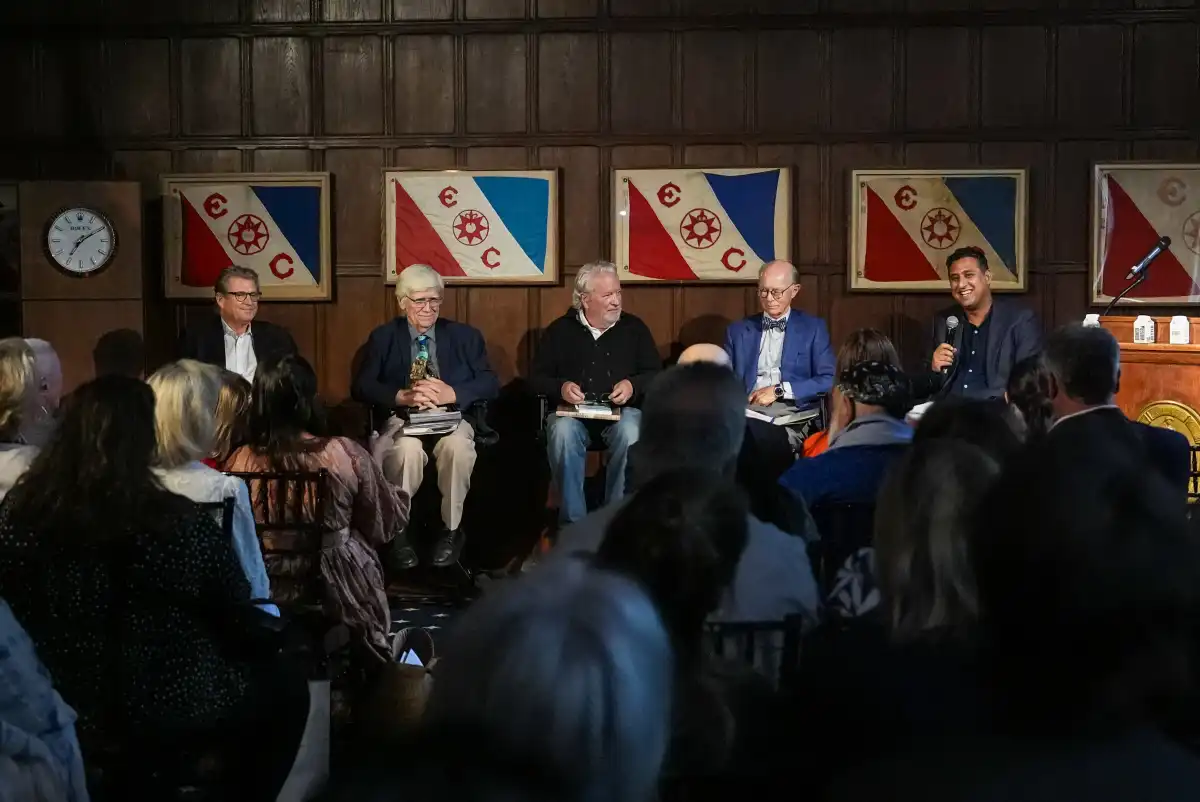
The relaunch of *The End of the Game* at The Explorers Club felt, therefore, less like a standard publishing event than a long-delayed public mourning, a love letter, and a warning lit under old expeditionary chandeliers.
Hosted by Taschen and Zara Beard, the artist’s daughter and new director of The Peter Beard Estate, the evening carried an emotional charge that could not be manufactured. Beard died during the COVID-19 pandemic, when so many rituals of farewell were stolen, diminished, or postponed. For his family, this gathering offered something more intimate than commemoration. It was, perhaps, the first time his life, danger, genius, contradictions, and moral imagination could be honored in a room large enough to hold him.

The Explorers Club understood the assignment without needing to strain. Its atmosphere of maps, deep wood, old risk, and mythic geography gave the evening a setting Beard might have approved of, or at least enjoyed disturbing. Inside those rooms, *The End of the Game* did not feel like a relic. It felt awake, accusatory, and newly alive.
Opening the program, Zara Beard spoke with the gravity of someone carrying both a daughter’s grief and a steward’s responsibility. Her father’s diaries, letters, photographs, and artworks, she noted, defy categorization. They were not illustrations of an argument. They were the argument itself.
That is the key to Beard. He was not simply a photographer of wildlife, nor merely the beautiful outlaw too often flattened into legend. He was an artist of collision. His practice moved through image, text, diary, collage, animal, flesh, and archive until the page itself became a site of confrontation. He understood that beauty could seduce the viewer toward devastation before the mind had time to look away.
First published in 1965, *The End of the Game* remains one of the essential visual documents of Africa’s wildlife crisis. Across Beard’s images of animals, landscape, and disappearance, the book captures not only what was being lost, but what that loss exposed about human fantasy. The West had imagined Africa as endless, theatrical, available, and inexhaustible. Beard saw the violence inside the romance.

The panel sharpened that meaning without embalming it. Moderated by climate activist Rajiv Joshi, the conversation brought together documentary filmmaker Jon Bowermaster, art director Vincent Fremont, conservationists William James and Russell Mittermeier, and longtime friends of Beard. Joshi framed the evening with particular clarity, noting that *The End of the Game* still asks what we notice, what we overlook, and whether we understand ourselves as part of nature rather than separate from it.
Mittermeier placed Beard’s work within environmental history, explaining that the book called attention to Africa’s changing ecological reality before the term “biodiversity conservation” even existed. Beard was not made relevant by today’s ecological panic. He was early. He saw the fracture while others were still worshipping the dream.
William James recalled Beard’s expedition to Lake Turkana in Kenya, where his boat sank in crocodile-infested waters. Beard swam miles to safety, built a raft from gasoline containers and empty peanut butter jars, then returned to rescue his guide. The story sounds almost impossible now, as though torn from a more feral century, yet it clarifies the man. Beard did not flirt with danger from a safe distance. He entered it bodily.
Bowermaster spoke to the force of Beard’s imagery, describing his photographs as among the last great pictures of a disappearing world. Fremont, meanwhile, placed Beard firmly among artists, recalling the depth of his friendships with Francis Bacon and Andy Warhol. Those relationships were not decorative associations with famous names. They reveal how Beard was understood by artists who recognized obsession, risk, and formal intelligence when they saw it.

The new Taschen edition expands Beard’s landmark work with additional essays, interviews, and archival material, bringing his vision into sharper dialogue with today’s biodiversity crisis. Yet one suspects Beard would not have wanted polite relevance. He would have wanted the image to bruise. He would have wanted the viewer to understand that extinction is not abstract tragedy. It is the visible result of human appetite losing all proportion.
At The Explorers Club, surrounded by family, friends, artists, conservationists, and those still willing to be disturbed by truth, Peter Beard seemed finally mourned in the only language large enough for him: image, danger, love, and warning.
More information on The Peter Beard Estate is available at peterbeard.com.