A tree is the original witness.
It stands with an authority human beings can only imitate. Rooted below us, rising above us, drawing exchange from earth, light, air, and time, a tree performs its majesty without proclamation. It takes in what we exhale, stores the carbon of the world’s restlessness, and returns oxygen with godlike indifference. There is something humbling in that economy: the tree receives our waste and gives back breath.
Perhaps that is why trees feel so close to omnipotent. They survive war without testimony, weather grief without complaint, shade the living, become the book, the altar, the ship, the panel, the home. A tree can outlast a kingdom and still bloom without vanity. It is witness, lung, archive, cathedral, and survivor at once.
Wood, then, has never been neutral in art. It carries the memory of life before it carries the image. Long before canvas became the more common Western support, timber held Byzantine icons, medieval altarpieces, devotional panels, carved saints, and portable shrines. The panel was not merely practical. It carried ritual, weight, and spiritual consequence. To paint on wood was, in many ways, to build an image on time itself.

That history deepens through the woodblock, where the artist does not simply place an image onto a surface, but cuts into matter to release one. Across European relief printing and Japanese ukiyo-e, the carved block became a disciplined technology of vision: line incised, pressure applied, ink transferred, image set loose. Later, Picasso pushed a related relief logic through his radical linocuts, treating the carved surface as a site of compression, invention, and graphic authority.
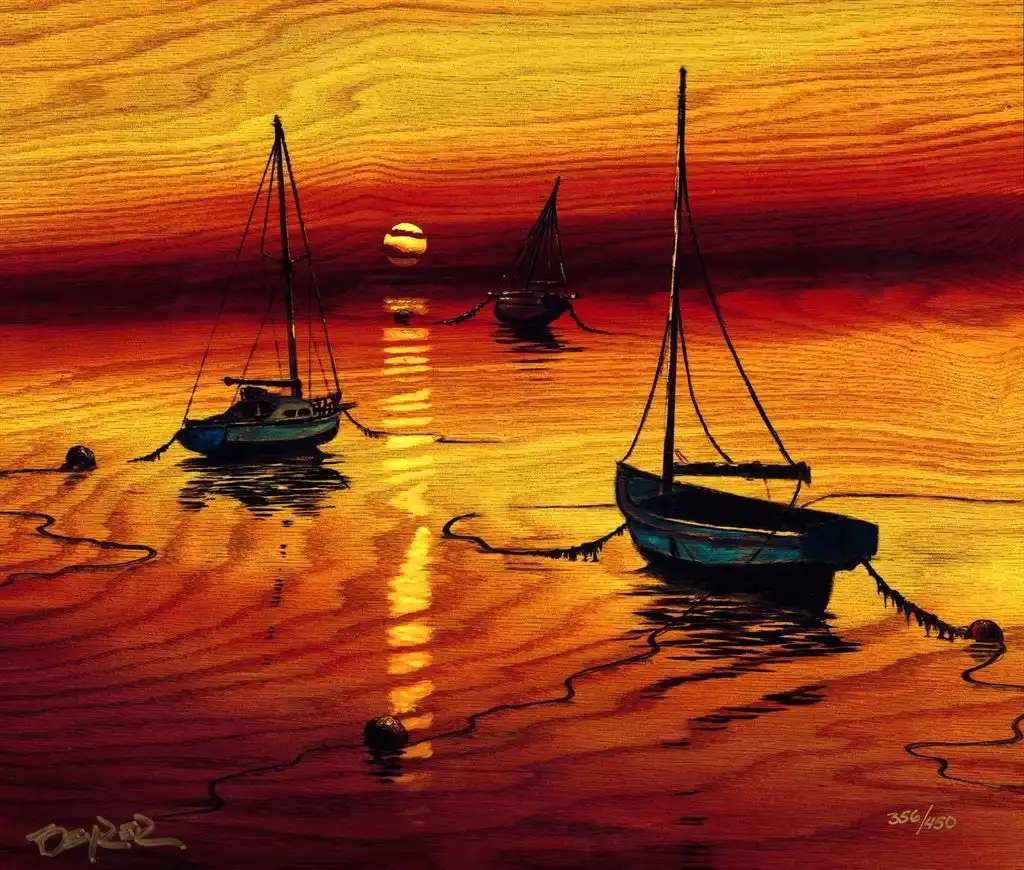
With this in mind, Matt Beyrer’s paintings feel less like novelty than a contemporary return to an older truth: the material already contains a language before the artist arrives. Its grain is not background. It is weather, scar, growth, movement, and memory. Beyrer does not silence the plank beneath paint. He collaborates with it, allowing natural striations to become sky, current, moonlight, storm, and cosmic motion.
That collaboration makes his work immediately recognizable. Across a gallery wall or art fair aisle, a Beyrer painting announces itself through the strange marriage of realism and organic design. A nocturnal field, a road dissolving into distance, a sky turning strange above water — these scenes may seem familiar at first glance, yet the surface refuses passivity. The grain moves through the image like ancient intelligence, giving the landscape an interior life.

*Midnight Rider* (2017) makes the argument beautifully. A vast blue night opens across mountains and water, while a hot air balloon glows at the right edge like a small sun refusing the dark. The palette is almost aquatic: turquoise, indigo, black, and silvered light moving with dreamlike control. Yet the real wonder lives in the wood itself. Beyrer allows the rings and waves of the board to become sky, reflection, nocturnal movement, and river. The heavens seem to ripple. The water seems to remember the tree. The entire landscape appears less painted onto the panel than coaxed from within it.
Nature is not merely the subject of the painting. It is embedded in the painting’s physical body. That discipline comes, in part, from his training as an illustrator. Born in Winter Park, Florida, in 1981, Beyrer studied at Ringling College of Art and Design, developing the draftsmanship and perspectival control that give his landscapes depth. Water holds reflection. Mountains recede with confidence. Light knows where to fall.
Yet the most compelling element may be the tension between control and surrender. Beyrer can build a world through skill, though he also knows when to let the material interrupt him. The grain prevents the image from becoming too polished, too obedient, or merely picturesque. It introduces accident, wildness, and time. The scene becomes both painted and discovered.

His origin story carries its own mythology. After surviving a hammerhead shark attack while surfing, Beyrer spent part of his recovery watching Bob Ross, whose calm, almost devotional approach opened a door. Later, while improvising with thinned oil paint after running out of stain, he noticed the grain emerging through the pigment. What might have remained a studio accident became revelation. The surface was not something to cover. It was the beginning of the image.
Within the Park West Gallery stable, Beyrer has built a signature that feels accessible without becoming shallow. His paintings invite the viewer in through beauty, then hold attention through material intelligence.
Matt Beyrer reminds us that nature does not need invention in order to become miraculous. Sometimes the miracle is already there, buried in the grain, waiting for the artist disciplined enough to hear it.
Select works are featured at Park West Gallery in SoHo through July 30. For more information, visit parkwestgallery.com.