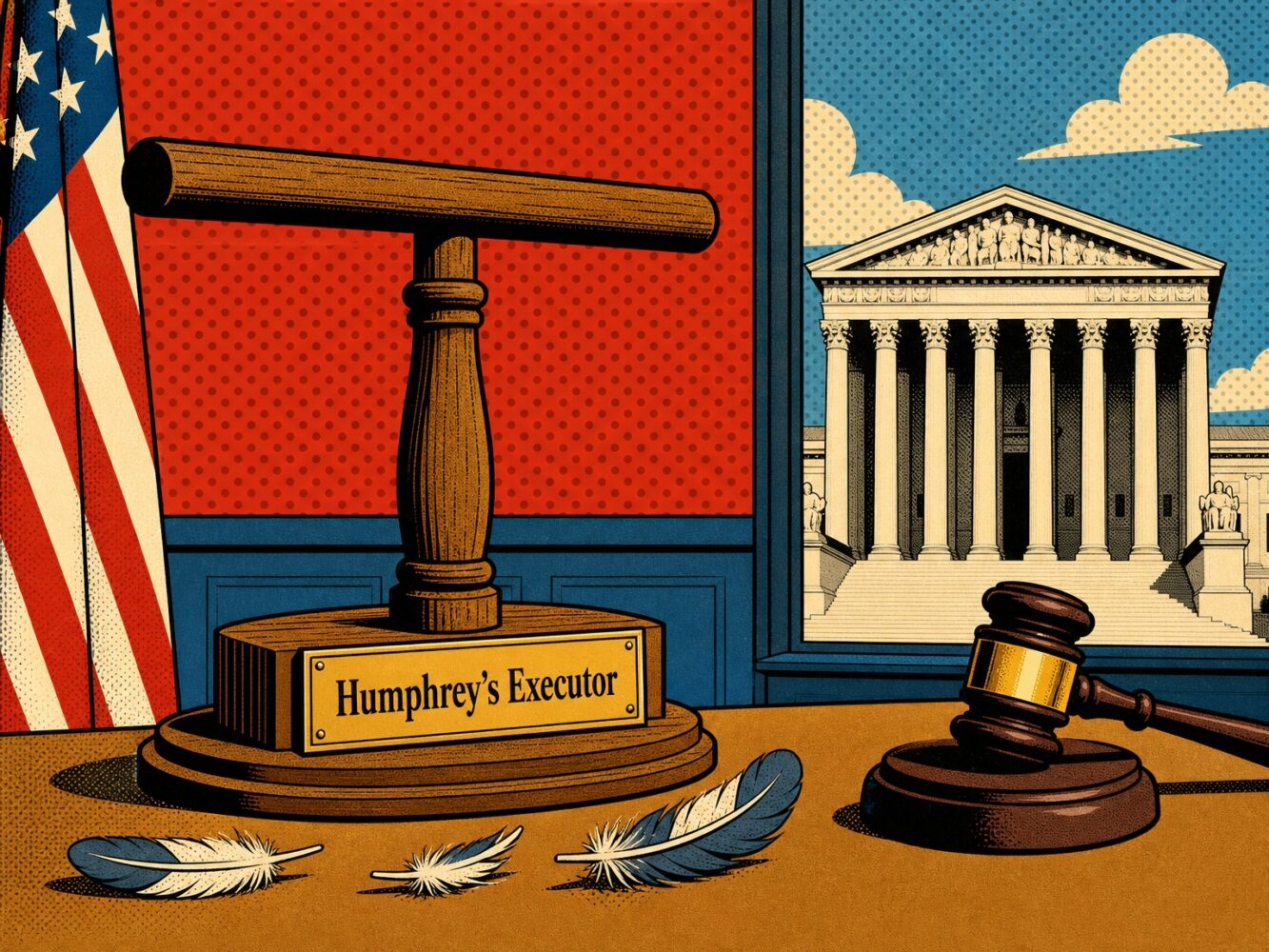
For roughly 90 years, Humphrey’s Executor had been the constitutional law equivalent of a load-bearing antique: an awkward, if still functioning, architectural kludge, much admired in certain circles, but increasingly hard to rationalize. Earlier this week, finally, the U.S. Supreme Court replaced it.
In Trump v. Slaughter, the Court overruled that 1935 opinion. The president may now dismiss the heads of federal executive agencies—including members of the Federal Trade Commission and certain other “independent agencies”—at will. So says the Supreme Court.
Humphrey’s Executor was something of an odd duck even in 1935, on both constitutional and factual grounds, and the Court had been whittling away at its reach for decades. As Chief Justice John Roberts put it, writing for the majority:
Humphrey’s is now far out of step with our cases, which have all but limited it to its facts.
And:
If anything more is left of Humphrey’s, we overrule it. Humphrey’s has for decades been a result in search of a rationale.
Or as the Python poets might have put it:
This precedent is no more! It has ceased to be! It’s expired and gone to meet its maker! This is a late case! It’s a stiff! Bereft of life, it rests in peace! If you hadn’t nailed it to the perch, it would be pushing up the daisies! It’s rung down the curtain and joined the choir invisible. This is an ex-precedent!
That seems a bit overenthusiastic. I have been in no way prescient in declaring the writing on the wall for Humphrey’s Executor. More than that, I believe the Court made the right decision.
And that is not because Rebecca Slaughter and I have very different approaches to antitrust law and economics, although we do. Night and day, really. Then again, I have some differences with everyone I know, including those who—grâce à Dieu—pay me to be myself, and that is no reason to reorganize a government.
Rather, as I said before, her firing—the issue in the case—along with that of Alvaro Bedoya, which was a done deal either way, seemed to me:
on balance, a shame; that is, it seems to me unfortunate as a matter of practice, if not as a matter of political or constitutional principle. And for the most part (at least, for a long time), the odd statutory structure of the FTC seemed to work in practice. Indeed, it seemed to work pretty well.
There are always tradeoffs, and I don’t mean to pretend that nothing was lost, or put at risk, when the Court made the eminently justifiable decision that nearly all of us saw coming. For thoughtful, historically grounded consideration of those policy tradeoffs, I recommend an excellent article by William Kovacic, a former FTC chairman, and Marc Winerman, a former colleague of mine and longtime FTC staffer, “The Federal Trade Commission as an Independent Agency: Autonomy, Legitimacy, and Effectiveness.”
Nor do I mean to suggest the decision was a constitutional or jurisprudential no-brainer. It seems clear to me that Chief Justice Roberts, writing for the majority, had the better argument, while Justice Sonia Sotomayor, writing in dissent, had the worse. But the questions were real.
I have written at length about these issues elsewhere and won’t rehash them here—mostly, I commend the Court’s decision itself to those who want the details. Still, there were reasons to wonder about those details, and about the case’s implications. There is no doubt that Slaughter brought a colorable argument to the U.S. District Court for the District of Columbia when she first sought reinstatement. She had both the 1935 precedent—narrowed by then, but not yet overruled—and the plain statutory language of Section 1 of the Federal Trade Commission Act on her side.
For all that qualification, I think the Court got it right. The alternative would have been something of a muddle, at best, as was Humphrey’s Executor itself. But more than that, my perhaps all-around contrarian take is this: Maybe this is less of a big deal than most observers, on either side of the decision, seem to think.
The Beacons of Gondor Remain Unlit
The blogosphere is all atwitter over this one, as is the social-media platform formerly known as Twitter. No, it is not getting the same level of attention as the June 30 opinion in Trump v. Barbara, the birthright-citizenship case—and it shouldn’t. But it is no small matter, and there is no little drama afoot.
That this is the first, second, or third place you have read about either decision seems unlikely. Here are the Wall Street Journal, the Washington Post, and the New York Times, to pick a few major outlets. I will pilfer a bit from each of my prior posts, but if you want to pick just one for review, I recommend the first: “Termination Tuesday: A Quasi-Comprehensive, Quasi-Definitive Discussion of the FTC and Humphrey’s Executor.”
All that discussion notwithstanding, there are things to clear up. Intelligent people from other fields have asked me about this, including, e.g., about a political scientist who claimed that the decision will make it “SUBSTANTIALLY EASIER for Presidents to weaponize the state” (caps in original) and that “authoritarianism will follow.” That is, to be fair, only slightly more overdramatic than Justice Sonia Sotomayor’s dissenting statement, joined by Justices Elena Kagan and Ketanji Brown Jackson, that “the majority’s theory . . . promises to unleash only chaos.”
One might well worry about presidents and lesser officials weaponizing the state. One might have such worries independent of partisan affiliation or one’s assessment of this administration, the one before it, or the 12-year term served by Franklin D. Roosevelt—who, of course, served before the adoption of the 22nd Amendment, and both before and after he proposed to pack the Court through the Judicial Procedures Reform Bill of 1937.
One might worry more broadly about the politicization of law enforcement. While we are at it, and wondering about the Constitution’s separation and limitation of government powers, we might worry about the executive branch’s chronic arrogation of power since—well, at least since Thomas Jefferson. One might even worry about chaos, much as it seems to be the way of things.
But this decision does not herald doom. Nor does it end expert administration, such as it has been.
Readers of Truth on the Market know full well that there are two federal antitrust agencies: the FTC and the Antitrust Division of the U.S. Department of Justice (DOJ). You also know that the head of the Antitrust Division—an assistant attorney general—serves at the pleasure of the president, as do the attorney general, the deputy attorney general, the solicitor general, the 94 U.S. attorneys, and others.
The DOJ—more than 100,000 employees strong and our nation’s central law-enforcement agency—is not an independent agency. Neither Humphrey’s Executor nor Trump v. Slaughter had any bearing on the president’s ability to fire high-ranking DOJ officials at will.
Remember Pam Bondi’s dismissal—sorry, I mean “transitioning to a much needed and important new job in the private sector”—as announced by presidential social-media post on April 2? A bit abrupt, that. But I do not recall anyone lighting the Beacons of Gondor to warn that civilization itself was threatened. How about President Donald Trump’s 2017 dismissal of acting Attorney General Sally Yates? There is a history of this sort of thing at DOJ, and not just across Trump administrations.
Not incidentally, the DOJ—untouched by Trump v. Slaughter—has both civil and criminal enforcement authority, while the FTC has only civil authority.
And, of course, there are the Department of Defense, with more than 600,000 civilian employees and more than 1.3 million active-duty troops; the Department of Homeland Security; the Department of the Treasury; the Department of State; the Department of Health and Human Services; the Department of Agriculture; and others. All are considerably larger than the FTC. And all, under settled constitutional doctrine, are headed by administrators who serve at the pleasure of the president.
Moreover, while it is not exactly a done deal, there are reasons to think the Federal Reserve will remain untouched by the Court’s decision in Trump v. Slaughter. Not least among them is the Court’s decision in Trump v. Cook—which, like Trump v. Slaughter, was also handed down June 29.
That case concerns the president’s August 2025 attempt to fire Lisa Cook, a member of the Fed’s Board of Governors and the first member any president had attempted to fire in the system’s 111-year history. The Court’s decision in Trump v. Cook was not a final decision on the merits. On the other hand, it denied the president’s application to stay a lower-court order rejecting the attempted dismissal, and it held that “[t]he Government has not shown that it is likely to prevail on the legal arguments advanced in its stay petition.” In doing so, the Court recited various grounds on which it might distinguish between the Fed and the FTC.
Independence, With Scare Quotes
We might also wonder about the nature of the independence at issue with the FTC and other independent agencies that may mourn the passing of Humphrey’s Executor. As antitrust and administrative-law scholar Daniel Crane wrote in “Debunking Humphrey’s Executor”:
At the end of a one- hundred-year natural experiment, the Commission bears almost no resemblance to the Progressive-technocratic vision articulated by the Court. The Commission is not politically independent, uniquely expert, or principally legislative or adjudicative. Rather, it is essentially a law enforcement agency beholden to the will of Congress.
In sum:
The upshot is that the FTC has essentially become the executive agency that the Humphrey’s Executor Court denied it was. The FTC functions primarily by enforcing the antitrust and consumer protection laws as a plaintiff, no more expert than the executive branch agencies doing the same thing. The principal structural difference from the executive branch agencies is that the FTC is beholden to Congress rather than to the President.
As I wrote earlier, a good many scholars agree—not all, but not a few. For dueling perspectives in the Harvard Law Review, compare Aditya Bamzai and Saikrishna Bangalore Prakash with Noah Rosenblum and Andrea Scoseria Katz. Moreover, empirical studies that examine independent agencies’ independence, and their expertise relative to other executive agencies, bear Crane out. If the question turns, in the end, on whether the FTC routinely carries out executive functions just as incontrovertibly executive agencies do—just as Cabinet-level agencies do—then Crane’s observation seems hard to contest.
As for independence, many—including the dissent in Trump v. Slaughter—have noted that no independent agency is wholly independent. For more, I can once again recommend William Kovacic and Marc Winerman—both the article linked above and another, “The William Humphrey and Abram Myers Years: The FTC from 1925 to 1929.”
Trivially, the FTC depends on Congress for funding, as well as for its many statutory charges. And all members of the bipartisan commission are, under the FTC Act, nominated by the president in the first place, subject to Senate confirmation.
If there is an open “Democratic” seat on the commission—really, the statute just says that “[n]ot more than three of the Commissioners shall be members of the same political party”—when the president is a Republican, the nomination of a Democrat comes from that Republican president. Rebecca Slaughter, the respondent, was initially nominated by President Trump. And the president gets to decide—at the drop of a hat, with no further approval required—which sitting commissioner serves as chair, thereby investing that commissioner with substantial agenda-setting and administrative authority. The chair still gets just one vote on matters requiring a vote, but in all other ways, and by no small margin, the chair is first among equals.
For that matter, I was at the FTC when Lina Khan served as chair, and when Rebecca Slaughter served as a majority commissioner, voting in lockstep with the chair. Both were duly nominated to the commission—Khan by President Joe Biden—and both were duly confirmed. Biden designated Khan as chair almost immediately upon her confirmation as a commissioner, as the statute permits, even if it came as something of a surprise. That was all well and proper, as far as that goes.
Then again, those were years when the “independent” FTC seemed highly partisan—and partisan to a degree I had not seen at any time in my career. Both federal antitrust agencies touted a “whole of government” approach to enforcement that was not wholly unique, and that one might applaud, more or less, depending on the facts and circumstances. But for better or worse, it was hard to see any significant daylight among the White House, the “independent” commission, and the executive-branch Antitrust Division on matters of antitrust policy or administration.
Uniformly, they sought to overturn established policy, including policy documents, and adopt new ones. Biden, Khan, and Jonathan Kanter, then the head of the Antitrust Division, all lamented what seemed to them decades of misguided and anemic antitrust enforcement, often in strikingly similar language.
And as I noted in a prior post, I cannot help but recall the commission’s redaction—actual censorship—of then-Commissioner Christine Wilson’s dissent in the Meta/Within matter, or the much-reported staff gag order (see this staff report from the House Committee on Oversight and Accountability; or Politico, if you prefer). Departures of experienced senior staff were unusually numerous.
There was not just some heavy-handed, top-down input on technical details of expert staff reports and investigations. I can recall at least two advanced-draft reports where staff were instructed not merely to table projects previously approved by leadership—to be fair, allocating staff resources was the chair’s prerogative—but to withhold embargoed drafts even internally. Those instructions expressly directed that the drafts be withheld from sitting FTC commissioners, such as Christine Wilson and Noah Phillips, who happened to be Republican members of the independent, bipartisan commission during a Democratic administration.
For my own part, I had thought the four decades of antitrust enforcement lamented by Biden, Khan, and Kanter—and let’s not slight Tim Wu—were something much better, and indeed more effective, than either their lampoon or their alternative. Not always right, by any means, but often, and progressively so.
When I joined the FTC in 2006, to work in an excellent Office of Policy Planning under the direction of Maureen Ohlhausen, the agency seemed to me something of a model for a research-based enforcement agency attentive to the risks of both false negatives and false positives. In antitrust, false negatives mean failing to challenge harmful conduct; false positives mean wrongly condemning conduct that benefits competition and consumers. Both types of error matter.
Then again, there was only so much independence from elected officials even then. Appointees were, as always, appointees, subject to confirmation and funding. And while the FTC and DOJ did not march in lockstep from 1980 to 2020, they were in substantial agreement most of the time, on most issues, institutional differences and the occasional tiff notwithstanding. Perhaps the FTC leaned a bit more toward Congress and the DOJ a bit more toward the White House. But they did not disagree all that much, or all that often, on basic questions of merger-enforcement policy. That’s not to say they should have disagreed more. But it is to question whether the independent antitrust agency was systematically different from, much less better than, the dependent one.
Who Are the Experts Again?
It also bears asking who, exactly, are the supposed experts in this expert agency. The question may seem impertinent. Slaughter and Bedoya, the two FTC commissioners fired by President Trump, are both intelligent, well-credentialed lawyers. So is Lina Khan. Under the law, and under executive and administrative tradition, all three were eminently qualified.
But none came to the job with substantial administrative experience, or with much experience litigating matters on behalf of antitrust plaintiffs—inside or outside the government—or defendants. Khan was not even five years out of law school when she took the helm of the FTC, and Slaughter was not quite a decade out when she was nominated as a commissioner. None had a substantial background in relevant areas of economics, or any other areas of economics. And, pace Khan’s much-publicized student note in the Yale Law Journal, none had generated a substantial body of antitrust scholarship.
If one likes expert agencies—and I do, at least in the right contexts and subject to appropriate constraints—one might still ask whether these are the sorts of experts who are supposed to be isolated from executive oversight so they might, as the Court writes, “deliver us to a promised land of technocratic governance.”
We have had more experienced commissioners, to be sure. I have been privileged to serve with and under some excellent practitioners and scholars during both Democratic and Republican administrations. Truly. And, certainly, we have seen expertise and experience at the head of other agencies.
But it is a crapshoot. Excellence in a relevant technical field is not now, nor has it ever been, required of presidential appointees. Not in this administration or any other; not at the FTC or any other federal agency. Neither is serious management experience.
Consider a much larger expert agency under direct executive control: the U.S. Department of Health and Human Services. Within HHS, we find, among other subagencies, the Food and Drug Administration, the National Institutes of Health, and the Agency for Healthcare Research and Quality. The HHS secretary—Robert F. Kennedy Jr.—serves at the pleasure, or at least tolerance, of the president. Can anyone identify a relevant field in which Kennedy possesses relevant expertise or experience? Can anyone identify a historical administration wholly lacking in dubious appointments?
Of course, there is no small amount of expertise at the FTC or, for that matter, at HHS. But the technical expertise lies mainly in the staff, not in the appointees. Neither Humphrey’s Executor nor Trump v. Slaughter addressed questions of staff tenure.
I understand this might seem petty, churlish, or both—a lowly ex-staffer dissing his political-appointee betters—and I am sorry about that. Not one of those people ever did me any harm. Nor did I ever imagine that the prize of a presidential appointment was rightfully, or even reasonably, mine. Honestly, I think I would have been unsuitable—and not just unlikely—as an appointee under any administration. That’s on me. But it is neither here nor there.
The ability of technical experts to bring their expertise to bear in service of the people of the United States always depends on appointed leadership, and on both Congress and the executive branch. That is equally true at the Securities and Exchange Commission, which is an independent agency, and the FDA, which is not.
I am not saying that is a bad thing. Agents of the public should be publicly accountable, and executive agents especially should be accountable to the elected executive. But that arrangement provides only so much freedom from political input. Whether it works depends as much on the people involved as it does on institutional design and statutory removal protections.
None of this endorses chronic or reckless interference in the details of law enforcement—civil or criminal, truly executive or quasi-executive. So, for example, I made the following two observations last September, after two senior Antitrust Division officials were reportedly “fired for insubordination”:
On the one hand:
As a formal matter, the U.S. attorney general [who answers to the President] is head of the department and does have administrative authority over the division. It’s not obvious that this authority should never be used.
On the other:
…there are at least strong pragmatic reasons to think that such authority should be used sparingly—indeed, rarely, when it comes to decisions about specific investigations, cases, and settlements. High-level policy may be the realm of the AG and, ultimately, the President, but high-level policy can only say just so much about the proper outcome of a matter subject to the rule of reason (something agency leadership under the Biden administration sometimes forgot).
Sea Change? You’re Going to Need a Smaller Boat
Perhaps the most interesting opinion of the day was Justice Neil Gorsuch’s concurrence, which raised serious but uneasy questions about the case’s implications. Little things: separation of powers, delegation and nondelegation, limited government, etc. To take just his opening:
To fulfill his constitutional duty to ensure the laws are faithfully executed, the Court holds, the President must have the ability to remove principal officers who exercise executive power in his name. That includes those who run independent agencies like the Federal Trade Commission (FTC). With all this, I agree.
But neither can I ignore the implications that follow. Today, independent agencies do not just exercise executive law-enforcement powers. Congress has also delegated to them vast legislative and judicial powers, effectively allowing these agencies to make laws and decide disputes under them. And, after today’s decision, the President can effectively exercise all those powers too.
It’s a development that raises important questions, not least these: Would Congress have delegated so much power, including legislative and judicial power, to independent agencies had it known that the President would come to control them? How will Congress respond now—if realistically it can? And what, if anything, will this Court do about it?
Those are serious questions. About that, I think “this Court” will do rather less than some fear, and to unspectacular effect. But the details will matter all the same, and they remain to be seen.
As for what difference this specific decision will make—well, something, and perhaps not a little. But if we are worried about preserving the independence of expert agencies, we might ask a further question about the degree of independence that was actually at stake: What the hell does it take to fire a commissioner for cause or, as the statute stipulates but does not define, “for inefficiency, neglect of duty, or malfeasance in office”?
I am not suggesting that Slaughter was culpable under any of those standards. I am wondering about the substance of the standards themselves, which seem rather malleable as standards go and, for the most part, untested. Inefficiency? Really? Inefficiency, thy name is government. What would it take for a court to deny an executive determination that an appointee was inefficient?
Consider the overruled case, Humphrey’s Executor, so named because William E. Humphrey had died by the time his case made it to the Supreme Court, which ruled in favor of his estate. Humphrey had been nominated to the FTC by Calvin Coolidge, our 30th president, and confirmed by the Senate. Concluding his initial term, he was reappointed by Herbert Hoover, our 31st president, in 1931. Hoover was succeeded by Franklin Delano Roosevelt, who did not much care for Humphrey and, in 1933, asked him to resign. Humphrey, caring little for resignation or Roosevelt, declined.
And so, to quote the Supreme Court in Humphrey’s Executor, “on October 7, 1933, the President wrote him: ‘Effective as of this date, you are hereby removed from the office of Commissioner of the Federal Trade Commission.’”
Roosevelt made no attempt to fire Humphrey for cause, just as Trump, more than 90 years later, made no attempt to fire Slaughter for cause. Neither president felt the need. What the Supreme Court decided in 1935—“distinguishing” (read “ignoring”) its own precedent in Myers v. United States—was not that Roosevelt had tried and failed adequately, or even nonpretextually, to establish “inefficiency, neglect of duty, or malfeasance in office.” It was that he had failed to so much as go through the motions.
And when Trump dismissed Slaughter under the now-sustained banner of executive authority, it was not because he or his staff had tried and failed to make an adequate or nonpretextual case for inefficiency, neglect of duty, or malfeasance in office. It was because he, like Roosevelt, thought he should not have to bother. And because he wanted the Court to agree with him.
And so it did.
Executive indifference to process—or even attempts to repudiate it—seems to be the way of things when the judiciary gets involved.
But I rather suspect Slaughter could have been fired for cause had the administration wanted to bother, and not because of any malfeasance on her part. In any case, the confirmation of Mark Meador, who sailed through confirmation in April 2025, would have made her a minority commissioner, no more able to block a Republican FTC majority than Noah Phillips and Christine Wilson had been able to stop, slow, or substantially modify the commission’s partisan “reforms” under Lina Khan.
That is not to say minority dissents serve no function. Nor is it to deny the potential utility of bipartisan agreement—not just in cases where there is thoroughgoing bipartisan agreement, and there are such cases, but in cases and rulemakings where commissioners see both the potential for and utility of compromise in the service of unanimity.
I have said it before, and I meant it: The underlying fracas seemed to me both unnecessary and a shame.
Once more, with feeling: There are always tradeoffs. But not every tradeoff is a sea change.
