At Medal Day 2026, Anthony Braxton, Tyshawn Sorey and a community devoted to artistic freedom revealed why America’s first residency remains one of its most quietly radical institutions.
Talent rarely arrives complete. Across disciplines, it must be protected before becoming the work the world later claims it always understood. For nearly 120 years, MacDowell has defended that interval between instinct and achievement, when a creator may still be reaching toward a masterpiece or purpose not yet visible.
A gravel road curls past chicken coops and into New Hampshire green so sumptuous that manufactured luxury looks rather desperate. Beneath the trees, time widens, silence develops texture and solitude becomes alchemy. Generations have crossed this hallowed ground carrying an unfinished sentence, an unruly score or a question too large for ordinary life. Some found the work that would define them. Others, perhaps, discovered the courage to begin again.
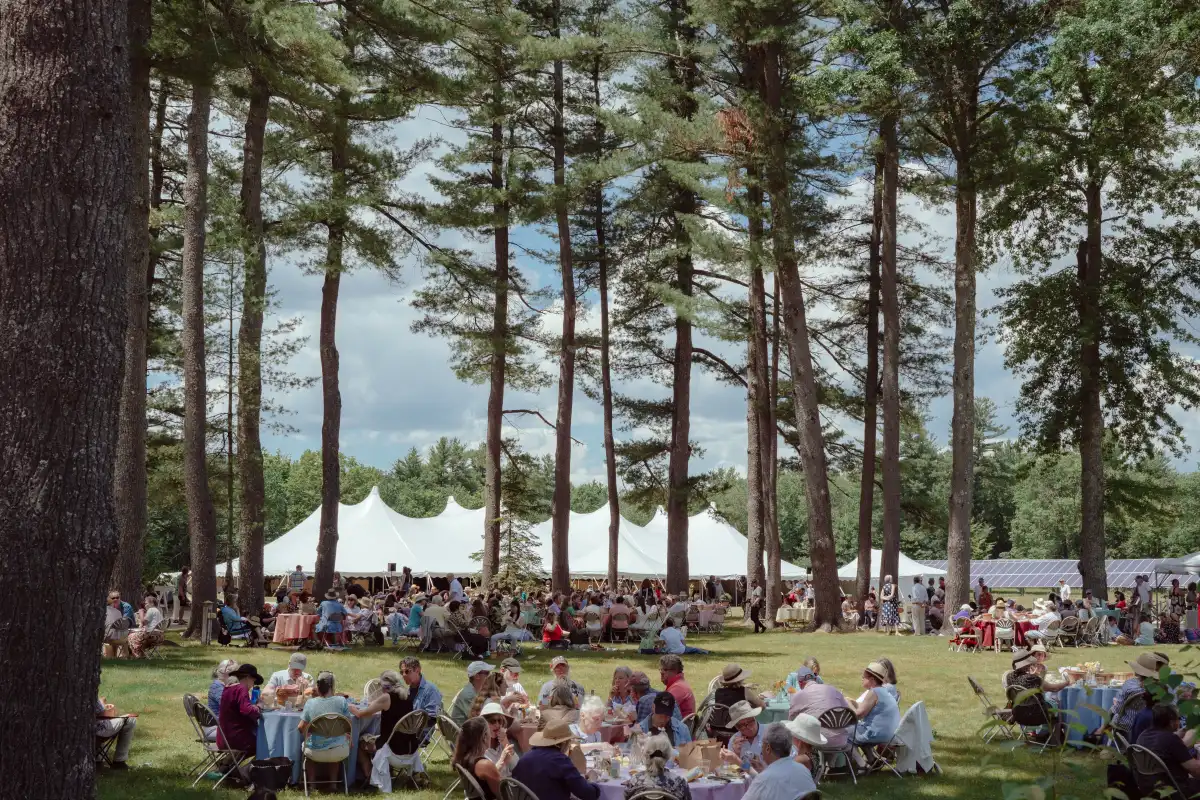
Like many people, I suspect, I arrived knowing little about MacDowell or Medal Day. Beyond the winding drive, a white tent stood against the forest, sheltering educators, musicians, writers, artists, patrons and donors. One address gave way to another, each more moving than the last. These were people who cared about creativity’s future and the fragile stage during which an idea learns how to exist.

MacDowell’s executive director, Chiwoniso Kaitano, gave that conviction its clearest form. Her speech positioned the residency not as an escape, but as one of the places from which public consciousness is born. Society adores finished brilliance while showing far less interest in the conditions required to produce it. Here, care becomes infrastructure and artistic freedom becomes a civic necessity.
Founded in 1907 by composer Edward MacDowell and pianist Marian MacDowell, the organization has awarded more than 16,500 residencies. Its lineage includes James Baldwin, Ta-Nehisi Coates, Louise Erdrich, Suzan-Lori Parks, Faith Ringgold and Meredith Monk, revealing what can happen when unfinished thought is sheltered long enough to become inevitable.
This year’s ceremony centered on Dr. Anthony Braxton, recipient of the 66th Edward MacDowell Medal. The composer, multi-instrumentalist and educator has spent five decades expanding jazz, improvisation and experimental music. Braxton spoke of kindness and compassion as instruments of human healing. His words landed with force in an era when cruelty is too often mistaken for intelligence and exclusion for discernment.
Then, to my immediate delight, he proclaimed, “The boys’ club is over!”
The response was volcanic. Tears arrived beside raucous applause. The declaration was funny, fierce and long overdue. Opportunity has never been distributed innocently, particularly within establishments that once treated genius as a male inheritance. MacDowell may be nestled in the woods, though spiritually it is a battleground for visionaries, where hierarchies are challenged, imagination is armed with time and the future is rehearsed.

The ceremony closed with Tyshawn Sorey, first through testimony and then through sound. His words carried the intimacy of a student honoring the mentor who enlarged his thinking. What followed was unlike anything I had witnessed. One tone resembled pounding; another moved with the insistence of a clock, while a sharper passage suggested a zipper opening. Sorey carried us into the interior mechanics of his mind, allowing rhythm, suspension and rupture to form their own vocabulary.
Each sonic turn registered across his face before the audience could name it. Concentration tightened into tension, tenderness gave way to release and every shift mirrored his expression. Braxton, after decades of emboldening younger musicians, admitted that he had now become a student himself. True mastery, perhaps, begins where certainty ends.
Lunch followed, presented in picnic baskets filled with sandwiches, bright pasta salad and lemon bread, arranged with the ease that made the afternoon feel lovingly composed. Guests settled beneath the canopy as conversation moved between music, literature and memory. After the ceremony’s emotional force, the meal offered a pastoral, communal rhythm, as though MacDowell understood that nourishment belongs to the architecture of imagination.

MacDowell Medal Day 2026 honoring composer Anthony Braxton, MacDowell, Peterborough, New Hampshire, June 28, 2026.
Our first stop afterward was the James Baldwin Library, where the institution’s lineage suddenly became intimate. Entering a brick-and-mortar space bearing Baldwin’s name carries tremendous weight. He was not merely a brilliant novelist and essayist, but one of America’s fiercest moral intelligences, examining race, desire, belonging and national hypocrisy without allowing the country to look away.
Within MacDowell, his name signifies something deeper. Before the books became indispensable and the voice monumental, there was an artist who required privacy, patience and faith in the unfinished process. Standing inside that library, one feels the distance between a solitary mind at work and the cultural force that private labor may eventually become.
Clad in heels, naturally, I continued along woodland paths toward cottages occupied by photographers, writers and other fellows. Removed from ordinary clamor, each resident had the freedom to surrender fully to craft, vision and the love that compelled the work. No premature explanation was demanded, and no artist was asked to translate an idea before it had found its proper form.
I arrived not knowing MacDowell. I left understanding that American culture has been quietly emerging from those woods for more than a century—and that visionaries still need somewhere to wage the private battles from which public transformation begins.
