Harlem Week, an annual festival celebrating the history and culture of the spirited borough, has attracted community members and visitors for over five decades. For some of this year’s lead organizers who have witnessed the festival’s years of growth, the organization is more than just a job—it’s a “coming home.”
Founded in 1974 as a one-day event to liven and support Harlem residents, the event has evolved into a multi-week celebration of art, music, and scholarship that supports businesses, community members, and Harlem’s youth.
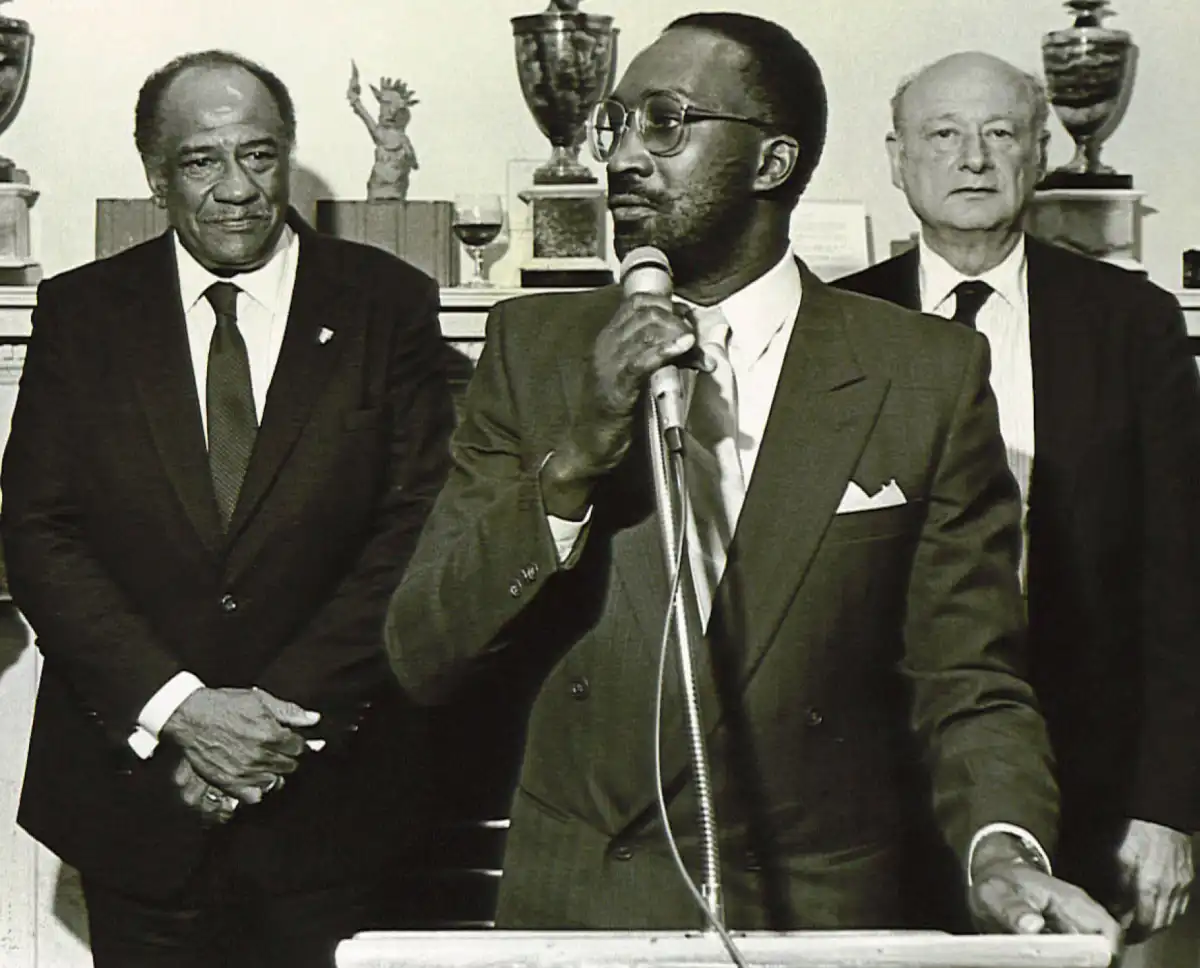
Adé Williams, first vice president of Harlem Week, joined the non-profit’s executive board this year after Lloyd Williams, his father who co-founded Harlem Week and headed The Greater Harlem Chamber of Commerce, passed away in August 2025. Williams told amNewYork that his earliest memories of Harlem Week are of assisting his dad ahead of the festival.
“Amongst my earliest childhood memories were being in the office,” Williams said. “I remember being a child and I sealed envelopes that they needed to mail. I worked through the copy machine on occasion, which I thought was a lot of fun.”
A family legacy
Williams began selling T-shirts and coordinating with Harlem Week exhibitors as he entered his teenage years, continuing this work throughout high school and college. After working in production at the historic Apollo Theater and running his own weekly radio show for over a decade, Williams returned to Harlem Week as a board member in 2020, when the celebration went virtual during the COVID-19 pandemic, and began working with staff on daily tasks in 2023.
“I felt that I have brought some connections and skills and ideas and such to help support this thing, which was very important to my father,” Williams said.
He added that coming back to Harlem Week in his adulthood was not like a return to any old job, but rather, a reunion with his family. Alongside his dad, Williams’ godfather, Marvin Kelly, was instrumental in the creation of Harlem Week and designed the logo that carries the name today.
“My father and his friends worked to try to reinvigorate Harlem with pride and to show people that Harlem was still worth fighting for and investing in, but the key part of that is that it was my father and his friends,” Williams said.
Williams said working with his father and his friends helped to “nourish” his own professional development and that returning to the organization was like “coming back home.”
From intern to executive
Similarly, Tamiko Evans, who joined the executive board as second vice president this year, traced her professional career back to Harlem Week. Evans first interned with the organization at 14 years old with encouragement from her parents, who knew Lloyd Williams as a figure “ingrained in the community.”
Evans told amNewYork that one of her “fondest memories” was of Lloyd Williams giving her a seat at a board meeting, where organizers met with state legislators and community leaders.
“I went and I sat down at the table, and I didn’t have a pen and a pad,” Evans said. “He called me out in front of a room of people.”
Evans described her 14-year-old self as running out of the meeting in tears, with Lloyd Williams following her outside to ask what was wrong. After apologizing and telling him that she felt embarrassed, Tamiko said the community leader gave her advice that she would carry throughout her professional career.
“He was like, ‘The love that you get here is gonna be the love that prepares you,’” Evans said. “‘It’s going to be sometimes tough love, but it’s going to be the love that prepares you for the world outside.’”
Evans, like Williams, would return to the festival throughout her high school and college years and became a board member in 2020, describing the Harlem Week team as “the family that you come back to.”
Beyond the borough
And that family has grown beyond the borough. Kristian Greene, a Bronx native who now lives outside of the city, was introduced to Harlem Week as a teenager while visiting family and friends who lived in Harlem. Greene later met Williams while studying at the University of Massachusetts Amherst and was encouraged to join the organization.
“After my freshman year was complete and I was looking for work, he said, ‘Hey, why don’t you come work with us?’” Greene said.
Harlem Week awarded Greene scholarships to support his college education, and now, he oversees the non-profit’s fiscal responsibilities. Greene described his college internship with Harlem Week as his first “professional job” and noted the importance of working in a more familiar and welcoming environment.
“In my professional world, I’ve been in more of a corporate structured environment where I may be the only person in the room that looks like me,” Greene said. “And when I was in college, I did not experience that at Harlem Week, and it’s something that I appreciated and I value to this day.”
The annual celebration is continuing to support young professionals, with Evan’s son now serving in the intern role she once held.
“Having my son here as an intern is a very full circle moment because he’s helping to continue, you know, what legacy looks like, especially from like a personal and family perspective,” Evans said. “Being able to pass the torch is really important.”
This year’s Harlem Week theme, “Honoring Our Legacy,” will continue to foster the festivities’ close-knit community. As the first Harlem Week celebration organized without the guidance of Lloyd Williams or longtime treasurer, Barbara Burwell, Williams said the timely theme is dedicated to preserving the borough’s rich history, honoring all who built the organization into what it is today, and “making them proud.”
“The success of Harlem Week is not whether we feel good, or even if my dad would have been proud of me,” Williams said. “The success of Harlem Week is, ‘Is our community served? Is our community proud of us?’”