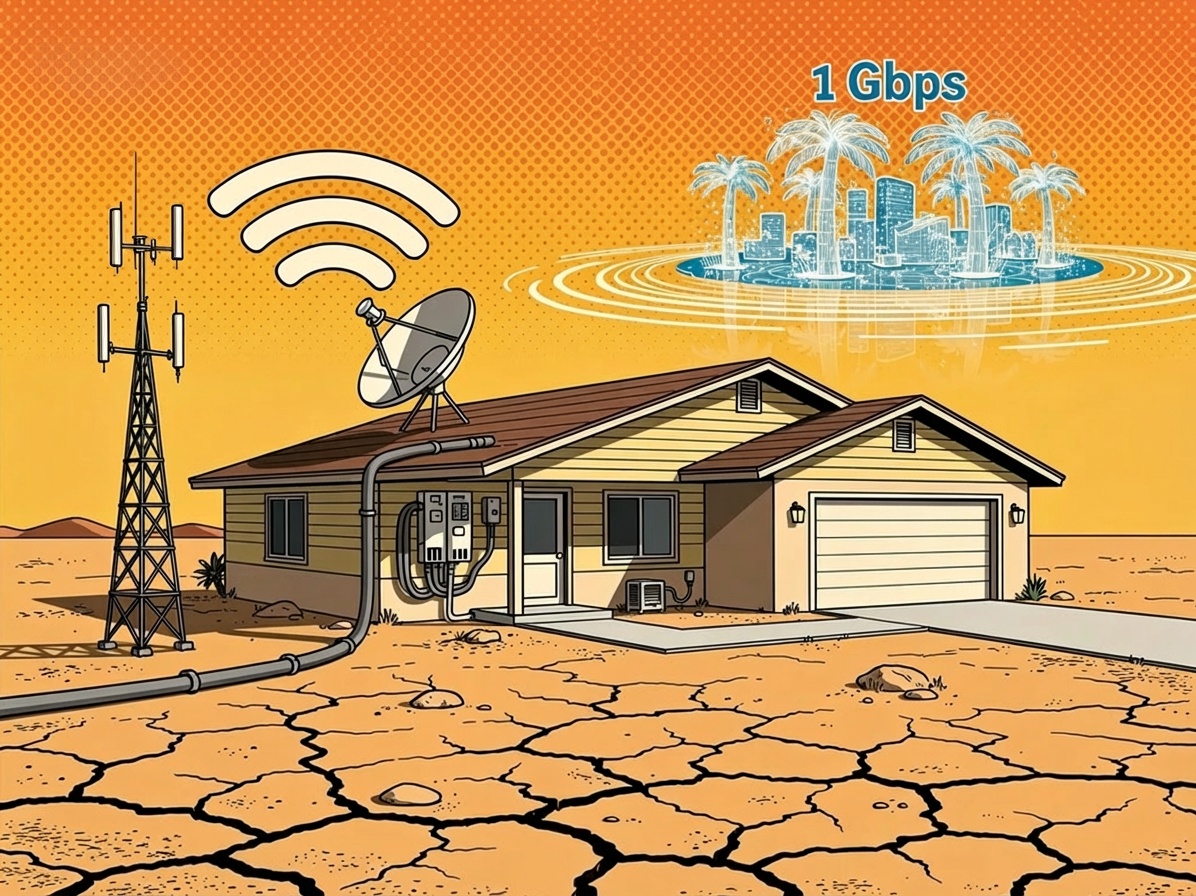
Regulators maintain looking for a easy take a look at to declare broadband markets “aggressive.” The California Public Utilities Fee’s Public Advocates Workplace (Cal Advocates) thinks it discovered one: depend gigabit networks. If a market lacks a number of overlapping gigabit-capable programs, Cal Advocates suggests in a report launched final month, regulators ought to deal with it as successfully noncompetitive.
That framing misses how competitors really operates. The report facilities on premium gigabit speeds, despite the fact that most households neither want nor select to purchase them. Customers usually favor cheaper, sub-gigabit tiers that simply fulfill commonplace broadband definitions and customary makes use of like streaming, videoconferencing, and gaming.
The pricing evaluation compounds the issue. The research compares common costs for the lower-speed tiers in aggressive markets to the highest-priced gigabit tiers in markets with just one gigabit supplier, whereas assuming shoppers within the latter subscribe to premium plans. In follow, the plans most households really buy—lower-speed tiers—present comparatively steady pricing, no matter gigabit overlap.
Even so, the report illustrates a broader regulatory pattern: advocates more and more depend on artificially excessive pace thresholds to label markets uncompetitive. That label typically helps utility-style regulation and opposition to mergers, regardless of the fundamental economics of community industries. The big fastened prices of broadband infrastructure naturally restrict what number of terrestrial networks a single market can maintain.
On the similar time, competitors doesn’t rely solely on duplicate fiber traces. Fiber, fastened wi-fi, and satellite tv for pc applied sciences now self-discipline pricing and broaden shopper selection. Costs have trended downward as these alternate options unfold.
Insurance policies constructed on flawed aggressive benchmarks carry dangers. If regulators suppress costs or block efficiency-enhancing consolidation primarily based on mismeasured competitors, suppliers lose the anticipated returns wanted to finance upgrades and rural deployment. The outcome would sluggish funding, weaken community enlargement, and hurt the very shoppers the insurance policies purpose to guard.
If It Isn’t Gigabit, It Doesn’t Rely
Cal Advocates’ “Broadband Competitors and Pricing Methods in California’s City Markets” report examined gigabit-tier pricing in 4 California markets—San Mateo, Oakland, Los Angeles, and San Diego. The report concludes that native pricing turns totally on whether or not a neighborhood has overlapping gigabit wireline networks, somewhat than on inhabitants, density, or earnings.
In areas with a number of gigabit-capable wireline suppliers, resembling San Mateo and Oakland, the research finds decrease promotional costs for top-tier service. In neighborhoods served by a single gigabit supplier, together with elements of San Diego, promotional costs run larger. From these comparisons, the report derives a “aggressive benchmark” of about $51 per thirty days for high-speed service and estimates that households in single-provider gigabit areas pay roughly $15 to $40 extra for what it treats as “comparable service.”
The report then scales that distinction statewide. Evaluating the benchmark to the very best promotional gigabit costs in single-provider areas and making use of it to an estimated 4.45 million areas, Cal Advocates calculates roughly $1.13 billion in annual “monopoly hire.” It asserts this burden falls on households throughout earnings ranges the place an incumbent cable or fiber supplier lacks a second wireline gigabit rival.
The regression evaluation additionally distinguishes amongst applied sciences. The presence of a further wireline gigabit community correlates with decrease gigabit-tier costs. Against this, the research finds no statistically important pricing impact from sub-gigabit opponents, notably fastened wi-fi entry (FWA) and satellite tv for pc providers.
Most Folks Don’t Want a Gigabit
The report’s gigabit-price comparisons supply a slim perception, however they don’t seize how most households expertise the broadband market. By concentrating on top-tier speeds, the evaluation overlooks precise utilization patterns, the efficiency of recent networks, and federal efficiency benchmarks.
The research treats sub-gigabit tiers as largely irrelevant as a result of they don’t self-discipline gigabit pricing. But, for many customers, gigabit speeds ship restricted incremental worth. The Federal Communications Fee (FCC) defines broadband as 100 Mbps obtain and 20 Mbps add—speeds supposed to help typical family exercise. Even demanding makes use of don’t require far more. A house streaming two 4K movies whereas kids play on-line video games wants roughly 60 Mbps downstream capability.
Some shoppers profit from quicker large-file downloads or unusually heavy simultaneous utilization, however most households won’t understand a significant distinction between 100 Mbps and 1 Gbps. As soon as service reliably clears a purposeful threshold, further bandwidth produces sharply diminishing returns.
Shopper habits displays that actuality. If a supplier units a promotional gigabit worth at $80 per thirty days—about $30 above the research’s benchmark—many shoppers won’t pay the premium. They are going to transfer to decrease tiers whose pricing adjustments little, if in any respect, with further gigabit competitors. Households are inclined to prioritize affordability and reliability over uncooked pace as soon as baseline wants are met.
Because of this, a better listed worth for gigabit service doesn’t essentially enhance shoppers’ whole spending. Many shoppers substitute into cheaper plans. Even when a subset pays extra for premium speeds, common family expenditure can fall, and total shopper welfare can stay unchanged or enhance.
Intro Costs Aren’t Actual Costs
The report additionally leans closely on promotional charges to deduce aggressive results and shopper hurt. These introductory affords matter for the time being a buyer indicators up or considers switching, however they don’t describe suppliers’ sustained pricing methods.
Promotional costs are short-term. They usually final a restricted interval after which revert to a normal month-to-month charge. An affordability evaluation ought to due to this fact concentrate on the efficient worth a family really pays over time—the mixed value of the promotional time period and the post-promotional charge, averaged throughout the contract interval.
As soon as considered that method, geographic variations shrink. Suppliers typically apply uniform post-promotional pricing inside service areas, so long-run efficient costs range far lower than the research’s advertised-rate comparisons counsel.
The Billion Greenback Mirage
The research additional claims Californians would save greater than $1.13 billion yearly if “aggressive” pricing prevailed statewide. That estimate is determined by a sequence of mismatched comparisons and robust assumptions about subscriber habits.
Begin with the benchmark. To ascertain a baseline worth, the report averages the bottom promotional charges throughout every supplier’s three hottest tiers, which regularly embrace sub-gigabit plans. However when calculating shopper hurt, it switches to the very best promotional worth for 1 Gbps service in areas with just one gigabit supplier. The outcome isn’t a like-for-like comparability. It contrasts premium gigabit costs in single-provider areas with a blended common of lower-tier costs in areas with extra community overlap.
The calculation then assumes each subscriber in a single-provider space buys gigabit service at roughly $40 above the benchmark. The market information say in any other case. Greater than 91% of U.S. properties and companies can get hold of gigabit service, but solely about 30% really subscribe. Most households select plans within the 200 Mbps to 500 Mbps vary, which value far lower than gigabit tiers.
That issues for the hurt estimate. If a family in a single-provider space purchases a $50-per-month 500 Mbps plan whereas the research’s benchmark is $51 for gigabit service, the patron doesn’t pay a penalty in any respect. Making use of a premium-tier worth distinction to the complete subscriber base due to this fact inflates the measured loss and dangers figuring out hurt the place none exists.
The research’s personal technical appendices reinforce the purpose. Suppliers present little variation in promotional pricing under 500 Mbps, and solely minor variations on the 500 Mbps tier for Comcast, Constitution, and Cox. Bigger promotional gaps seem solely at gigabit speeds. Decrease-tier pricing stays comparatively steady as a result of suppliers compete most intensely for mainstream plans, the place most households really buy service.
When Excellent Turns into the Enemy of Linked
The Cal Advocates report additionally illustrates a recurring regulatory sample. By tying aggressive evaluation to ever-higher bandwidth thresholds, advocates can classify many markets as noncompetitive after which use that label to justify blocking mergers or imposing utility-style guidelines.
That strategy overlooks the economics of community industries. Broadband suppliers incur monumental fastened prices to construct and preserve infrastructure. A single locality can not realistically maintain a giant quantity of duplicative terrestrial networks providing extremely substitutable service. Aggressive equilibrium in communications markets doesn’t require 5 or seven parallel wireline programs.
Even so, shoppers at the moment face a large set of alternate options. Fiber and cable compete with fastened wi-fi choices, terrestrial cellular information, and low-earth-orbit satellite tv for pc providers. Suppliers experiment with pricing and repair ranges throughout these platforms, and actual costs have trended downward as these choices expanded.
Funding incentives matter. If suppliers can not count on a return, they delay upgrades and restrict enlargement. Present subscribers would see slower enhancements in reliability, latency, and capability, whereas unserved areas would stay unconnected. Corporations reply both by consolidating to unfold fastened prices throughout a bigger buyer base or by elevating costs to cowl capital expenditures.
Proof of shopper demand cuts in opposition to claims of systematic overpricing. Even for primary 25/3 Mbps service, estimated willingness to pay ranges roughly from $50 to $165 per thirty days relying on earnings, exceeding many prevailing retail costs. Continued subscription at present costs signifies significant shopper surplus, complicating claims that broadband pricing is broadly extractive.
The danger of mismeasurement isn’t some abstraction. If regulators outline broadband solely at gigabit speeds, many functioning markets will seem noncompetitive on paper. Insurance policies constructed on that premise might limit environment friendly consolidation and weaken incentives to broaden and improve networks, in the end harming shoppers, somewhat than defending them.
Dangerous Metrics Make Dangerous Coverage
The Cal Advocates research rests on a single premise: deal with premium gigabit pricing because the proxy for competitors. That strategy overlooks how households really select service, how suppliers worth throughout tiers, and the way networks get well giant fastened prices. A market can’t be assessed precisely by evaluating promotional gigabit affords whereas disregarding efficient long-run costs, mainstream pace tiers, and substitution throughout applied sciences.
At the moment’s broadband atmosphere is formed by competitors amongst fiber, cable, fastened wi-fi, cellular information, and satellite tv for pc suppliers. Most households buy mid-tier plans that meet purposeful wants, and pricing for these plans stays comparatively steady throughout markets. Measuring competitors solely on the highest efficiency tier dangers complicated a product improve with a market failure.
Coverage penalties comply with from the measurement. If regulators label markets noncompetitive primarily based on an unrealistic benchmark, they might block environment friendly consolidation or impose utility-style regulation. These steps would weaken funding incentives, sluggish upgrades, and delay enlargement to unserved areas.
Sound coverage begins with sound metrics. Aggressive evaluation ought to replicate shopper habits, long-run pricing, and the economics of infrastructure funding. In any other case, well-intended regulation dangers discouraging deployment and innovation, leaving shoppers worse off than earlier than.
