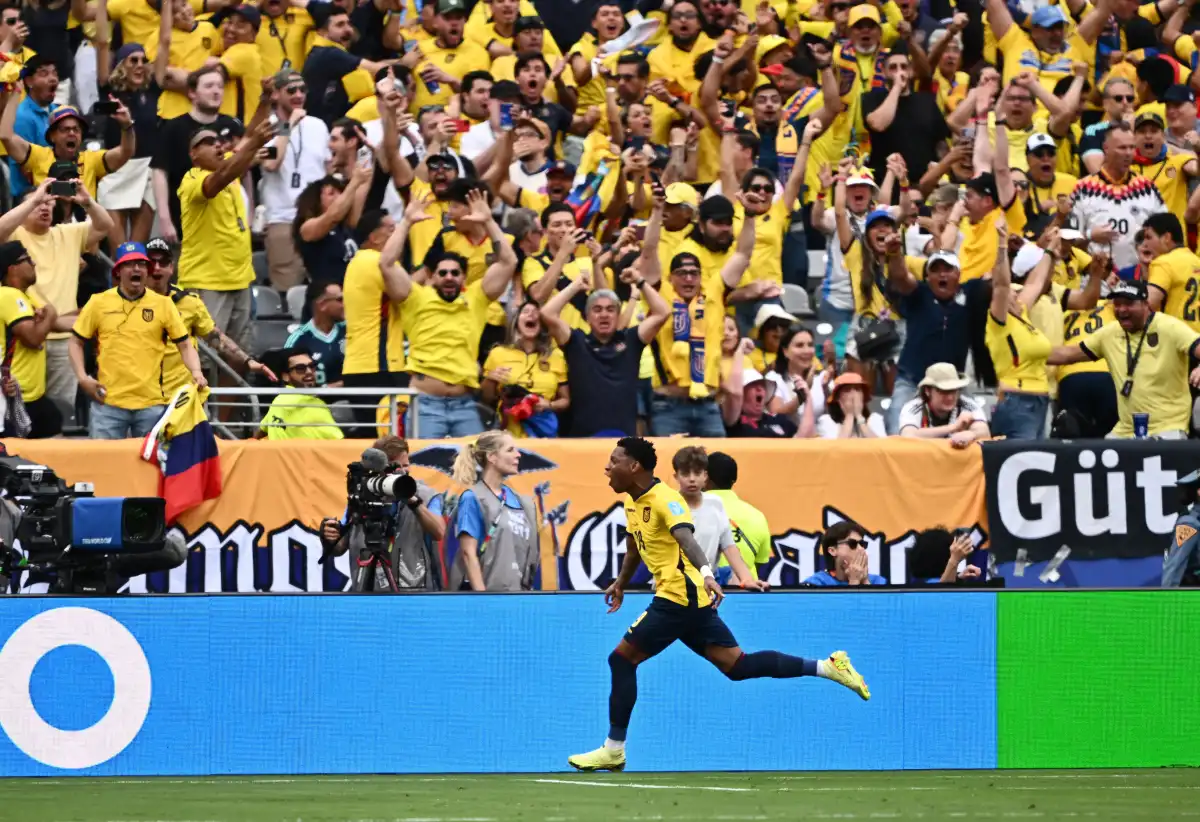
This was supposed to be the World Cup where it all came together for Ecuador’s golden generation — and it still just might be after a dramatic win over Germany in New Jersey secured its passage to the knockout stages for the first time since 2006.
After breezing through South American qualification with a highly impressive campaign that saw them finish second in the CONMEBOL standings, expectations were as high as they have ever been in Ecuador, who arrived in North America as one of the foremost dark horses.
Reaping the rewards of consistent success at the youth level, Ecuador came to the World Cup with a squad chock-full of household names across major European leagues for arguably the first time in its history, not least PSG’s Willian Pacho, Arsenal’s Piero Hincapié, and Chelsea’s Moisés Caicedo.
But it all looked like coming undone after an uninspiring start saw La Tri pick up a solitary point from its opening two games against Cote d’Ivoire and Curacao.
With a second straight group-stage elimination staring Ecuador in the face after a disappointing campaign in Qatar four years ago, nothing but a win against Germany would keep their World Cup hopes alive and ensure that Ecuador’s remarkable progress at the youth level did not go to waste.
That win seemed unlikely, given that Germany selected a full-strength side for Thursday’s game despite already confirming its place in the knockout stages as group winners.
History, however, has a funny way of repeating itself.
It was in 2019 that Ecuador recorded its best-ever performance at a youth World Cup, when it placed 3rd at the U20 World Cup in Poland. But its progress to the semi-finals — and even the knockout stages — was far from straightforward.
Just like at the ongoing World Cup, Ecuador entered its final group game with Mexico needing a win after picking up a point from its opening games against Japan and Italy.
Step forward Gonzalo Plata in the 12th minute to score the only goal in a 1-0 win that sent Ecuador to the knockout stages as one of the best third-placed teams.
On Thursday, history repeated itself as Plata scored from close range — this time with 12 minutes remaining — to secure a 2-1 come-from-behind win over Germany and with it Ecuador’s place in the knockout stages.
Plata, however, is by no means the only product of Ecuador’s youth success to appear at the World Cup, nor was the 2019 team the only side to represent Ecuador at a youth World Cup over the last decade.
Ecuador qualified for three U17 World Cups and three U20 World Cups between 2015 and 2023 – more than half of the 11 youth World Cups it has participated in throughout its history.
More than half of Ecuador’s squad, which is the second youngest at the tournament, has appeared at a youth World Cup at either level since 2015, including Plata’s 2019 teammates Moisés Ramírez, Jackson Porozo, and Jordy Alcívar.
Other youth teams – like the 2015 and 2019 U17 sides – achieved notable success at their respective World Cups, reaching the knockout stages and giving rise to players like Pervis Estupiñán and Hincapié.
Nilson Angulo – the other goalscorer in Ecuador’s 2-1 win over Germany – appeared at the 2023 U20 World Cup, where Ecuador fell to a narrow defeat against South Korea in the last 16.
Notably, Caicedo and Pacho – two of the most high-profile names in the Ecuador squad – never represented Ecuador at youth World Cups due to a combination of injuries and late development, respectively. But both players – along with half of the 2026 squad – are products of the famed Independiente del Valle, which also gave rise to Hincapié and Chelsea’s Kendry Páez, among several others.
But with this consistency in youth success and youth development came great expectations as Ecuador entered the 2026 World Cup with an average age of 26 and most of its players aged 22 to 28. And it looked as though the weight of expectation had gotten the better of them as La Tri failed to score in defeat against Cote d’Ivoire and in a goalless draw against minnows Curacao.
When Leroy Sané scored after two minutes to give Germany a 1-0 lead on Thursday, it looked as though Ecuador’s golden generation had run aground, but a stirring fightback has ensured that this talented crop of youngsters will now have a chance to blossom in North America.
And just like in 2019, when the U20s took out a fancied Uruguay side in its first knockout match, no one will want to face Ecuador in the Round of 32, especially considering a buoyant Ecuador, led by the charismatic Sebastián Beccacece, is quite literally bouncing into the next phase.
“In the first few matches we struggled to find our rhythm,” Pacho said after Thursday’s seismic win. “But it’s finally clicked for us. Even after conceding that goal, we stuck to our idea of how to hurt them, and the team responded well.”
Angulo, meanwhile, is not afraid of any potential opponent in the knockout stages.
“We know we can go toe-to-toe with any team, and I think we proved that today,” he said.
Ecuador will certainly not fear anyone in its first World Cup knockout match since 2006, when it also advanced from a group involving Germany to meet England in the last-16, who remains a potential opponent in the round-of-32 next week.
Pacho credited that 2006 team, as well as the 2002 side, which made history by becoming the first Ecuadorian side to qualify for a World Cup, for laying the foundations for current successes.
“We owe a huge debt of gratitude to those early pioneers – the ones who first qualified for the World Cup,” Pacho said. “We’re here because of them.”
For more on Ecuador and the World Cup, visit AMNY.com
