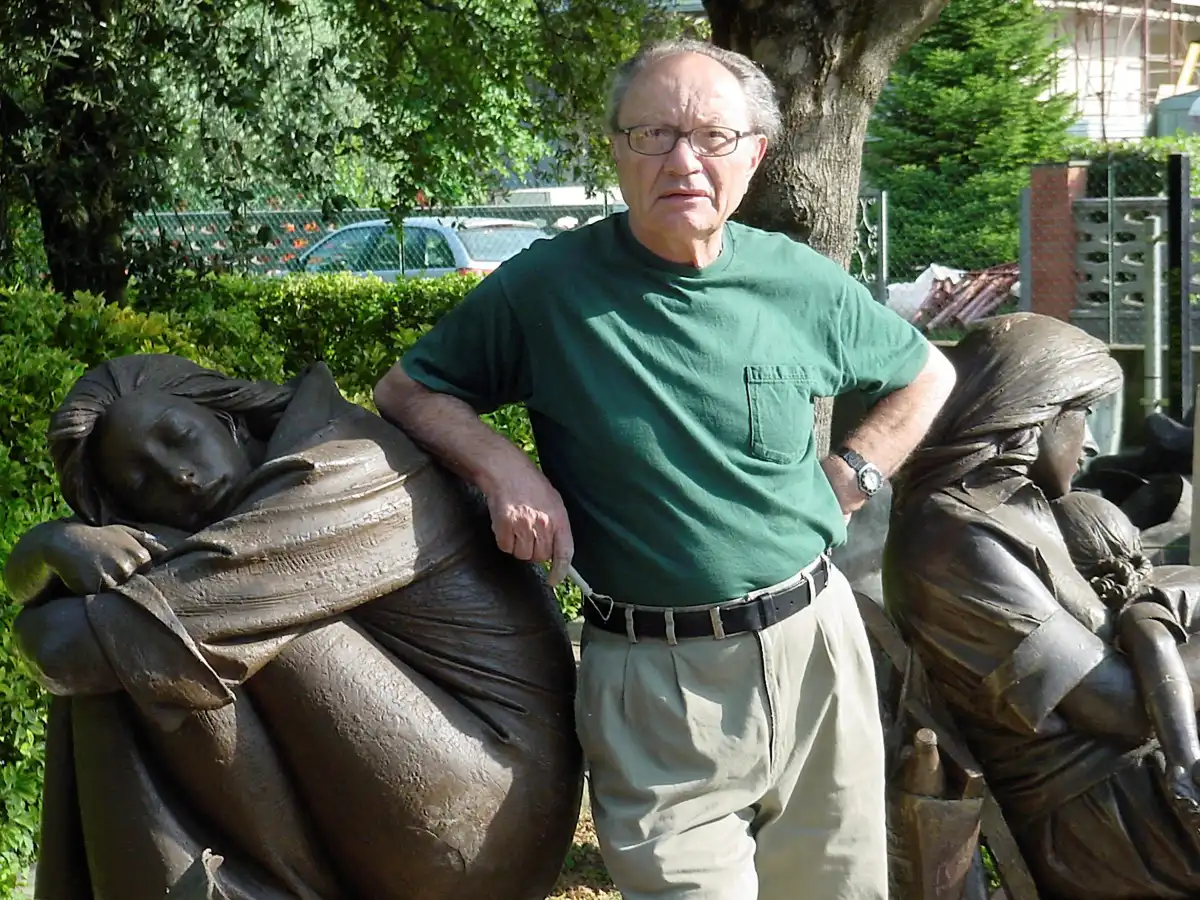
Bruno Lucchesi understood that making a human being from clay is an act bordering on trespass. The sculptor presses a thumb where an eye will open, draws a mouth from wet earth and decides how much sorrow a shoulder can carry. Limbs emerge, collapse and are summoned again. Material gathers beneath the fingernails; anatomy becomes instinct. Nothing about the process is distant or entirely civilized. Rather, it is tactile, guttural and perilously close to creation itself.
Lucchesi, the Italian-American master who died in New York at 99, weeks before his 100th birthday, devoted seven decades to this encounter between hand and matter. His loss feels immense, not simply because a distinguished artist has departed, but because a custodian of figurative tradition is gone. In many ways, he understood what others spend lifetimes trying to recover: technique is not the enemy of feeling. Mastery gives emotion somewhere to live.
Born in 1926 in Fibbiano Montanino, in Lucca, Lucchesi began as a shepherd. While tending sheep, he carved designs into sticks, discovering that the ordinary could be transformed through intention. At ten, he entered a monastery in Lucca, where sculpture revealed itself as art. War later returned him to his family’s farm, where a Yugoslavian refugee artist led him toward drawing lessons and, eventually, the Art Institute of Lucca.
That history matters, of course. Lucchesi emerged from a landscape where Renaissance achievement lived inside churches, civic squares and facades. Donatello gave the body psychological force; Michelangelo made flesh appear trapped inside stone; Bernini taught cold material to gasp and burn with desire. Long before them, prehistoric fertility figures, Egyptian likenesses, Greek marbles and Roman portraits established the human form as art’s first archive. Civilizations disappeared, and still, their sculpted inhabitants remained.

Notably, Lucchesi inherited this formidable past without allowing it to suffocate him. After working in Florence, he moved to New York in 1958, where small figures made during spare hours began selling through his father-in-law’s Greenwich Village frame shop. Inclusion in the Whitney Annual, a 1961 solo exhibition at Forum Gallery, a Guggenheim Fellowship and decades of honors followed.
For all that prestige, however, it remains the least compelling thing about him.
Lucchesi portrayed people amid the unguarded business of living. Women bathe, rest or carry the residue of shopping. Mothers settle beside children. Bodies wait, converse, labor and surrender to exhaustion. His figures possess none of the sterile perfection that can make academic realism feel embalmed. Instead, stomachs soften, clothing wrinkles and spines curve beneath invisible obligations. Humor flickers without cruelty, while compassion arrives without condescension. His subjects do not perform their humanity; they inhabit it.
Perhaps this tenderness distinguished him from the heroic bombast that has long dominated monuments. Art history may be crowded with gods, conquerors and men on horseback, yet Lucchesi granted permanence to gestures rarely considered important enough to preserve. A woman washing her foot could be worthy of bronze. A family gathered closely could contain the emotional structure of an entire society. Through his gaze, the ordinary became monumental.

Modernism fractured the figure, while abstraction abandoned it. Still, the body refused to leave. Rodin broke its surfaces open; Giacometti thinned it almost to disappearance; Bourgeois transformed anatomy into memory and menace. Lucchesi, meanwhile, retained recognizable flesh while excavating its quieter interior existence.
His influence extends beyond works held by the Metropolitan Museum of Art, the Whitney Museum of American Art, the Smithsonian American Art Museum, the Hirshhorn and numerous collections. More importantly, it survives through his teaching, international workshops and foundational books still open inside studios. Young sculptors are, in a very real sense, learning from his hands.
That continuation feels especially urgent in a culture separated from physical matter. Screens flatten nearly everything; images vanish without mass, temperature or consequence. Sculpture, by contrast, refuses such weightlessness. It occupies our territory and asks to be encountered from every angle. Light travels across its surface, shadows gather beneath the chin and the figure changes as we circle it.

Collecting sculpture, then, becomes an intimate form of stewardship. A three-dimensional presence does not merely adorn a home; it joins its atmosphere. Patina deepens, familiarity accumulates and the object passes into other hands, carrying histories its maker could never have predicted.
Quite fittingly, Lucchesi’s story will not conclude with mourning alone. This fall, [Cavalier Galleries will present *The Memorial Bruno Lucchesi Exhibit*, celebrating the breadth of his life and the enduring force of his artistic legacy. Dates and locations will be announced in the coming weeks, offering collectors, students and admirers an opportunity to stand before the work itself—the only place, perhaps, where the full power of sculpture can truly be understood.
Bruno Lucchesi has left us, yet his figures remain among the living—waiting, laboring, loving and quietly enduring. They remind us, perhaps now more than ever, why sculpture is essential to art and indispensable to civilization: humanity has always needed to touch the world in order to leave proof that it was here.
The hand disappears. The impression, somehow, does not.